

Answer: Republic of Hungary
It was once known at the Kingdom of Hungary (approximately 946 years). It also was referred to as the Principality of Hungary for a very short time. The Dukedom of Hungary is a figment of my imagination.
From Quiz: "Hungary" For The Truth
Answer: Balaton
From Quiz: Do You Know Hungary?
Answer: 1873
From about 1850-1914 Budapest experienced a period of very rapid growth, which transformed a group of hitherto small towns into a major Central European metropolis, with a population of about 850,000 just before the First World War.
From Quiz: Hungary - Essentials
Answer: It collapsed in World War I
From Quiz: Do You Know Hungary?
Answer: 895
Hungary is among the oldest of European countries. The Magyar Grand Prince Arpad is credited with uniting the Kingdom of Hungary in 895 AD.
From Quiz: "Hungary" For The Truth
Answer: 10.0 million
About 20% of the population lives in Budapest (2002). The population has remained very stable for some decades.
From Quiz: Hungary - Essentials
Answer: 7
These seven countries are: Austria, Croatia, Romania, Slovakia, Slovenia, Ukraine and Serbia (and Montenegro).
From Quiz: Do You Know Hungary?
Answer: Danube
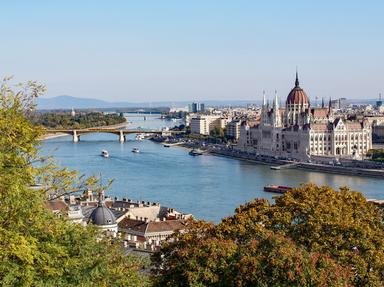
The Hungarian name for the Danube is Duna. It runs through the capital, Budapest.
From Quiz: Hungary - Essentials
Answer: Magyarorszag
From Quiz: Do You Know Hungary?
Answer: 7
The border countries are: Austria, Croatia, Romania, Slovakia, Slovenia, Ukraine and Serbia.
From Quiz: "Hungary" For The Truth
Answer: Finno-Ugric
Magyar is NOT an Indo-European language, and it is unrelated to the languages spoken in neighboring countries. The other main Finno-Ugric languages are Finnish and Estonian. Hungarian is generally regarded as a hard language for native speakers of English to learn.
From Quiz: Hungary - Essentials
Answer: Catholicism
Over 5.5 million Hungarians practice Catholicism. That is more than all other religions combined in Hungary.
From Quiz: "Hungary" For The Truth
Answer: 1699-1918
From 1541 till about 1690 most of the present area of Hungary was part of the Ottoman (Turkish) Empire. Some of the western parts were under Habsburg rule from the late Middle Ages onwards, but the Ottoman Empire continued to expand into many of these areas until the early 1680s.
From Quiz: Hungary - Essentials
Answer: Danube River
The beautiful Danube River cuts Hungary in half. It flows from north to south, and eventually empties into the Black Sea.
From Quiz: "Hungary" For The Truth
Answer: Red-White-Green
From Quiz: Do You Know Hungary?
Answer: 1867
The defeat (by Prussia) of Austria in 1866 greatly strengthened the case for reorganizing the Habsburg Empire in a way that made Hungary an almost equal partner with Austria in the Empire. At the same time it was an exercise in 'divide and rule', as from 1867 onwards it was the Hungarians who ruled Croatia, Slovakia and Transylvania as well as what is now Hungary. In 1868 the Hungarians concluded an agreement with Croatia which gave the latter a high degree of autonomy.
From Quiz: Hungary - Essentials
Answer: There is no coastline
From Quiz: Do You Know Hungary?
Answer: Lake Heviz
Lake Garda is located in Italy. Lake Rotorua is located in New Zealand. Lastly, the Lake Arenal is located in Costa Rica.
From Quiz: "Hungary" For The Truth
Answer: 1956
The uprising was supressed amid considerable bloodshed, and a large number of Hungarians fled to the West.
From Quiz: Hungary - Essentials
Answer: Franz Liszt
Franz Liszt (22 October 1811 - 31 July 1886) was Hungarian. Johann Sebastian Bach (31 March 1685 - 28 July 1750) was German. Ludwig Van Beethoven (17 December 1770 - 26 March 1827) was German. Frederic Chopin (1 March 1810 - 17 October 1849) was Polish.
From Quiz: "Hungary" For The Truth
Answer: Germany
Germany 37 percent, Austria 11 percent, Italy 6 percent and The Netherlands 5 percent.
From Quiz: Do You Know Hungary?