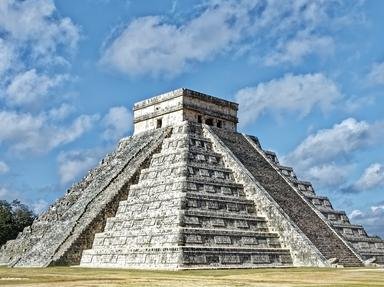
Answer: Yucatán
Uxmal is a UNESCO World Heritage Site, and is approximately 40 miles away from Yucatán's state capital, Mérida.
The Pyramid of the Magician is the tallest building of Uxmal, at approximately 130 feet high. It is constructed of limestone, and is the main tourist attraction of Uxmal.
From Quiz: Magnificent Mexico
Answer: Mountains
There are five different systems of mountain ranges in the state of Oaxaca, with the major ranges being the Sierra Madre del Sur, the Sierra Atravesada (Sierra de Niltepec), and the Sierra Madre de Oaxaca. There are five peaks over 3,000 meters in the state, with the tallest being Cerro Quiexoba at 3,750 meters. The mountainous terrain means that the rivers in Oaxaca are not navigable, though some of them, like the Coatzacoalcos River, are navigable in other regions downriver.
From Quiz: Oaxaca, Mexico
Answer: Eagle
On the Mexican flag there is an eagle holding a snake in its talons, and sitting on top of a cactus.
From Quiz: Mexico Trivia
Answer: Quintana Roo
Cancun is found in Mexico's Quintana Roo, in the Yucatán Peninsula. It is located on the Yucatan Channel separating Mexico from Cuba. Forty years ago, Cancun was generally unknown, but due to an energetic development program, it has become Mexico's largest tourism resort.
From Quiz: The United States of Mexico
Answer: Sinaloa
Sinaloa is located on the Mexican Pacific shoreline. Quintana Roo is in the Yucatan Peninsula, while Baja California is another peninsula very close to Sinaloa. Jalisco is about 500 km. away from Mazatlan. A famous beach of Jalisco is Puerto Vallarta.
From Quiz: All About Mazatlan
Answer: Lake Chapala
Lake Chapala is actually located on the border of Jalisco and Michoacan. The rivers Duero, Lerma, Zula, and Huaracha all feed the lake and it is drained by the Santiago River. Lake Chapala attracts many tourists and has many activities available. It is also a place where mariachi bands play for the crowds.
From Quiz: Jalisco, Mexico
Answer: There is no such city.
Huatulco isn't a city. It's a region of coastline that encompasses a couple of towns and over 30 spectacular beaches sprinkled along nine bays. It's located about 400 miles east southeast of Acapulco on the Pacific Ocean, not too far from the Guatemalan border. There is an inland town called Santa Maria Huatulco, but it isn't part of the coastal resort. It's where many former residents of the resort area were relocated when the resort development began.
From Quiz: Huatulco: Semi-Secret Vacation Paradise
Answer: Sunday Night Festival
Every Sunday night, El Malecon comes alive with locals and tourists alike, participating in festivities, including markets, street performers, food, music, and much much more. Definitely a must see when in Puerto Vallarta.
From Quiz: Puerto Vallarta, Mexico
Answer: Mexico City
Mexico City is located on the ancient "Aztec"/Mexica capital of Tenochtitlan.
From Quiz: Mexico - A little of everything
Answer: Popocatépetl
Popocatépetl is an active stratovolcano, and is the second-highest natural peak of Mexico, after Pico de Orizaba, also known as "Citlaltépetl" which is an inactive stratovolcano. Popocatépetl is one of the most active volcanoes of Mexico, having experienced over 15 major eruptions since the Spanish arrived in 1519.
There is a state in Mexico called "Mexico" just like the country. Popocatépetl is located in the state of Mexico, and the states of Puebla and Morelos.
From Quiz: Magnificent Mexico
Answer: Puerto Escondido
Many tourists visit Puerto Escondido for its beaches. It has become known as the "Mexican Pipeline" and attracts surfers every year for competitions. Additionally, it is often included in lists of the top ten places to surf and lists of places with the best waves.
Puerto Escondido means "Hidden Port", but the name comes from a story that led to the bay to be named la Bahía de la Escondida, or "Bay of the Hidden Woman". According to the legend, Sir Francis Drake's brother, Andrés (Andrew), and his men kidnapped a Mixtec woman. She escaped from them while they were anchored in the area and hid in the jungle. The pirates were never able to find her, and so they began calling her "La Escondida".
From Quiz: Oaxaca, Mexico
Answer: El Centro
The downtown area of Cancun is known as "El Centro," and is actually a very beautiful design. The supermanzana superblocks form giant trapezoids that have large central open areas framed by u-shaped residential streets. The downtown area is quite walker- and cyclist-friendly. El medio is the Spanish word for middle. Ciudad is Spanish for city and Mercado is the Spanish word for market.
From Quiz: Exploring the "CAN" in Cancun
Answer: Spain
Mexico gained its independence from Spain on September 16, 1810. However, this was not recognized by Spain until September 27, 1821.
From Quiz: Mexico Trivia
Answer: Jalisco
Puerto Vallarta is situated on Bahía de Banderas, in the state of Jalisco. The city was founded in 1851, and was originally a small fishing and pearl-diving village. What helped put Puerto Vallarta on the map was John Huston's 1963 filming of 'The Night of the Iguana' in Mismaloya, a small town very near to Puerto Vallarta, and the publicity given to Elizabeth Taylor and Richard Burton's romance at the time.
From Quiz: The United States of Mexico
Answer: La perla del pacifico
La perla del pacifico means 'the pacific pearl'. La perla de occidente (western pearl) is used for Guadalajara Jalisco, Mexico's second largest city. La sultana del norte (the northern kingdom) is used for Monterrey, Nuevo Leon, Mexico's third largest city. And la ciudad de la esperanza (the city of hope) is used for Mexico City, the Mexican capital.
From Quiz: All About Mazatlan
Answer: Sierra Madre Occidental
The Sierra Madre Occidental begins in Arizona and ends in Guanajuato where it connects with the Sierra Madre Oriental. Some of the mountains in Jalisco which form part of the Sierra Madre Occidental include: Los Huicholes, El Gordo Hill, and the sierras of San Isidro and Los Guajolotes. The mountain range is home to a diversity of plant and animal life, including pine-oak forests and a wide variety of endemic bird species.
From Quiz: Jalisco, Mexico
Answer: The tourism development arm of the Mexican government.
FONATUR stands for Fondo Nacional de Fomento al Turismo (National Fund to Develop Tourism). It's part of Mexico's government, and it's devoted to developing Mexico's numerous areas of exceptional beauty without polluting or otherwise ruining them. What a concept, eh?
From Quiz: Huatulco: Semi-Secret Vacation Paradise
Answer: Guadalupe
The Church of Guadalupe is found in the heart of Old Town Puerto Vallarta. Construction of the church was started in 1918 and finished in 1951. The top of the Church is a replica of the crown worn by the empress of Mexico, Carlota, in the 1890's.
From Quiz: Puerto Vallarta, Mexico
Answer: Tequila
The maguey plant for tequila is primarily grown in Jalisco. The plant begins to mature at 7-12 years, and it becomes enormous. There are strict standards for the making of tequila. It must be at least 51% agave; the remainder is usually liquid made from sugarcane or maize. There are many different qualities of tequila. The finest tequila goes down smoothly and is quite delicious. Other drinks made from maguey are pulque and mezcal. Aguardiente is brandy, and azucar is sugar.
From Quiz: Mexico: A Taste of the Culture
Answer: Popocatepetl
Popocatepetl means "smoking mountain" in Nahuatl - one of the native languages of central Mexico.
From Quiz: Mexico - A little of everything
Answer: Orizaba
Mount Orizaba is 18,697 feet above sea level. It is an extinct volcano in southern Mexico. It is also known as Mount Citlaltepetl.
Chimborazo and Mount Cotopaxi are in Ecuador and Ojos del Salado is on the Chile-Argentina border.
From Quiz: 9 for 10 - Mexico
Answer: Cuernavaca
Alexander von Humboldt was impressed with the weather in his time at Cuernavaca, hence the nickname. The nickname has somewhat stuck. There is a statue of Alexander von Humboldt in Cuernavaca.
The Palace of Cortés, built in the 1520s, is located in Cuernavaca. It was originally a fortified establishment for the conqueror Hernán Cortés. It was renovated into a prison after the Cortés fled it, due to his own legal issues. As a prison during the Mexican War of Independence, it held prisoners such as the Catholic priest José María Morelos y Pavón. It now a museum.
There is a statue to Cuauhtémoc, the last Aztec emperor, in Cuernavaca. Hernán Cortés tortured, then later executed, him.
From Quiz: Magnificent Mexico
Answer: Ave Tulum
Ave Tulum is the main north-south roadway serving the airport and downtown Cancun. The airport is about 30km or 19 miles south of the downtown area. The Aeropuerto Internacional de Cancun is Mexico's second busiest airport and served over 17 million visitors in 2014.
From Quiz: Exploring the "CAN" in Cancun
Answer: United States, Guatemala & Belize
Mexico is bordered by the United States to the north, and Guatemala and Belize to the south.
From Quiz: Mexico Trivia
Answer: Deer Island, Bird Island, Wolf Island
Deer Island is the biggest one at 1.85 km. long. Wolf Island is 50 meters long - it used to be known as Goat Island. Bird Island is 0.4 km. in length.
From Quiz: All About Mazatlan
Answer: Beaches. There are many beaches in the area, uncrowded, unspoiled and beautiful.
Huatulco has many beaches spread along its ocean bays, some of which are accessible only by water. Each has its own brand of charm. Some are completely undeveloped while others have restaurants and bars, and even shops nearby. One is on a spit of land between the ocean and the mouth of a lovely river flowing into the sea.
From Quiz: Huatulco: Semi-Secret Vacation Paradise
Answer: Jalisco
Puerto Vallarta is very close to the border of the State of Nayarit, where Nuevo Vallarta is situated. It is a quick 30 minute cab ride to Nuevo Vallarta.
From Quiz: Puerto Vallarta, Mexico
Answer: Tamales
Almost anything can be used as a filling for tamales. Pork, chicken and beef with a mild chili sauce are favorites. But you can also use cheese, there are sweet tamales, fish tamales, almost anything edible can be used. They are traditional at Christmastime, when all the women in the family gather to make dozens of tamales. As you stroll in any plaza, you're bound to come across a stand where tamales are sold. Enchiladas, burritos and tacos are all dishes wrapped with tortillas.
From Quiz: Mexico: A Taste of the Culture
Answer: Pico de Orizaba
The volcano last erupted in 1546 and is 18,856 feet high. Its Aztec name is Citlatepetl which means, "star mountain".
From Quiz: Travels in Mexico Part 1
Answer: California
Border towns can be found along all of the states mentioned above, but Tijuana, just south of San Diego, California, is one of the most famous.
From Quiz: Mexico - A little of everything
Answer: New Mexico
The Rio Grande is 1885 miles in length. It rises in Colorado and then flows south through the center of New Mexico. It then flows in a south easterly direction and enters the Gulf of Mexico. The four states are, from west to east, California, Arizona, New Mexico and Texas
From Quiz: 9 for 10 - Mexico
Answer: Tijuana
Tijuana is located on the coast of the Mexican state of Baja California, which is also the northernmost and westernmost of Mexico's 32 federal entities (which consist of 31 states, and the autonomous Mexico City.
At a capacity of 22,000 people, Tijuana is home to one of the largest bullrings in Mexico. The Plaza Monumental de Tijuana, known in English as "Bullring by the Sea" is purported to be the only seaside bullring in the world. It located only 60 meters from the border with the U.S.A.
From Quiz: Magnificent Mexico
Answer: Chiapas and Veracruz
The Selva Zoque region consists of the Chimalapas rain forest, Selva El Ocote, Uxpanapa, and La Sepultura. The region is home to an estimated 3,500 different plant species, including more than 300 species of orchids. Additionally, its diversity in animal life includes over 500 species of birds (some estimates say over 600), including the horned guan, resplendent quetzal, and harpy eagle. Not only is the Selva Zoque region important because of its biodiversity, but also because of the presence of indigenous communities, like the Zoque.
From Quiz: Oaxaca, Mexico
Answer: Chihuahua
Chihuahua is Mexico's largest state. It is 247,455 sq. km. Sonora is the 2nd largest state, Durango is the 4th largest, and Chiapas is the 10th in size.
From Quiz: Mexico Trivia
Answer: Acapulco
Acapulco is located in the state of Guerrero on the Pacific Coast of Mexico. It is one of Mexico's oldest and best-known beach resorts. The most famous feature of Acapulco is the death-defying show put on by The "La Quebrada Cliff Divers" who daily risk their lives diving off the cliff.
From Quiz: The United States of Mexico
Answer: Aeropuerto Internacional General Rafael Buelna
Aeropuerto Internacional General Rafael Buelna has the IATA code: MZT, and the OACI code: MMMZ. Aeropuerto Internacional Miguel Hidalgo y Costilla is Guadalajara's Airport. Aeropuerto Internacional Lic. Gustavo Diaz Ordaz is Puerto Vallarta's Airport. Finally, Cozumel International Airport serves Cozumel.
From Quiz: All About Mazatlan
Answer: Commercial or charter airline, or by car or personal watercraft.
Huatulco has an airport, a small one, but capable of accommodating commercial airliners. Flights come in daily from Mexico City. There are some charters available as well. There is no port in the Huatulco area capable of accommodating anything like a cruise ship, but if you have a smaller craft, there's a marina.
From Quiz: Huatulco: Semi-Secret Vacation Paradise
Answer: Pinatas
No Mexican birthday fiesta is complete without a piñata. The piñata originally came from China. Marco Polo introduced the piñata to Europe after having come upon them during his travels there. The Spanish then introduced piñatas to Mexico, where they became part of the Catholic religious celebration called the posada. Their use in celebrations has continued and spread throughout North America.
Muñecas (dolls), cochinitos (little pigs) and perritos (little dogs) are children's toys.
From Quiz: Mexico: A Taste of the Culture
Answer: Quintana Roo
Quintana Roo is a Mexican state which is located on the Yucatán peninsula. Incidentally, Yucatán is also a state to the West of Quintana Roo.
From Quiz: Mexico - A little of everything
Answer: Texas
After flowing through New Mexico the Rio Grande enters Texas near the city of El Paso. On the Mexican side is the city of Ciudad Juarez.
From Quiz: 9 for 10 - Mexico