

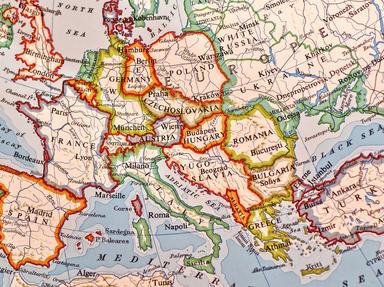
Answer: Vistula River
The Vistula river is about 651 miles long. The Oder River forms the majority of Poland's westernmost border. Since earliest times, these rivers have been used for navigation.
From Quiz: Poland
Answer: Rysy
Poland's highest point lies in the High Tatras and it's called Rysy (2,499 m above sea level), which can be translated into "scratches" or "crevices". Rysy consists of three peaks: middle (2,503 m), north-western (2,499 m) and south-eastern (2,473 m), but only the south-eastern peak lies on the Polish side of the Polish-Slovakian border.
From Quiz: Fantastic Poland
Answer: Lower Silesian (Dolnoslaskie)
Before 1998, Wroclaw had its own voivodeship called the Wroclaw voivodeship(Wroclawskie). From 1975 it was one of 49 voivodeships in Poland. Up until 1975, it bordered with the Opole, Poznan and Zielona Gora voivodeships as well as Czechoslovakia in the NRD(East Germany).
From Quiz: Wroclaw - The Meeting Place
Answer: Warsaw
Warsaw (Warszawa) lies in the centre of Poland on the river Vistula (Wisla). According to Wikipedia, its population in 2006 was 1.7 million. The city has a lot to offer, with its many museums, art galleries, theatres, cinemas, restaurants, shops and historical monuments.
From Quiz: Polish Cities
Answer: Poland
Poland is in East Europe, next to Germany, from east - Lithuania, Ukraine and Belarus, south - Slovakia and Czech Republic.
From Quiz: The Beautiful City Of Lodz
Answer: Poznan Cathedral
Mieszko I and Boleslav (Boleslaw) Chrobry both originally had graves in the crypt of Poznan Cathedral, but both graves are now in ruin.
From Quiz: Poland
Answer: Baltic Sea
Poland's coastline is on the Baltic sea, the easternmost part of the coastline is a bay of this sea, the Gulf of Danzig (Gdansk), and it is here that the port of Danzig (Gdansk) is located.
From Quiz: Geographically Speaking - Poland
Answer: Mt. Rysy
The peak of Rysy is found on the border of Poland and Slovakia. The peak was first ascended in 1840 by Ede Blasy and Jan Ruman-Driecny, Senior, his guide.
From Quiz: Poland
Answer: Vistula
Yes, Vistula (Wisla) is the longest river in Poland (1047 km). The next one is Oder (Odra) - 854 km, and then Warta which is 808 km. The source of the Vistula River is at Barania Gora (1220 m above sea level) in the Silesian Beskids (western part of Carpathian Mountains). The Vistula passes through several large Polish cities including: Cracow, Warsaw, Torun and Gdansk.
From Quiz: Fantastic Poland
Answer: Breslau
The first name in German for Wroclaw was Prezla, then Presslau and then finally Breslau. It is thought that the name "Wroclaw" originated from Johannes Wrotizlaensis who was the Bishop of the area.
Incorrect answers: Wrocislaw is the medieval Polish name, Wratislavia and Vratislavia are both medieval Czech names used for Wroclaw.
From Quiz: Wroclaw - The Meeting Place
Answer: Zakopane
Zakopane lies at the foot of the Tatra mountains, around 100 km to the south of Kracow, close to the border with Slovakia. It is a famous tourist resort with various skiing sites.
From Quiz: Polish Cities
Answer: boat
Lodz means boat. There's a legend about a fisherman that was in a boat. The weather changed, and fisherman had to face thunderstorm. He landed on a meadow and covered himself with his boat and waited there until the thunderstorm stops. When the sun appeared again, fisherman saw the beautiful area and decided to live there. He named the area "Lodz" - because the boat saved his life. And, of course, he lived happily ever after there;). I don't know if he lives here now, I've never seen him;)
From Quiz: The Beautiful City Of Lodz
Answer: Kalisz
Believe it or not, Kalisz was mentioned in Ptolemy's atlas in the 3rd century AD. It bore the name Calissa and it was a stopping point on the amber route.
From Quiz: Poland
Answer: 39 million
From Quiz: Geographically Speaking - Poland
Answer: Adam Mickiewicz
Mickiewicz is highly regarded as one of the country's best writers and is classed as one of "Poland's Three Bards."
The statue of Mickiewicz is a popular meeting place for tourists and groups of friends. There are a huge range of shows and performances (e.g. break-dancing and fire juggling) which take place by the statue in order to raise money for charity and entertain visitors. The shows are so seemingly spontaneous that I found myself watching what I believed to be a staged fight, and did not realize it was serious until the police carriages came rushing in.
From Quiz: Krakow - Poland's Second City
Answer: Gdansk
Gdansk is the fourth largest city in Poland and is the main seaport on the Gdansk Bay. It is located in northern Poland.
From Quiz: Poland
Answer: A4 and A8
The A4(E40)runs south of Wroclaw and the A8(E67) acts as a ringroad of western and northern Wroclaw-it is only 28km long!
Incorrect answers: A4 and A18-A4 runs as explained above and the A18(E36) runs from Olszyna to thye Krzyzowa junction on the A4 motorway, A1 and A2-The A1 is not yet built and the A2 is near Poznan, north of Wroclaw, A5 and A7-the roads don't actually exist!
From Quiz: Wroclaw - The Meeting Place
Answer: Krakow
It is the ancient capital of Poland. It attracts many tourists from abroad, who can visit there, for instance, Sukiennice (Cloth Market) and Wawel Royal Castle. It is also the seat of the Jagiellonian University (founded in 1364, it is the oldest university in Poland and the second oldest university in Central Europe).
From Quiz: Polish Cities
Answer: 1423
Earlier it was a small town and a village. In 1423 king Wladyslaw Jagiello made Lodz a city.
From Quiz: The Beautiful City Of Lodz
Answer: Carpathians
The Urals are in Russia and form part of the boundary between Europe and Asia. The Jura are on the French Swiss border.
From Quiz: Geographically Speaking - Poland
Answer: Czech Republic
Poland shares borders with Germany (467 km) to the west, the Czech Republic (796 km) and Slovak Republic (541 km) to the south, Ukraine (535 km), Belarus (418 km) and Lithuania (104 km) to the east and Russia, Kaliningrad Oblast (110 km) to the north. Poland also borders the Baltic Sea from the north.
From Quiz: Fantastic Poland
Answer: Salt Market (Plac Solny)
The Salt Market (Plac Solny) is a medieval market square in Wroclaw. Now it is used as a flower market. Interesting fact about the Salt Market(Plac Solny): Underneath the square, there is an underground shelter(about 1000m2) which was used during World War II as an air raid shelter for the public. Its maximum capacity was 300 people. During the war, it had two toilets, a sewage system and two entrances/exits.
From Quiz: Wroclaw - The Meeting Place
Answer: Gdansk
Under the name of Danzig, in the Middle Ages this city was a member of the Hanseatic League of northern European trading cities. It is in the shipyard of Gdansk where the "Solidarity" (Solidarnosc) movement was born in 1980. Under the leadership of Lech Walesa, it brought about the end of the communist rule in the entire Soviet Bloc.
From Quiz: Polish Cities
Answer: Piotrkowska
Piotrkowska street is the longest street in whole Europe that is totally straight! It is almost five kilometers long and is full of shops, offices, pubs, restaurants... It really has its historical value.
From Quiz: The Beautiful City Of Lodz
Answer: Krakow
AGH is one of three famous universities in Krakow in addition to the Jagiellonian University and the Krakow Polytechnic.
From Quiz: Poland
Answer: Oder
The Oder, or Odra, rises in the Czech Republic and runs north to the Baltic Sea.
From Quiz: Geographically Speaking - Poland
Answer: Karol Josef Wojtyla
This man became Pope John Paul II. He was born in the nearby town of Wadowice, but moved to Krakow to study in 1938. During his time as Pope, John Paul II kept a house in Krakow and this has become a popular site to visit, especially after his death in 2005.
The university was closed by Nazi Germans in 1939 and, following the death of his father, Karol began to realise that he was destined to become a priest.
From Quiz: Krakow - Poland's Second City
Answer: Lake Hancza
In Europe, only Finland has a greater density of lakes than Poland. The largest lakes are Lake Sniardwy and Lake Mamry in Masuria and Lake Lebsko and Lake Drawsko in Pomerania. However the deepest lake is Lake Hancza (108,5 m depth) in the Wigry Lake District, east of Masuria in Podlaskie Voivodship.
From Quiz: Fantastic Poland
Answer: Copernicus
This airport has seen a massive rise in passengers over the past few years. This is mostly due to low cost airlines such as Ryanair or Wizzair.
From Quiz: Wroclaw - The Meeting Place
Answer: Lodz
It is a major industrial and cultural centre. It lies only 130 km away from Warsaw and can be easily reached by train. It is also a seat of many tertiary education institutions, among them a famous Lodz Film and Drama School.
From Quiz: Polish Cities
Answer: 742 thousand
It's the third biggest city in Poland, after Warsaw and Krakow.
From Quiz: The Beautiful City Of Lodz
Answer: Transylvania
He wasn't Dracula, but he sure was duke of Transylvania. Stefan Batory never learned to speak Polish, but he won one major battle for Poland at Pskov and he quelled rebellions at Gdansk.
From Quiz: Poland
Answer: Danzig
Danzig was declared a free port in the Treaty of Versailles in 1919. It was to gain control of this port that Hitler's troops marched into Poland in 1939. Protests against the Communist government were centered in this city.
From Quiz: Geographically Speaking - Poland
Answer: Lublin
Lublin has a pretty Old Town, located on a hill, which is home to a lot of sights. There is the Dominican Church and a monumental castle, with its chapel decorated with beautiful 15th-century frescoes.
From Quiz: Poland
Answer: Biebrza National Park
Biebrza National Park (Biebrzanski Park Narodowy), located along the Biebrza River, is the largest (592 square km) of the 23 Polish National Parks. The most valuable part of the Biebrza National Park are the marshes. It's also a home for many birds and mammals such as elks and beavers.
From Quiz: Fantastic Poland
Answer: 1997
Heavy showers between 3rd and 8th of July 1997 caused the river Oder(Odra) and its tributaries to flood. Within a couple of days it had flooded nearly the whole of the nearby city, Opole and around about half of Wroclaw. The Polish people named it "the flood of the millenium."
From Quiz: Wroclaw - The Meeting Place
Answer: Poznan
Poznan is the capital of Wielkopolska province and fifth biggest city in Poland. Thanks to its thriving economy and the International Fair, the city is often called the economic capital of Poland.
From Quiz: Polish Cities
Answer: Jewish
Jewish Cemetery (at Inflancka Street;) is the biggest cemetery of this kind in the whole of Europe.
From Quiz: The Beautiful City Of Lodz
Answer: Cieszyn
The only that is left of the rotundas is a modern reconstruction atop a mound in Cieszyn.
From Quiz: Poland
Answer: Vistula (Wisla)
Warsaw was almost totally destroyed in World War II. It has since been rebuilt.
From Quiz: Geographically Speaking - Poland