

Answer: Black Sea
Romania is Europe's twelfth largest country, with an area of approximately 238,400 square kilometers. It has approximately 3,150 km (1,957 mi) of land borders, and the five countries it borders are, clockwise from the south: Bulgaria (631 km, or 392 mi), Serbia (546 km or 339 mi), Hungary (448 km or 278 mi), Ukraine (649 km or 403 mi), and Moldova (681 km or 423 mi). The Ukrainian-Romanian border is split into two by Moldova.
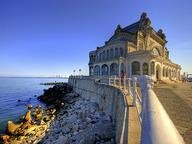
Romania's coastline is 194 km (or 120 mi) long, and this is completely along the Black Sea, called Marea Neagra in Romanian. Constanta is the most important Romanian city on the coast; it is the largest port on the Black Sea. Founded in 600 BC, it is a major tourist destination, particularly for its archaeological sights.
From Quiz: Roaming Romania
Answer: Predeal
Predeal is also a mountain resort, along with Sinaia, Busteni and Azuga. All four are in the Bucegi Mountains.
From Quiz: All About Romania
Answer: Long live Romania
The yell is commonly heard in soccer stadiums whenever Romania has to play against another country. It comes from a song that repeatedly states the following three phrases:
"Trãiascã libertatea, trãiascã România,
Trãiascã în fericire si liniste poporul,
Trãiascã România trãiascã tricolorul."
This means: "Long live freedom, long live Romania, that its people may live in happiness and peace, long live Romania, long live the tricolours (blue/yellow/red represents the Romanian flag).
From Quiz: Traiasca Romania! - All About Romania
Answer: Constanta
Constanta is located on the Black Sea. It has an area of 125 square kilometers. Constanta is one of the most populous cities in Romania.
From Quiz: Cities of Romania
Answer: Timisoara
Timisoara is one of the biggest cities in Romania with over 320,000 inhabitants. It is the city where the Revolution from 1989 began.
Street lighting had been used in London, Newcastle and Paris to some extent before Timisoara.
From Quiz: Cities of Romania
Answer: Bucharest
Bucharest is the biggest city in Romania, having over two million inhabitants. Its history begins in the fifteenth century.
From Quiz: Romania
Answer: December, 1989
In December of 1989, communist leader Nicolae Ceausescu and his wife Elena Ceausescu were convicted of committing acts of genocide, armed attack on the people and the state power of Romania, destruction of buildings and state institutions, and starving the people of Romania. On December 25, 1989 both Nicolae and Elena Ceausescu were executed.
From Quiz: Romania: Random Facts
Answer: Moldoveanu
The Carpathian Mountain Range is Europe's second longest, and travels 1,500 km (932 mi) through various countries in Eastern Europe. Although nearly half is situated in Romania alone, the highest peaks are centered in Slovakia, in the Tatra subdivision. The second highest group within the Carpathians is the Southern Carpathians in Romania, also called the Transylvanian Alps. Romania's highest peak is Moldoveanu in the Fagaras Mountains of the Southern Carpathians, and is 2,544 m (or 8,346 ft) high. It is accessible to hikers, who usually embark from the city of Victoria.
Drocea is situated in the Zarand Mountains in Arad County, and is only 836 m (or 2,743 ft) high. Musala is Bulgaria's highest peak, while Jakupica is a Macedonian range.
From Quiz: Roaming Romania
Answer: Paltinis
Paltinis is a summer/winter mountain resort and is located in Sibiu county, near the city of Sibiu. Although Predeal (which is a mountain resort itself) is the highest Romanian city, Paltinis is located at a higher altitude, but it's too small to be considered "a city".
From Quiz: All About Romania
Answer: The queues are formed from left to right and don't leave privacy for the one being helped at the front of the queue
When it comes to queuing, Romanians are not very polite people. It is said that queuing sideways probably started in the Communist era under Ceausescu, when food rations were low and people were suspicious of each other. One was generally struggling to survive and had no time to be courteous, as any courtesy was an opportunity for taking advantage. Standing from left to right, and leaving no space between the person being helped and the successor, serves better the purpose of maintaining one's place in line, than when waiting one behind each other. (people can less easily sneak in front of you). It might take another couple of decades for this habit to die out and become uniform to the queueing standards of Western Europe.
From Quiz: Traiasca Romania! - All About Romania
Answer: Ramnicu Valcea
Ramnicu Valcea is the county seat of Valcea. It is located in the region of Oltenia.
From Quiz: Cities of Romania
Answer: Sibiu
Sibiu is one of the representative cities of Romania and owns many "records" such as: the first hospital in Romania(1292), the first school in Roamania that was testified(1380), and first pharmacy in Romania (1494).
Sibiu was the Cultural Capital of Europe in 2007.
From Quiz: Cities of Romania
Answer: Carpathian Mountains
Sinaia is a famous skiing resort town located in the Carpathians.
From Quiz: All About Romania
Answer: leu
In Romanian leu means lion. Its name comes from an Austro-Hungarian currency that was used than and had two lions on it - the sign of the royal house of Austro-Hungaria.
From Quiz: Romania
Answer: 2.2 million
In terms of population, Bucharest (Bucuresti, in Romanian - pronounced 'bookooresht') is said to be the biggest city between Berlin and Istanbul. (Some estimates of the population of Bucharest are much higher).
From Quiz: Romania - A Miscellany
Answer: Dambovita
The Dambovita is an indirect tributary of the Danube, flowing first into the Arges River which itself flows into the Danube. The Dambovita's name derives from the word for "oak", so named because it used to flow through oak forests (Codrii Vlasiei) on the Wallachian (or Romanian) plain. The river, which is not navigable, gives its name to Dambovita County.
Bucharest, called Bucuresti in Romanian, has a larger population than any Romanian county, and contains various lakes as well as the Dambovita and its tributaries. Famous landmarks include the Arcul de Triumf, modeled after the Arc de Triomphe in Paris, and built to commemorate Romanian independence in 1878. Bucharest has many cultural sites, particularly museums, and is home to many summer festivals. It has been the site of six treaties.
From Quiz: Roaming Romania
Answer: Constanta
In 8 AD, Ovidius had been exiled to Tomis, a Greek colony on the Black Sea (Pontus Euxinus) shore. Legend says he never returned to Rome and died at Tomis. Tomis was later renamed Constanta, and became the largest Romanian city by the sea.
From Quiz: All About Romania
Answer: Cerbul De Aur (Golden Stag)
Cerbul De Aur has existed since 1968 and is held in the city of Brasov, in central Romania. A lot of international guest singers have performed there too, such as Gilbert Becaud, Josephine Baker, Jerry Lee Lewis, Ricky Martin and Pink.
Stufstock: a combination of the Romanian word Stuf, which means reed - and stock from Woodstock. It's meant as a protest against what some Romanian people consider to be bad quality music. (for instance, 'manele' and Romanian pop music)
George Enescu Festival: the biggest festival for classical music in Romania.
Tanjaua = a Folk dance and music festival, held in the spring.
From Quiz: Traiasca Romania! - All About Romania
Answer: Bucharest
Bucharest is the capital of Romania and has been since 1862.
From Quiz: Cities of Romania
Answer: Tirgu Mures
Tirgu Mures (Targu Mures) is one of the important cities of Transylvania with a population over 160,000. It is situated on river Mures.
From Quiz: Cities of Romania
Answer: Hungary
The Transylvanian region has long been disputed by the Hungarian and Romanian governments. Prior to WWI Transylvania was included in the Hungarian portion of Austria-Hungary, otherwise known as the Austro-Hungarian empire.
Today there are large numbers of Hungarians still living in Transylvania and other parts of Romania. In fact, they make up the largest minority group in Europe living in one country.
From Quiz: All About Romania
Answer: red, yellow and blue
The first time when this colors were proposed for the national flag was in 1848. It is said that red represents the blood of those who fought for the country, yellow represents the grains which feed the population and blue represents the sky over the country.
From Quiz: Romania
Answer: Dambovita River
(Pronounced 'dambovitsa'). The city lies on the Wallachian Plain, just over 40 miles north of the Danube, which forms most of Romania's border with Serbia and Bulgaria. The Dniester and Don are both well to the east of Romania.
From Quiz: Romania - A Miscellany
Answer: Olt and Mures
According to legend, once the two rivers were transformed, they parted to never be reunited again. The legend also says that Olt was the more impulsive brother, and so he took the harder path, deciding to work his way through the highest mountains in the Carpathian Range (Fagaras Mountains). Mures, being the calmer one, took the easier path, through the Western Carpathians.
From Quiz: All About Romania
Answer: Mamaia
Mamaia is Romania's largest sea resort. This resort is known for its natural white sand. Mamaia has around 60 hotels. These can range from 2-3 star hotels to luxurious 4-5 star hotels. Its beaches are 8km long and around 100 meters wide.
From Quiz: Vacation in Romania
Answer: Cluj-Napoca
Commonly known as Cluj this city is located in the northwestern part of the country. Located in the Someºul Mic River valley, the city is considered the unofficial capital to the historical province of Transylvania.
From Quiz: Cities of Romania
Answer: 1,500-2,000
Baile Tusnad has a population of 1,600. It is a small resort on the river Olt. It is famous for its mineral springs and landscapes. This zone it is known as "Little Switzerland".
From Quiz: Cities of Romania
Answer: Vlad Tepes
Bram Stoker never set foot in Romania. He based his blood sucking character on general European legends of the time (and on detailed research). Vlad Tepes is in fact admired by Romanians as the leader who succeeded in briefly ousting the Turks.
From Quiz: All About Romania
Answer: Black Sea
The largest port in the Black Sea is Constanta. For about five hundred years that part of Romania was in the Ottoman Empire.
From Quiz: Romania
Answer: Oil
The Romanian oil-fields are situated near the town of Ploiesti. They were among the very first oil-fields to be developed in the world (1857 onwards) and were of immense strategic importance to Germany and its European allies in both World Wars. From the Middle Ages till the early 19th century the gold mines (in the north-west of country, near Baia Mare) were extremely important, but are now almost exhausted.
From Quiz: Romania - A Miscellany
Answer: Romanian
Hopefully, for the most part, this question did not pose too many problems ...
From Quiz: Romania: Random Facts
Answer: Deva
Girls from all over the country go to Deva to train in gymnastics. The local sports club is called "Cetate Deva". Before Deva, the Romanian gymnastics team used to train in Onesti, Nadia Comaneci's hometown.
From Quiz: All About Romania
Answer: Hungarians
Hungarians make up for 6.60% of the population. Roma Gypsies are second with 2.46% of the population while Ukrainians and Jews both have less than 2%.
From Quiz: Traiasca Romania! - All About Romania
Answer: Tulcea
It is the county seat of Tulcea County. It was founded in the 7th century B.C. and was called Aegyssus. In ancient times, it was an important harbor, and still is today.
From Quiz: Vacation in Romania
Answer: Brasov
Brasov is the eighth largest city in Romania. Bran Castle, Poiana Brasov, and Tampa are popular tourist attractions.
From Quiz: Cities of Romania
Answer: Iasi
Iasi is the most important political, economic and cultural centre of Moldavia and one of the oldest cities in Romania. Situated in the northeast of Romania, between the Moldavian Plateau and Jijia Plain, on the River Bahlui, it used to be the crossing place of the most important commercial roads that passed through Moldavia coming from Poland, Hungary, Russia and Constantinople.
From Quiz: Cities of Romania
Answer: Tuica
Romanians have a tradition of drinking a shot of tuica before a meal. It is supposed to help with digestion.
From Quiz: All About Romania
Answer: Danube
The Danube is the second biggest river in Europe after the Volga.
From Quiz: Romania