

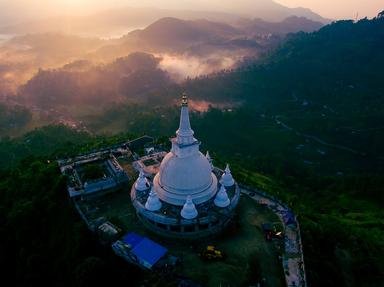
Answer: Kandy
The Perahera is a Buddhist festival held in July and August each year and lasting twelve days and nights. The focal point is the 'Dalada Maligawa', or 'Temple of the Tooth', where the last remaining part of Buddha, his tooth, is preserved. The sacred tooth is paraded each year during the festival. The tooth was originally brought to Sri Lanka from India in the fourth century, but the modern ceremony dates from the reign of King Kirthi Sri Rajasinghe (1747-1781) who believed that the population of Kandy should be given the opportunity to honour the relic, which had previously been the personal property of the monarchy.
Question posed by playmate1111
From Quiz: The Beautiful Island of Sri Lanka
Answer: Sri Jayawardanapura Kotte
The former capital was Colombo, which remains the commercial capital. In 1982 Sri Jayawardanapura Kotte (the former Sinhalese capital city of Kotte) was made the legislative capital.
From Quiz: All About Sri Lanka
Answer: Colombo
The other cities have had some influence and have been capitals but it wasn't until the 1870s when the British moved the capital from Galle that it became official. Sri Lanka's parliament has been based in the Sri Jayewardenepura Kotte area of Colombo since 1982.
From Quiz: Sri Lanka
Answer: Cinnamon
The scientific name for cinnamon is Cinnamomum zeylanicum, with the latter part of the name coming from Ceylon, the former name of Sri Lanka. It also grows in southwest India and Myanmar. Cinnamon was used by the Egyptians in embalming and in medieval times it was used to treat coughs and throat infections. At one time Sri Lanka held a monopoly on production of the spice, but this declined as cultivation spread to other areas. Coffee is believed to have been introduced by Arab traders or pilgrims, although the plant was not used for drinking, with the leaves being used to flavour food. Rubber trees were first planted in 1876 and tea was brought from China by the British in 1824, becoming a commercial enterprise in 1867.
Question supplied by rossian
From Quiz: The Beautiful Island of Sri Lanka
Answer: River Mahaweli
The River Mahaweli starts at the top of Adam's Peak, and falls to the sea in Trincomalee. River Mahaweli supplies many towns with water, though it only appears as a brown muddy stream on Adam's Peak.
From Quiz: Sri Lanka
Answer: Lion Rock
Lion Rock is also known as Sigiriya by most Sri Lankans. It was built by King Kasyapa as his fortress with a palace at the top.
From Quiz: All About Sri Lanka
Answer: Buddha
The Temple of the Tooth houses the only remaining relic of the Lord Buddha. Buddhists believe that upon the death of Lord Buddha, his body was cremated on a sandalwood pyre. His left canine tooth was found in ashes and has been venerated ever since. This temple is found in the city of Kandy, which was at one time, the capital of the Sri Lankan kings, and is now a UNESCO world heritage site. Buddhism is the most popular religion in the county and this fabulous temple palace is a must-see for anyone visiting or making a pilgrimage the island.
From Quiz: An Exciting Excursion to Sri Lanka!
Answer: 25
These 25 districts are in nine separate provinces. Some provinces have more districts than others. The nine provinces in Sri Lanka are: Central, Eastern, North Central, Northern, North Western, Sabaragamuwa, Southern, Uva and Western.
From Quiz: Sri Lanka
Answer: Buddhism
Strictly speaking Buddhism is a system of philosophy and morality. It is adhered to by 70 percent of the population.
From Quiz: Sri Lanka
Answer: Portugal
The Portuguese, under Lourenço de Almeida, arrived to find the island divided into seven different kingdoms too busy fighting each other to be able to fend off invaders. They settled mainly in the coastal regions of the west and south and established a capital city at Colombo on the west coast. Colombo is still often referred to as Sri Lanka's capital, although the official capital is now Sri Jayawardenapura-Kotte which adjoins Colombo. The Portuguese occupation was a time of religious persecution with Christianity being imposed on the Buddhist Sinhalese population and the Islamic Moors. The country received help from the Dutch who established their own colony in 1656 and the name was anglicised to Ceylon when the British took control of the island.
Question written by rossian
From Quiz: The Beautiful Island of Sri Lanka
Answer: Velupillai Prabhakaran
Velupillai Prabhakaran created the Liberation Tigers of Tamil Eelam in 1976. The group fought to have their own sovereign state of Tamil. Velupillai Prabhakaran died on May 19, 2009.
From Quiz: Sri Lanka
Answer: Sinhala and Tamil
From Quiz: Sri Lanka
Answer: It is built in a cave
The Golden Temple of Dambulla is also known as the Dambulla Cave Temple. The Golden Temple houses Buddhist statues and wall paintings exhibited over five caves. Humans have been living in these caves for almost 3,000 years and there are burial sites in this cave complex. This temple was built in the 1st century B.C. and from the front looks somewhat like a normal temple built into an overhanging rock. As soon as you enter you will be greeted with fantastic paintings on the walls and ceilings. While the public may view this lovely temple, there are parts that are kept private as they are considered very sacred and only a few are blessed enough to enter.
From Quiz: An Exciting Excursion to Sri Lanka!
Answer: Pidurutalagala
This mountain is situated in Nuwara Eliya. It has an elevation of 2,524 m (8,281 ft). Even though it is pretty cold up on Pidurutalagala, it usually doesn't snow.
From Quiz: Sri Lanka
Answer: Hydro-powered energy
Because there are many waterfalls in Sri Lanka, hydro-power provides most of the country's electricity via power houses near the waterfalls.
From Quiz: All About Sri Lanka
Answer: Australia
From Quiz: Sri Lanka
Answer: Sigiriya
Sigiriya, or the 'Lion Rock Fortress', was declared a world heritage site in 1982. A fortified palace was built in the fifth century by King Kassapa on the peak of a rock which was over 150 metres in height to protect himself from the attacks of Dhatusena. The most famous aspects of the site are twenty-two well preserved frescoes of young women painted on the sheer rock. It is believed that there may have been over five hundred pictures originally. The entrance was guarded by a statue of a lion at the base of the rock, with the gateway being between its paws, which are now all that remain of it.
Question created by szabs
From Quiz: The Beautiful Island of Sri Lanka
Answer: Central Province
The Temple of the Tooth is also called Dalada Maligawe. Dalada Maligawa is situated in Kandy of the Central Province. The Temple of the Tooth is a sacred site for Buddhists.
From Quiz: Sri Lanka
Answer: Moors
Moors are the descendants of the Arab Traders who began arriving in Sri Lanka in the A.D. 700s.
From Quiz: All About Sri Lanka
Answer: Lion
The flag represents a gold lion (from the word Sinha) on a crimson field (pre-colonial state) with gold bo leaves (Buddhist symbols) at the {corners;} vertical green (Muslims) and orange (Tamils) stripes at the left represent the minorities.
From Quiz: Sri Lanka
Answer: Cinnamon
Cinnamon is obtained from the bark of the Cinnamomum verum tree that is native only to the island of Sri Lanka. The wonderful flavor and variety of uses for this spice have made it one of the most popular in the world. It has also led to the export of Cinnamomum verum trees to other countries allowing them to produce the spice. Sri Lanka was famous for the spices grown there, and its convenient geographic location allowed for spice trading overland as well as by sea. Any visitor will be able to see native spices being grown on window ledges and small gardens as well as large plantations.
From Quiz: An Exciting Excursion to Sri Lanka!
Answer: Northeast
The Liberation Tigers of Tamil Eelam (LTTE) were formed in 1976 by Velupillai Prabhakaran to carry out attacks on government targets. Their aim was to have an independent Tamil state in the north eastern area of Sri Lanka. The organisation carried out many assassinations including those of Sri Lankan president Ranasinghe Premadasa in 1993 and the 1991 killing of Rajiv Gandhi, the former Prime Minister of India. Following failed attempts at peace negotiations, the Sri Lankan army launched a campaign in 2006 which eventually led to the death of Prabhakaran on 18 May 2009. A new leader, Selvarasa Pathmanathan, was appointed by the LTTE but he was quickly captured and hostilities ceased. Thirty-two different countries listed the LTTE as a terrorist organisation, having carried out crimes including, but not limited to, sea piracy, arms smuggling, extortion and drug trafficking.
Question supplied by mlcmlc
From Quiz: The Beautiful Island of Sri Lanka
Answer: JR Jayewardane
JR Jayewardane was the first leader of independent Sri Lanka. He belonged to the United National Party, or UNP, party. William Gopallawa preceded JR Jayewardane, but he was not an Executive President. Jayewardane died on November 1, 1996.
From Quiz: Sri Lanka
Answer: Adam's Bridge
Rama's Bridge, or Rama Setu, stretches between Pamban Island off the coast of Tamil Nadu, India and Mannar Island off the coast of Sri Lanka. The bridge is 30km (18 miles) long and is a chain of limestone shoals. Hindus believe that the bridge was created by Shri Laksman and Shri Rama in order to find Shri Rama's wife, Sita, who had been kidnapped by Ravana, the king of the demons. Evidence has been found suggesting that the bridge was a former land connection between India and Sri Lanka. The name of Adam's Bridge appears to be of more recent origin, with the earliest reference being dated to 1804 and based on a legend that Adam used the bridge to reach the mountain called Adam's Peak on Sri Lanka.
Question created by playmate1111
From Quiz: The Beautiful Island of Sri Lanka
Answer: 4th February 1948
The country officially received Dominion Status from the United Kingdom. Mr. D.S. Senanayake was the first Prime Minister. The country was known as the Dominion of Ceylon.
From Quiz: Sri Lanka
Answer: February 1948
1948 was a big year - Gandhi began his final fast; Israel was formed; Republic of Ireland declared; Japanese premier Tojo sentenced to death for war crimes; World Health Organisation, and other events. Ceylon, as it was then, gained home rule from the UK in 1948. They were a dominion of the UK from 1948 - 1975, and became a republic, but still a member of the Commonwealth of Nations, in 1975.
From Quiz: Sri Lanka
Answer: Eelam War IV
The ending date of the civil war was 18 May 2009. The two sides fighting consisted primarily of the Liberation Tigers of Tamil Eelam and the Sri Lankan military. Eventually, the government's military defeated, killed and/or captured the majority of the rebels.
From Quiz: Sri Lanka
Answer: Jaffna (Tamil)
Tamil cooking is very close to southern Indian cooking; Galle in the south relies on seafood as their main staple and in Kandy (high in the mountains) there are a lot of fruit and vegetables used in their cooking.
From Quiz: Sri Lanka
Answer: Tsunami
Known by various names including the Indian Ocean tsunami, South Asian tsunami and the Boxing Day tsunami, as it happened on 26 December, the tsunami was triggered by an undersea earthquake off the coast of Sumatra, Indonesia. Most of the countries bordering the Indian Ocean suffered massive damage and loss of life, with over 230,000 people losing their lives. Sri Lanka sustained a large amount of damage particularly on its southern and eastern coasts. Estimates of casualties, confirmed dead and missing, are in the region of 35,000 to 40,000 in total.
Question supplied by rossian
From Quiz: The Beautiful Island of Sri Lanka
Answer: Indian Ocean
Sri Lanka is an island nation. It is called the "Pearl of the Indian Ocean". Sri Lanka experiences tropical weather and monsoon seasons, which include high temperatures and humidity.
From Quiz: Sri Lanka
Answer: Mahiyanganaya
The Vedhas live in Mahiyanganaya, a remote area. They are not at all developed people. They hunt animals and they live in the jungle.
From Quiz: All About Sri Lanka
Answer: 2
There are two monsoons. The South-West from June to October and the North-East from December to March. Sunny and warm days are the rule even during the height of the monsoons.
From Quiz: Sri Lanka