
|
Structure
Interesting Questions, Facts and Information
- There are a total of 40 general entries. We are selecting 30 for display.
|
Interesting Questions, Facts, and Information
The Reformation
The Roman Catholic Church held nine 'Church Councils' between 1215 and 1545 to deal with what issue? | The European Reformation
|
How to deal with Church corruption. The Reformation occurred in large part because of widespread dissatisfaction with the corrupt practices that the Roman Catholic Church had allowed to exist. Over the centuries, the church, particularly in the office of the papacy, had become deeply involved in the political life of western Europe. The resulting intrigues and political manipulations, combined with the church's increasing power and wealth, contributed to the bankrupting of the church as a spiritual force. Abuses such as the sale of indulgences (or spiritual privileges) and relics and the corruption of the clergy exploited the pious and further undermined the church's spiritual authority. The Church itself recognized this and held the nine Councils in an attempt to resolve the issue of corruption and abuse of power. All of teh Councils failed to reach any resolution. There were other reforms though that attempted to stem the corruption, such as the reformations achieved by St. Francis, Peter Waldo, Jan Hus, and John Wycliffe, which addressed abuses in the life of the church in the centuries before 1517. In the 16th century, Erasmus of Rotterdam, a great Humanist scholar, was the chief proponent of liberal Catholic reform that attacked moral abuses and popular superstitions in the church and urged the imitation of Christ, the supreme teacher.
Martin Luther is credited as being the person who began the Reformation in the 16th Century by doing what action? | The European Reformation
|
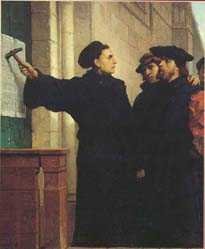
Nailing a list of grievances to a door. The Reformation movement began essentially on Oct. 31, 1517 (the Eve of All Saints day) when a Martin Luther posted a list of grievances, called the Ninety-Five Theses, against the door of the Castle Church in Wittenberg, Germany. Although he had become uncomfortable with many Church teachings, what fundamentally spurred him to action was an incident that occurred when a friar named Tetzel (who was selling indulgences issued by the pope, to acquire the finances needed in the building of St. Peter's) made his way to Germany. Luther took the offense against the Church's doctrine. In his Theses, he reviewed ninety-five points in which the Church had erred in its interpretation of the New Testament. He touched on major teachings of the Church, including the sacrament of Penance, transubstantiation, and papal authority. Luther claimed that what distinguished him from previous reformers was that while they attacked corruption in the life of the church, he went to the theological root of the problem--the perversion of the church's doctrine of redemption and grace. Luther, a pastor and professor at the University of Wittenberg, deplored the entanglement of God's free gift of grace in a complex system of indulgences and good works. He proposed an ethical and theological reform of the church: Scripture alone is authoritative (sola sciptura) and justification is by faith (sola fide), not by works. While he did not intend to break with the Catholic Church, a confrontation with the papacy was not long in coming.
Where was Luther supposed to stand trial and answer for the action that he perpetrated which in effect began the Reformation? | The European Reformation
|
The Imperial Diet of Worms. In 1521, Luther was tried before the Imperial Diet of Worms. The Diet was presided over by The Holy Roman Emperor Charles V, who was trying to gain control of a dangerous situation. Luther was excommunicated, but was engendering mass support amongst the general population and so Charles wanted to be the figure who settled the situation down. It is believed that Charles wanted to have Luther burnt at the stake as a heretic at the outset of the Diet, but was prevented from doing so by Luther's quick abscondance from the scene. The Diet of Speyer in 1529 was important as being the occasion when Protestantism was given its name. The Diet of Speyer also rescinded most of what toleration had been granted to the followers of Martin Luther three years earlier and set the stage for the violence that followed. The Diet of Regensburg, held in 1541, again presided over by Charles, was an attempt to reconcile the increasingly entrenched Protestants by offering major concessions. Both Luther and the Pope later rejected the concessions. The Imperial Diet of Augsburg saw the publication of the 'Interim,' a formula conciliatory to the Protestants but retaining the Roman Catholic ritual in general. Although Charles V believed that he had granted far-reaching concessions to the people and the Protestant authorities in this document, his main concern was to make the Protestants return to the Catholic Church.
Eisleben. Martin Luther was born on November 10, 1483, in Eisleben, Saxony (now a part of Germany). His parents, Hans and Margarethe Luther, had moved to Eisleben from Mohra. They soon moved on again to Mansfeld, where Hans Luther worked in the copper mines, making enough money for his son's education. Luther was educated at a school in Magdeburg and at Eisenach, and then went on to University at the University of Erfurt, one of the oldest and best attended universities in Germany at the time. He attained his B.A. degree in 1502 and then his M.A. in 1505.
Before splitting from (well, okay, being excommunicated from ...) the Catholic Church, to what monastic Order did Luther belong? | The European Reformation
|
Augustinian. The Order of St. Augustine, commonly known as the Augustinians, is one of the four great mendicant religious orders of the Middle Ages. In joining the eremitical order of St. Augustine, Luther had joined an important mendicant order, which by the middle of the 15th century had over 2,000 chapters. As a result of reforms carried through in 1473, the house at Erfurt, to which Luther went, accepted the strict, observant interpretation of the Rule of St. Augustine, written about 400 A.D. which is a guide to religious life divided into 8 chapters, which are the Purpose and Basis of Common {Life;} {Prayer;} Moderation and Self {Denial;} Safeguarding Chastity,and Fraternal {Correction;} The Care of Community Goods and Treatment of the {Sick;} Asking Pardon and Forgiving {Offenses;} Governance and {Obedience;} and, Observance of the Rule.
St. Ignatius Loyola, was the founder of what monastic order that fought most tenaciously for Roman Catholicism in debates at the very beginning of the Reformation? | The European Reformation
|
Jesuit. St. Ignatius Loyola founded the Society Of Jesus (which became known as the Jesuit Order), noted for its educational, missionary, and charitable works, once regarded by many as the principal agent of the Counter-Reformation and later a leading force in modernizing the church. The Jesuits have always been a controversial group regarded by some as a society to be feared and condemned and by others as the most laudable and esteemed religious order in the Catholic Church. Loyola was a Spanish soldier who experienced a religious conversion during a period of convalescence from a wound received in battle. After a period of intense prayer, he composed the Spiritual Exercises, a guidebook to convert the heart and mind to a closer following of Christ. The society grew rapidly, and it quickly assumed a prominent role in the Counter-Reformation defense and revival of Catholicism. Almost from the beginning, education and scholarship became the principal work.
What religious sect broke away from Zwinglism insisting that the principle of scriptural authority should be applied without compromise, unlike most other forms of Protestantism that emerged throughout the Reformation? | The European Reformation
|
Anabaptists. From the group surrounding Zwingli emerged those more radical than himself. These Radical Reformers, part of the so-called 'left wing' of the Reformation, insisted that the principle of scriptural authority be applied without compromise. Unwilling to accept what they considered violation of biblical teachings, they broke with Zwingli over the issue of infant baptism, thereby receiving the nickname 'Anabaptists' on the grounds that they rebaptized adults who had been baptized as children. The Swiss Anabaptists sought to follow the example of Jesus found in the gospels. They refused to swear oaths or bear arms, taught the strict separation of church and state, and insisted on the visible church of adult believers--distinguished from the world by its disciplined, regenerated life.
A league of Lutheran Princes. In 1530, Charles, attempting to bring about a reformation within the Catholic Church through the convocation of a universal council, also tried to find a modus vivendi with the Protestants. The Catholics, however, replied to the Confession of Augsburg, the basic confessional statement of the Lutheran Church, with the Confutation, which met with Charles's approval. The final decree issued by the Diet accordingly confirmed, in somewhat expanded form, the resolutions embodied in the Edict of Worms of 1521. As a result of this, Charles, had basically made it clear that it was his intention to crush the growing heresy initiated by Martin Luther. In defense, the Lutheran princes banded together in 1531 in the Schmalkald League, and between 1546 and 1555 a sporadic civil war raged.
Huguenots. Francis I tolerated the French Protestants depending upon how advantageous it was to him at any given time, although persecutions did occur. Under Henry II, the son of Francis, repression was intensified, particularly when in 1559 France and Spain made peace and thus each was free to devote attention to the suppression of heresy at home. The persecution of the Huguenots, as the Protestants came to be called in France, would have been intense save for the death of the King in a tournament.
The Peace of Augsburg. The Peace of Augsburg was the first permanent legal basis for the existence of Lutheranism as well as Catholicism in Germany, and was promulgated on Sept. 25, 1555, by the Diet of the Holy Roman Empire assembled earlier that year at Augsburg. The Diet determined that in the future no member of the empire should make war against another on religious grounds and that this peace should remain operative until the denominations were peacefully reunited. Only two denominations were recognized, the Roman Catholics and the adherents of the Confession of Augsburg--i.e., the Lutherans. Moreover, in each territory of the empire, only one denomination was to be recognized, the religion of the prince's choice being thus made obligatory for his subjects. Any who adhered to the other denomination could sell his property and migrate to a territory where that denomination was recognized. The free and imperial cities, which had lost their religious homogeneity a few years earlier, were exceptions to the general ruling. Protestant and Catholic citizens in these cities remained free to exercise their religion as they pleased. The same freedom was furthermore extended to Protestant knights and to towns and other communities that had for some time been practicing their religion in the lands of ecclesiastical princes of the empire. This last concession provoked vehement Catholic opposition, and Ferdinand circumvented the difficulty by deciding the matter on his own authority and including the clause in a separate article.
Pope Leo X. Pope Leo X was born on December 11, 1475, in Florence, Italy and died December 1, 1521, in Rome. His original birth name was Giovanni De' Medici, son of Lorenzo De' Medici (also known as Lorenzo the Magnificent). Leo has been cited as being the most extravagant of the Renaissance popes (reigned 1513-21), who made Rome a centre of European culture and raised the papacy to significant political power in Europe. He depleted the papal treasury, and, by his response to the developing Reformation, he contributed to the dissolution of the unified Western church. Leo excommunicated Martin Luther in 1521.
Henry VIII. In England the Reformation's roots were primarily political rather than religious. Henry VIII, incensed by Pope Clement VII's refusal to grant him a divorce, repudiated papal authority and in 1534 established the Anglican Church with the king as the supreme head. In spite of its political implications, in the longer run the reorganization of the Church of England was primarily based on the teachings of Erasmus and Luther, although some Calvinism was filtered in.
Which very influential family was the power behind the throne at the time that the Reformation began gaining ground in France? | The European Reformation
|
De' Medici. The hugely powerful Medici family from Italy were not only the power behind the throne, but also the throne itself for three periods of reign. Catherine De' Medici was the queen consort of Henry II of France (reigned 1547-59) and subsequently regent of France (1560-74), and was also one of the most influential personalities of the Catholic-Huguenot wars. Three of her sons were kings of France: Francis II, Charles IX, and Henry III. She was the daughter of Lorenzo the Magnificent, and niece of one Pope and sister of another. Catherine was actually probably the strongest figure in the entire period of French history, not only protecting her sons on the French throne, but fighting off and playing Catholic and Protestant forces against each other to lessen their influences on the French Kings.
During the French struggles between Catholicism and Protestantism, what bloody massacre set off a string of small wars? | The European Reformation
|
Massacre at Vassy. The main Protestant body in France were Calvinist believers. The French too, like the majority of Europe, were becoming tired of the continual violence erupting over the difference of religious beliefs, but could not adopt the Treaty of Augsburg, due to the fact that it excluded Calvinists. France seemed on the verge of all out religious war, but this was averted when Catherine De' Medici granted an Edict in 1562 allowing the Huguenots limited toleration in restricted areas. Francois, duc de Guise (head of the most powerful Catholic family in France and advisor to the King) discovered a group of Huguenots worshipping outside the prescribed limits in a barn in Vassy, as he claimed, and opened fire. The Massacre of Vassy set off the wars. The Huguenots now were led by a prince of the blood, Louis I, 1st prince de Conde, of the House of Bourbon. There followed three inconclusive wars. Conde was killed in the first and Francois, duc de Guise, was assassinated.
After ten years of war following the Massacre in Question 16, the French King's mother attempted to reconcile the Catholics and Protestants by what means? | The European Reformation
|
A Truce. Catherine made another effort at a settlement in the form of a truce, which was to be cemented by the marriage of Henry of Navarre (the future King of France, Henry IV), a Bourbon, the son of Jeanne d'Albret and the hope of the Huguenots, and her own daughter Margaret (Marguerite de Valois), a Catholic. On Aug. 18, 1572, they were married, with all of the leaders of all parties came to Paris for the wedding.
What series of wars erupted in Germany in 1524 and 1525 as the result of Injustice and also the teachings of Luther and Zwingli, that resulted in a angry written treatise by Luther? | The European Reformation
|
The Peasant's War. In the summer of 1524 the Peasants' War had broken out in the Black Forest area. Their program was variously motivated. Their demands were for concrete medieval liberties connected with the game and forest laws or with tithes. Some of them drew on Catholic teaching, others on the theology of Zwingli and of Luther, who had set an example of successful defiance of authority, had been no respecter of dignities, and whose teachings about Christian liberty and a priesthood in which all believers shared were plainer than his subtle distinctions between two kingdoms. In the spring of 1525 the Thuringian peasants rose, with Thomas Muntzer among their leaders, and at first seemed likely to carry all before them. Faced with imminent political chaos, Luther wrote a brutal, virulent broadsheet, Wider die rauberischen und morderischen Rotten der andern Bauern ('Against the Murdering and Thieving Hordes of Peasants'). The writing was less violent than Muntzer's hysterical manifestos, but it was bad enough.
What invention that appeared in Europe shortly before the outset of the Reformation is credited as having played a key role in the spread of Protestantism? | The European Reformation
|
Printing by movable type. Until the invention of printing by movable type, spiritual teachings relied on mural painting, mosaic, and stained glass which are common in Catholic churches. Protestant reform rejected visual imagery and insisted upon the primacy of the word. Mass production of printed material meant that religious and philosophical literature was widely available at affordable prices.
1517. The Reformation began on October 31, 1517 when Martin Luther nailed the Ninety-Five Theses on the door of the Castle Church Wittenberg in Germany. Since about 1500, people's ways of thinking started to change, making men aware of the principles of individual liberty and responsibility before God.
Movable type printing press. The movable type printing press was invented around 1440 by Johannes Gutenberg. Before the invention of the movable type printing press, printing was a tedious job, and as a result, literature was not very accessible to the public. Blocks were carved out of wood, and then discarded. Creating a technique that allowed setting individul letters together to print a page made printing books and pamphlets easier and less expensive. Because of this invention, people could more readily afford to buy more books. The first book to be printed from the movable type was, appropriately, the Bible.
All of these (The Voyages of Discovery, The Italian Renaissance, The Northern Renaissance). The Italian Rennaisance lasted from about A.D. 1300 to 1600 and emphasized the humanities through pagan culture. The Northern Renaissance, which can scarcely be distinguished from the Reformation movement, began in the A.D. 1500s, and occured in countries north of Italy. It emphasized the humanities as well, However, the men of the Northern Renaissance felt that there was no book about man or any other subject more important than the Bible.
John Wycliffe. Because he lived before the Reformation began, John Wycliffe is called the "Morning Star of the Reformation". Born around 1329 and educated at Oxford University, Wycliffe was an outstanding scholar who could not accept the doctrines of the Roman church. He became the first man to translate the entire Bible into English. Wycliffe was harrassed by priests, monks, and friars, and his books were banned in England. Although he died in 1384, the Roman church condemned his beliefs and at the Council of Constance in 1415 ordered his writings be burned. Finally, in 1428 the pope ordered that Wycliffe's remains be dug up and burned.
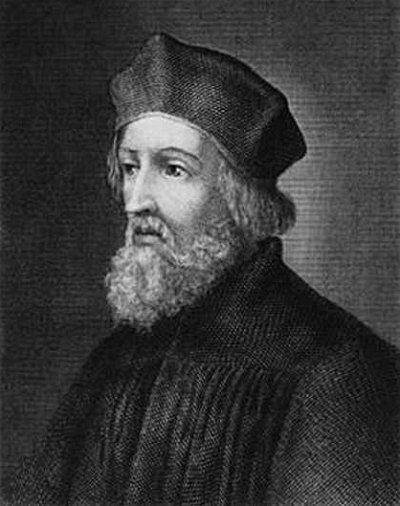
John Huss. John Huss was born around 1374 to a poor family. Encouraged by his mother to get an education, he studied theology and philosophy at the University of Prague. Huss became a great preacher causing a movement for reformed Christianity to break out in Bohemia. Alarmed at the growth of support Huss was getting, the Roman church persuaded Huss to go to the Council of Constance in order to explain and defend his beliefs. Repeating his idea that the pope can make mistakes, he refused to recant his belief that the church meant all believers, not just popes and priests. Even though Huss had gone to Constance with a safe-conduct guarantee, he was condemned by the Council and burned at the stake in 1415. His last words were, "Lord, unto Thy hand I commend my spirit".
Desiderius Erasmus. Born about 1466 in Rotterdam, Erasmus lived and studied all over Europe. Either in person or through letters, he had come to know nearly every major scholar on the continent. In March of 1516, Erasmus printed the first edition of the New Testament in the original Greek, which opened the eyes of many to how much the Vulgate had distorted the New Testament. Erasmus lived to see the Bible translated into many different languages. He died in 1536 as the most famous figure by far of the Northern Renaissance.
What Augustinian friar wrote a list of ninety-five propositions to the Roman Catholic church in an attempt to reform its corrupt practices? | The Protestant Reformation
|
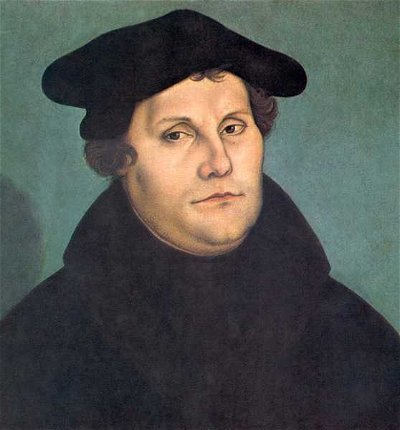
Martin Luther. Martin Luther was born in 1483 in Eisleben, Germany. Graduating from the University of Erfurt in 1505, he abandoned his parents' wishes for him to become a lawyer by becoming a monk. In time, Luther went back to school, earned a doctorate, and taught Bible at the University in Wittenberg. After a serious study of the New Testament, Luther began to protest the practices of the church, particularly indulgences. On October 31, 1517, he nailed the Ninety-five Theses to the church door at Wittenberg. After reading a copy of the Theses, Pope Leo X charged Luther with heresy and contempt for church authority. Luther's protest against the church's corrupt ways lead to the Diet of Worms in 1521, where he was put on trial in an attempt to force him to recant his writings and beliefs. Still, Luther took a stand and said, "Unless I am convicted by Scripture and plain reason - I do not accept the authority of popes and councils, for they have contradicted each other - my conscience is captive to the Word of God. I cannot and I will not recant anything, for to go against conscience is neither right nor safe. God help me. Amen."
Ulrich Zwingli. Born in 1484, Zwingli was appointed to the post of "people's priest" in the city of Zurich in 1519. He preached through the whole book of Matthew in the New Testament during a time when preaching of the Bible by a priest was unheard of. He also attacked many Roman doctrines. After a debate in which Zwingli defended his faith as stated in sixty-seven theses, the city council of Zurich decided to support the Reformation in 1523. However, not all of Switzerland agreed with this, and as a result, wars broke out between the Swiss Protestants and the Swiss Catholics until 1531 when both sides accepted that some areas of Switzerland would be Protestant and others Catholic. During the wars, Zwingli served the Protestant forces as a chaplain and was, unfortunately, killed in battle in 1531. Nevertheless, it was thanks to Zwingli's leadership that the Reformation had come to Switzerland.
What French reformer, who was based in Geneva, Switzerland, became one of the most influential Protestant leaders of all time? | The Protestant Reformation
|
John Calvin. John Calvin was born in Noyon, France in 1509 and became committed to the Protestant faith by 1534. Having to flee France due to King Francis I's anti-Protestant law, Calvin put many ideas into practice in Geneva. He lived there for twenty-eight years while writing and preaching which influenced every aspect of the city's life. Calvin died in 1564. Today, he is known as the founder of the Presbyterian church as well as other churches that are called Reformed.
Many of the Protestant leaders were concerned about educating the public. What was their main reason for this? | The Protestant Reformation
|
To better understand the Bible. Luther, for example, knew that the Bible was to no avail if the people could not read. The emphasis on educating the public distinguished the Modern Age from all previous eras, and the difference was made by the Reformation. This is the difference between the Northern Renaissance and the Italian Renaissance: in Italy, learning was exclusively reserved for a priviledged few. Whereas in the Northern Renaissance, all men were able to have the opportunity to learn. Thank you for taking my quiz. I hoped you learned something new.
Eisleben in 1483. Luther was born on November 10, 1483 to thrifty, hardworking parents who brought him up with strict discipline. He was taught to fear God and to believe that heaven and hell are real places. On the outside, Luther was everything a good Roman Catholic was supposed to be. On the inside, however, he never experienced a sense that his sins were truly forgiven, and always felt only guilt and condemnation.
University of Erfurt. The University of Erfurt was the first German university to incorporate the new learning of the Renaissance and reject scholasticism, thereby keeping philosophy and theology separate. In this way, Luther had the chance to read and accept the Bible for just what it says.
He was struck by lightning. On a hot, summer day in 1505, a thunderstorm hit as he was on his way home on an open country road. Struck down in the rain, Luther's grasp of eternity became terribly vivid. Fearing for his life, Luther cried out, "St. Anne, help me and I will become a monk!". Because he was extremely serious about his salvation, Luther chose to join the most severe monastic order available, the Augustinian friars. His father was very upset. He had wanted Martin to become a lawyer and could not understand why his son chose to become a monk. While in the monastery, Luther struggled with the attempt to earn salvation for his soul and to make himself acceptable to God. He severely punished his body by going for days without food. He went without sleep, said many more prayers than the rules required, and confessed his sins over and over again. While in confession, Luther finally managed to confess that he hated God, because he knew that all he was doing before God was not enough. Due to his questions for salvation, Luther was advised to go back to university. He enrolled in Wittenberg University in 1508, and began a serious study of the Bible, particularly, the New Testament. It was in the book of Romans that Luther felt assured of his salvation when he read in chapter 1 verse 17 that "the just shall live by faith".
What was the name of the friar who, in 1517, traveled through Germany selling special indulgences to benefit the construction of St. Peter's Cathedral in Rome, and in doing so, carried the idea of indulgences to new extremes? | The Protestant Reformation Part 2 : Martin Luther
|
Tetzel. Albert of Brandenburg was a German aristocrat, who purchased the office of Archbishop of Mainz in 1517. Pope Leo X, in turn, sent Tetzel through Germany selling indulgences to reimburse Albert. Half of the money would go to Albert (which Tetzel failed to mention to the German people), and the other half would go to the pope for constructing the new St. Peter's Basilica in Rome. Tetzel proclaimed to the people that any buyer would immediately be released from all punishment for his sins, and any relatives and friends in purgatory would be immediately freed to go to heaven. His slogan was, "The money rattles in the box; the soul from purgatory flies." His shameful selling tactics made Luther very angry.
|