FREE! Click here to
Join FunTrivia. Thousands of games, quizzes, and lots more!

Australian Animals Trivia Questions and Answers
Fun Facts & Interesting Information
Fun Trivia Question Usage
You are welcome to use the questions in this section for non-commerical purposes: quizzing friends/coworkers, classrooms, newsletters, trivia nights, events, etc. Questions may
not be used for websites or in apps, and may not be resold. You use the questions at your own risk, and FunTrivia is not responsible for errors, etc in the content.
Please
link to or
credit FunTrivia textually (http://www.funtrivia.com) if you use any of these questions. Thanks!
Visit our
Trivia Question Store to buy question packs for commercial or for-profit ventures.
1. What kind of mammal is a black flying fox?
Answer: Bat
Interesting Information:The black flying fox (Pteropus Alecto) is one of Australia's largest bats. It is also known as the black fruit bat. Although its size is limited to about 16cm (6.5 inch), its wingspan can reach a full metre (more than a yard).
The black flying fox feeds on pollen and nectar and occasionally also fruits such as apples or mangos. They live all over the northern shores of Australia, as well as in Indonesia and the south of Papua New Guinea.
A typical Australian carnivore is the dingo, related to wild dogs. The Australian snubfin dolphin is a typically Australian species of dolphin, living near the northern shores. An example of a native Australian rodent is the western chestnut mouse.?
Difficulty: Very Easy.
From Quiz: Australian Animals Abound
Some incorrect choices:
Rodent, Carnivore, Dolphin
2. What carnivorous animals were given their ungodly name by early settlers who were appalled by their teeth-baring and aggressive behaviour?
Answer: Tasmanian Devil
Interesting Information:Now confined only to the island state of Tasmania, the Tassie Devil only behaves aggressively when threatened. Oh, and when devouring its dinner. They feed on frogs, birds, smaller mammals, fish and insects. They are also happy to feast as a group on roadkill.
They are in danger due to a rare contagious cancer called devil facial tumour disease (DFTD). One species that has been unaffected has been isolated in order to allow breeding of untainted offspring.
Difficulty: Very Easy.
From Quiz: Goodbye Tiger
Some incorrect choices:
Quokkas, Quandong, Tiger snake
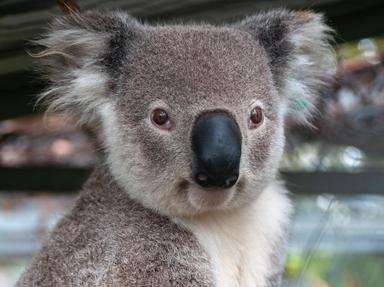
3. Which animal from Australia is grey and eats eucalyptus leaves?
Answer: Koala
Interesting Information:Koalas live in tall, eucalyptus forests. The only states where you would find koalas naturally in the wild are Queensland, NSW, Victoria and South Australia. Koalas are mostly nocturnal and often sleep 18-20 hours per day. A baby koala is called a joey. The joey stays in its mother's pouch for about six or seven months and drinks only milk during this time.
Difficulty: Very Easy.
From Quiz: Which Animal am I?
Some incorrect choices:
Platypus, Echidna, Kangaroo
4. The infamous Australian dog called a dingo has had a negative impact on which local industry?
Answer: Cattle raising
Interesting Information:Dingoes are able to live on many different terrains. They are commonly associated with desert lands but they also live in wetlands, forests and even colder habitats. Dingoes live more populously in areas where cattle raising is heaviest. In fact, the dispersal of dingoes within Australia is almost perfectly aligned with where the most cattle are raised. Dingoes typically prey on cattle and sheep but have also been known to fish. Because of their predatory tendencies, farmers and ranchers in the Outback often hunt dingoes to keep them away from their herds. Dingoes may also be poisoned and dead dingoes are sometimes hung on fences as a further deterrence.
Difficulty: Hard.
From Quiz: Animals of the Outback
Some incorrect choices:
Tourism, Ship building, Cotton
5. The marsupials are a unique group of animals in the mammal kingdom. How can we tell that a mammal is also a marsupial?
Answer: They carry their young in a pouch
Interesting Information:Marsupials carry their young in a pouch for some of their gestation periods. Most Australian mammals are also marsupials, and marsupials are generally found in the Australasian region.
Kangaroos are tiny when they are born, about the size of a jellybean. They normally remain in the pouch except for small periods until around nine months of age. Kangaroos also possess the ability to diapause or suspend the development of pregnancy during times of drought and poor food or water supply.
Difficulty: Very Easy.
From Quiz: The Three Ms - Mammals, Marsupials and Monotremes
Some incorrect choices:
They are Australian, They are brown, They lay eggs
6. In which Australian state was the cane toad first introduced?
Answer: Queensland
Interesting Information:A shipment of around 100 cane toads arrived in Queensland in June, 1935. These toads were bred to increase their numbers and eventually more than 3000 of them were released in northern Queensland. The cane toad spread rapidly and is now found across a broad swathe of Australia, ranging from Kakadu National Park in the Northern Territory to northern New South Wales.
Difficulty: Hard.
From Quiz: The Great Cane Toad Caper
Some incorrect choices:
New South Wales, Victoria, South Australia
7. Known as the brush-tailed marsupial mouse, what am I?
Answer: Phascogale
Interesting Information:Found only in Victoria and Western Australia, I am a small marsupial measuring around 24 cm from nose to tail. I am a very good climber, but find most of my food, small birds, mice and insects, on the ground, and I don't drink, I get all the moisture I need from my food!
Difficulty: Hard.
From Quiz: More Australian Animals
Some incorrect choices:
Pygmy possum, Pademelon, Quokka
8. In America they call it the black widow spider, what do Australians call it?
Answer: Red-Back spider
Interesting Information:Red-back spiders are found throughout the warmer parts of the world including Europe, North America, New Zealand and Australia. Only the female is dangerous. They can cause serious illness and even death. However, no deaths have been reported since the introduction of anti-venom.
Difficulty: Hard.
From Quiz: The Great Australian Bite...Or Sting
Some incorrect choices:
Katipo spider, Hourglass spider, Botton spider
9. What two well known animals are on the Australian Coat of Arms?
Answer: Emu and Kangaroo
Interesting Information:The reason that these two animals were chosen is that neither of them can walk backwards. Hence on the Coat of Arms they are both facing each other depicting a nation that ONLY goes forwards and never backwards.
Difficulty: Easy.
From Quiz: Australian Wildlife
Some incorrect choices:
Wombat and Lyrebird, Koala and Dingo, Kangaroo and Numbat
10. Not every bird flies. Which flightless bird would you be most likely to see in the wild in Australia?
Answer: Emu
Interesting Information:The emu is a flightless bird that can reach up to six feet (183 cm) in height, due in part to its long thin legs. Though the emu cannot fly, it can run at speeds up to 30 mph just under 50 kph). They are relatively common in the wild in Australia. Emus are most active during the day and have a fairly varied diet including insects, grasses, and leaves.
The ostrich is typically seen in Africa in the wild. The kiwi would be found in the wild in New Zealand. The moa is an extinct flightless bird.
Difficulty: Easy.
From Quiz: The Living Things of Australia
Some incorrect choices:
Kiwi, Moa, Ostrich
11. What sweet diminutive creature lives on a diet of nectar and pollen?
Answer: Honey Possum
Interesting Information:The honey possum has a prehensile tail, and is famous for its long snout; the genus name, rostratus, means "beaked" in Latin. Its feeding behaviour is a little like the hummingbird, as its tongue moves rapidly in and out of its mouth, at about three times a second. The animal is endemic to the south-west of Western Australia, and is a talisman animal for some of the traditional owners of that area. They are nocturnal, and feed on flora endemic to the area, namely banksias, bottlebrushes, heaths, grass trees and kangaroo paws.
Difficulty: Very Easy.
From Quiz: Goodbye Tiger
Some incorrect choices:
Hooded owl, Wallaby, Wombat
12. Which animal from Australia has big hind legs and uses jumping as a way of getting around?
Answer: Kangaroo
Interesting Information:There are four kangaroo species: the red, antilopine, eastern grey, and western grey kangaroo. Kangaroos are the national symbol of Australia and appear on postage stamps, coins, and aircraft. The sex of offspring can be determined by the female. When scared, young kangaroos (joeys) sometimes jump head first into their mother's pouch.
Difficulty: Very Easy.
From Quiz: Which Animal am I?
Some incorrect choices:
Bilby, Wombat, Quokka
13. What is the name of the feral horses that populate the grassier areas of the Outback?
Answer: Brumbies
Interesting Information:Brumbies are descendants of horses brought to Australia from Europe. Horses are not normally endemic to Australia. Brumbies, although feral, have been known to be helpful to humans and are sometimes kept as pets and work horses. They are also common sights in horse and pony shows. Brumbies live all over Australia but are more common in the Northern Territory, in areas where the Outback is not as harsh and unforgiving.
Difficulty: Very Easy.
From Quiz: Animals of the Outback
Some incorrect choices:
Grumbies, Mustangs, Ponies
14. The quoll is a small mammal not widely known outside of Australia. They are a nocturnal animal and are carnivorous. Giving birth to live young, the young are carried in a pouch. All land animals who carry their young in a pouch are known as ...?
Answer: Marsupials
Interesting Information:Quolls range from quite small, around 300g to large, around 7 kg. When giving birth, quolls may have up to 18 puppies, but only 6 survive to be suckled.
Marsupials are a class of mammals within the animal kingdom. As well as giving birth to live young, marsupials carry their young within a pouch. Monotremes are a separate, specialist category of mammals. There are only two known living species in the world of monotremes.
Many Australian mammals are also marsupials, including koalas, kangaroos and possums.
Difficulty: Very Easy.
From Quiz: The Three Ms - Mammals, Marsupials and Monotremes
Some incorrect choices:
Possums, Koalas, Kangaroos
15. At what age does a male Eastern grey kangaroo reach sexual maturity?
Answer: two years
Interesting Information:Males reach sexual maturity at two years of age. Females mature a little earlier. Adverse conditions such as drought may delay sexual maturity.
Difficulty: Hard.
From Quiz: Born in the Wild: Kangaroo
Some incorrect choices:
six years, twelve years, eight years
16. Which shark, with the scientific name of Carcharhinus leucas, is generally considered to be the most dangerous to humans?
Answer: Bull shark
Interesting Information:At the cusp of the twentieth and twenty-first centuries, there were only about two fatalities a year due to shark attacks in Australia. Did you know that over 70% of people attacked by sharks live to tell the tale? True.
Sometimes it is impossible to know which type of shark is responsible for an attack (especially in fatalities where the body is not recovered), and that is one reason for some disagreement between authorities. But most agree that the bull shark is more dangerous to humans than any other shark.
Bull sharks (Carcharhinus leucas) are omnivorous; they will eat anything. They are also one of the only sharks that can live for long periods in fresh water. They have been recorded 4000 km away from the ocean in the Amazon River system, and Lake Nicaragua, Central America, is a known breeding ground. This is a fish that hangs out in murky, fresh water, rivers and lakes... just where humans enjoy a good swim. Unfortunately, these sharks enjoy a good human, and they don't need fava beans and a nice Chianti...
Difficulty: Hard.
From Quiz: Killers Down Under
Some incorrect choices:
Tiger shark, White pointer shark (called the great white shark in the U.S.), Nurse shark
17. Dear Mum,
I saw a Southern right whale today! I was amazed to learn that they were called that because they are found in southern waters, and for what other reason?
Answer: They were the right whales to sell at market
Interesting Information:They were considered the right whales to be sold at market, due to the high percentage oil they contain, as well as the fact that they float when dead, making it easier for whalers to locate. Calving mother *do* swim up to beaches to give birth, and sadly, whale do sometimes beach themselves, for reasons unknown.
Difficulty: Hard.
From Quiz: It's Nothing To Write Home About
Some incorrect choices:
They swim anticlockwise, Their right fin is bigger than the left one, They swim right up to the beach
18. To which region are cane toads native?
Answer: The Americas
Interesting Information:Cane toads are native to the southern United States and tropical regions of South America. The cane toads introduced to Australia were shipped to the country from Hawaii. Cane toads can live in a variety of environments from sand dunes to the outskirts of tropical forests and mangroves.
Difficulty: Hard.
From Quiz: The Great Cane Toad Caper
Some incorrect choices:
Eastern Europe, Central Asia, Antarctica
19. What is the most venomous jellyfish in the world?
Answer: Box jellyfish
Interesting Information:The box jellyfish is found in northern Australia where it feeds on small fish and crustaceans. It has up to 5000 stinging cells and if stung you have virtually no chance of survival unless treated immediately. Because the pain is so bad, you are more likely to go into shock and drown before reaching the shore.
There are other types of box jellyfish, but the one to avoid is found in various areas of the Indo-Pacific area, not just off the coast of Australia.
Difficulty: Average.
From Quiz: The Great Australian Bite...Or Sting
Some incorrect choices:
Lion's mane jellyfish, Bell jellyfish, Sea nettle jellyfish
20. This unique animal is a mammal, which has a spiny body and a long snout. It has a long sticky tongue to pick up ants and termites. What Australian animal am I talking about?
Answer: Echidna
Interesting Information:Echidnas are found in grassy and woodland areas with soft soil. They can live in habitats ranging from snow to deserts. If the weather is wet or cold, the echidna will go into a state of torpor and can go without food in that time for 10 to 12 days. When an echidna is scared, it will roll into a ball and reveal only spines. Using its hind legs, it can tip over stones that weigh twice as much as it does. The echidna is depicted on the 5 cent coin.
Difficulty: Average.
From Quiz: Great Australian Fauna
Some incorrect choices:
Hedgehog, Anteater, Porcupine
21. The laughing kookaburra is one of the native Australian birds. What is its diet?
Answer: Small terrestrial animals
Interesting Information:The laughing kookaburra (Dacelo novaeguineae) is an Australian kingfisher. But unlike most kingfishers, it doesn't hunt for fish and crustaceans but for terrestrial animals: small mammals such as mice, small lizards, small snakes (their favourite food), worms and insects.
The laughing kookaburra is about 44cm (17.5 inch) long, with dark brown plumage (spotted in blue) on the back and creamy white undersides. It lives a monogamous life in the eastern part of Australia. The name is derived from their call, which they usually indulge in with the whole family.
The "Australian seven-course meal" is of course a joke: it consists of six pints of ale and a meat pie. This would not be suitable for wild animals (and is also rather unhealthy for humans), because of the high alcohol content.
Difficulty: Hard.
From Quiz: Australian Animals Abound
Some incorrect choices:
Small fish and crustaceans, Fruits, leaves and nectar, An Australian seven-course meal
22. What arboreal possum is also known as the fluffy glider?
Answer: Yellow-bellied glider
Interesting Information:Distributed along a vast part of the coast of the eastern states, the yellow-bellied glider is about the size of a rabbit. The young of the species are cared for by both parents in the den for several months before they are weaned and sent off into the wide world. Their habitat is classified as "at risk" due to the removal of old nest trees, but the animals themselves are not threatened because of their wide distribution.
Difficulty: Hard.
From Quiz: Goodbye Tiger
Some incorrect choices:
Yass bandicoot, Squirrel glider, Sugar glider
23. Which animal from Australia has spines on its back and is classified as having a beak, but not in the traditional sense?
Answer: Echidna
Interesting Information:Echidnas are also called spiny anteaters. Their spines are modified hairs. They prefer alpine meadows, coastal forests and interior deserts. Echidnas only eat termites, ants and other soil invertebrates. They typically breed between July and August.
Difficulty: Very Easy.
From Quiz: Which Animal am I?
Some incorrect choices:
Dingo, Toad, Wombat
24. Venomous mammals tend to be rare around the world, but of course Australia has one of its own. The male members of what Australian species have a venom spur on their hind legs?
Answer: Platypus
Interesting Information:Platypus venom is not lethal to humans but is known to cause excruciating pain. Fortunately, getting stung by a platypus is an unlikely event for most people, as they are reclusive creatures. The males only produce venom during the breeding season and seem to use it in fights with each other rather than to defend against predators.
Difficulty: Average.
From Quiz: Australia's Dangerous Creatures
Some incorrect choices:
Echidna, Koala, Kangaroo
25. The bilby is a small marsupial with big ears that lives in the Outback. How does the bilby stay hydrated in the dry desert heat?
Answer: From its diet
Interesting Information:Like a number of Outback animals, the bilby can obtain enough water from its diet of seeds, fruits and small insects. Water sources are extremely rare in the Outback so this is a necessity. The bilby also keeps cool by burrowing under the ground which has the added benefit of protecting it from predators.
Difficulty: Hard.
From Quiz: Animals of the Outback
Some incorrect choices:
From underwater springs, By drinking its own urine, The bilby does not need water at all
26. This particular creature is semi-aquatic and is the only known Australian mammal to be venomous. A monotreme, it lays eggs rather than giving birth to live young. Which Aussie creature is it?
Answer: Platypus
Interesting Information:The male platypus has a venomous spur on its hind leg which administers a painful sting. When the first specimens of platypuses (no agreement has been reached on how to spell the plural) reached Europe, many naturalists thought that it was a joke or prank animal.
There are only two monotremes (egg-bearing mammals) both of whom are native to Australia.
The other options are all well known Australian mammals and marsupials.
Difficulty: Very Easy.
From Quiz: The Three Ms - Mammals, Marsupials and Monotremes
Some incorrect choices:
Koala, Wombat, Wallaby
27. How long is a red kangaroo's gestation period?
Answer: thirty three days
Interesting Information:Baby kangaroos are called joeys. When a joey is born, it climbs from the birth canal all the way through its mother's thick fur to the pouch on her abdomen, where it will stay for another 190 days. Let's keep in mind that this is a big journey for a baby that is blind, hairless and no bigger than a jellybean.
Difficulty: Hard.
From Quiz: Born in the Wild: Kangaroo
Some incorrect choices:
sixty three days, ninety three days, one hundred and twenty three days
28. What is the cane toad's scientific name?
Answer: Rhinella marina
Interesting Information:Lithobates catesbeianus is the American bullfrog, Anaxyrus terrestris is the southern toad and Ingerophrynus biporcatus is the crested toad, commonly found in Indonesia. Cane toads can range in colour from grey to reddish-brown, with paler-coloured undersides. They are a large species, with adults able to reach sizes of up to 15 cm.
Difficulty: Hard.
From Quiz: The Great Cane Toad Caper
Some incorrect choices:
Lithobates catesbeianus, Anaxyrus terrestris, Ingerophrynus biporcatus
29. Which of these was considered one of the most venomous snakes in the world, until the discovery of the fierce snake...its cousin?
Answer: Taipan
Interesting Information:The taipan is a very highly venomous snake producing approximately 120 mg of venom. A maximum of 400 mg has been recorded, about 50 times more than a cobra. If you are unfortunate enough to be bitten, you will be bitten more than once.
Difficulty: Hard.
From Quiz: The Great Australian Bite...Or Sting
Some incorrect choices:
Cobra, Tiger snake, Brown snake
30. What is the spiky egg laying mammal of Australia called?
Answer: Echidna
Interesting Information:The echidna's spikes are used as protection from predators. Its short sturdy legs and strong claws enable it to burrow beneath the soil as well as a tool for searching out its food of termites and ants.
Difficulty: Average.
From Quiz: Australian Wildlife
Some incorrect choices:
Hedgehog, Houndhog, Echinacea
31. What kind of bird is the Australasian shoveler?
Answer: Waterfowl (Anseriformes)
Interesting Information:The Australasian shoveler (Spatula rhynchotis rhynchotis) is a species of duck living in the southern parts of Australia, in swamp areas with lots of plants. A similar subspecies lives in New Zealand. As a duck, it belongs of course to the waterfowl family, together with geese and swans.
The Australasian shoveler reaches a length of about 50cm (almost 20 inches). It has a mainly brown plumage, while the males have blue-grey heads.
Australian owls include the Christmas Island boobook. The Australian hobby is one of the native falcons. And as for the hundreds of songbirds native to Australia, I'll mention just the superb lyrebird - one of the largest songbirds, and with a fascinating courtship dance.
Difficulty: Easy.
From Quiz: Australian Animals Abound
Some incorrect choices:
Falcon (Falconidae), Songbird (Passeriformes), Owl (Strigiformes)
32. Which group encompasses all of the types of amphibians that are native to Australia?
Answer: Frogs
Interesting Information:All species of native Australian amphibians are members of the order Anura and are therefore frogs. Climate plays an important role in how the various species are introduced. Several species going extinct led to increased efforts of conservation beginning in the 1980s. Frogs are more commonly found closer to the coast as opposed to the drier interior.
Perhaps the best known amphibian in Australia, the cane toad, was introduced by humans in the 1930s to combat pests.
Difficulty: Hard.
From Quiz: The Living Things of Australia
Some incorrect choices:
Toads, Newts, Salamanders
33. Pushed out of its natural habitat into the desert, what once flourishing creature is now thought to be extinct?
Answer: Lesser bilby
Interesting Information:In common with many small Australian native animals, the introduction of foxes and cats had a devastating effect on these creatures. They were also vulnerable to being the prey of dingos. Its habitat was spinifex and cane grass on dunes and sandy plains in northeast South Australia and adjoining southeast Northern Territory. It also lived in the Gibson and Great Sandy Deserts of Western Australia, adjoining the Northern Territory.
Difficulty: Hard.
From Quiz: Goodbye Tiger
Some incorrect choices:
Lyre Bird, Numbat, Quoll
34. Which animal from Australia has a flat wide tail like a beaver and a wide flat bill like a duck's?
Answer: Platypus
Interesting Information:Platypuses can be found in habitats ranging from cold highlands to tropical rainforests. Platypuses are carnivores; they eat worms, shrimp, crayfish, and larvae of insects. They live, sleep, and give birth within tunnels in the riverbank. Platypuses breed between June and October.
Platypuses have no teats. The mother platypus oozes milk from glands on her abdomen and, rather than feeding on teats, the babies suck the milk from her fur.
Difficulty: Very Easy.
From Quiz: Which Animal am I?
Some incorrect choices:
Wombat, Sugar Glider, Bettong
35. What kind of animal is the perentie, which is one of the largest of its kind?
Answer: Lizard
Interesting Information:The perentie is a kind of lizard that is one of the largest in the world. It is sometimes confused for a crocodile given its shape and color. Perenties live primarily in the Australian Outback near loose rocks and soil. They spend the majority of their time underground which means they are very rarely seen. Perenties carry a mild venom that can cause swelling and pain but is rarely lethal to humans. The perentie is probably best known for being used in medicines by ancient Aborigines.
Difficulty: Easy.
From Quiz: Animals of the Outback
Some incorrect choices:
Bird, Fish, Cat
36. The other monotreme of the mammal family also lives in Australia. It looks very similar to hedgehogs found in Europe. Beginning with E, what are they called?
Answer: Echidna
Interesting Information:The echidna is named after a Greek mythological creature believed to be half-woman, half-snake. After a young echidna is hatched, it lives in its mother's pouch for several months, much like members of the marsupial family.
The echidna has been described as looking like a porcupine or hedgehog.
Difficulty: Very Easy.
From Quiz: The Three Ms - Mammals, Marsupials and Monotremes
Some incorrect choices:
Elephant, Egg layer, Porcupine
37. What's the easiest way to tell the difference between male and female red kangaroos?
Answer: body size and colouration
Interesting Information:Male red kangaroos are much larger than the females, standing roughly two metres tall, 2.8 metres long and weighing up to 90kg. Females stand between one and 1.5 metres tall, measure 1.9 metres long and weigh roughly 40kg.
There's also a difference in fur colour. Males are pale or brick red while females are bluish-grey.
Difficulty: Average.
From Quiz: Born in the Wild: Kangaroo
Some incorrect choices:
tail length, they have different shaped ears, there are no differences
38. Dear Mum,
I got laughed at the other day. I was sad, until I realised the one doing the laughing was sitting in an old gum tree, and is the largest kingfisher in the world! Can you guess what was laughing at me?
Answer: kookaburra
Interesting Information:If we go for a picnic a little way past the city environs, we often see kookaburras. If you hold out food (raw meat is best, though they prefer mice or snakes!) they will sometimes swoop down and snatch it from you and keep flying past you up to the nearest tree. They often make sure what you've given them is dead by thrashing it against the tree branch. It's great to watch!
Difficulty: Easy.
From Quiz: It's Nothing To Write Home About
Some incorrect choices:
koala, wombat, All of the above
39. As adults, cane toads are most active during warm weather. At what time is this activity concentrated?
Answer: At night.
Interesting Information:Cane toads are generally nocturnal. When the weather is cold and/or dry, they prefer to find shelter, which they are able to dig for themselves if necessary. They are a hardy species, and can tolerate a temperature range of 5-40 degrees Centigrade.
Difficulty: Hard.
From Quiz: The Great Cane Toad Caper
Some incorrect choices:
Between 6am and 10am., All day., Late afternoon.
40. Showing the least fear of humans, this Australian marsupial mammal that inhabits the southern and eastern coasts of Australia and Tasmania, has teeth strong enough to cut through trees. What is its name?
Answer: Wombat
Interesting Information:The placid, ambling wombat can display a devastatingly bad temper. With extremely powerful jaws and perpetually growing teeth encased in a body that is a solid ball of muscle, a wombat is strong enough to knock over a human and inflict terrible flesh wounds.
Difficulty: Hard.
From Quiz: Australian Animals Attack!
Some incorrect choices:
Tiger Cat, Emu, Tasmanian Tiger
Please remember to credit FunTrivia.com, add links on your website or newsletters, or otherwise spread the word about our website. Thank you very much, and we hope these questions have been useful!
|