|
|
|
Structure
Interesting Questions, Facts and Information
- There are a total of 30 general entries.
|
Interesting Questions, Facts, and Information
Andorra
There is no income tax in Andorra. Viewed as a tax haven, Andorra attracts a lot of tourists, which account for most of the country's income.
What is the name of the peace treaty signed by France and Spain, that resulted in Andorra's independence and which is still in force? | Andorra, The Little Big Country
|
The Pareage. The constant fighting between France and Spain prompted the King of Aragon to force the treaty upon them. The treaty called for Andorra to pay a yearly tribute, called the Pestia to France and Spain alternately. This tribute is still payed.
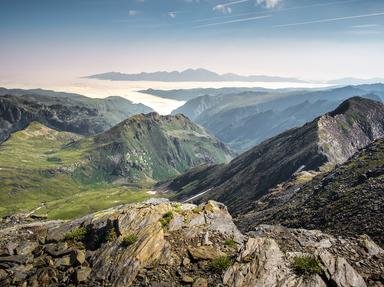
true . Forests of pine and birch trees are found high in the Pyrenees, concern over the maintenance of these forests is a burning issue for the government. Soil erosion from over grazing is also causing concern.
Andorra has no airports. The tiny country has no airports and no rail system, but possesses an excellent road system.
false . Andorra has no military. The defence of the country is the responsibility of Spain and France.
The President of France and the Bishop of Urgel. Andorra pays a regular tribute to the incumbents of each office.
1278. Andorra was declared a free state by Charlemagne in the 9th century. In 1278 it became an independent Principality under the control of France and Spain. In 1993 Andorra's citizens voted to have a new constitution and Andorra was admitted into the United Nations.
A Principality. A parliamentary democracy, Andorra remains a Co-Principality.
Catalan. Although you are probably as likely to hear French, Castilian or even Portuguese being spoken.
Andorra-La-Vella. Set in the centre of the country, this small but beautiful capital city is very near to world class ski resorts.
Fresh streams trickle down the snowcapped mountains and they gradually accumulate into the largest river in Andorra. What is the name of this river? | Admiring Andorra
|
Valira. The Valira begins at two main sources similar to the geography of the Nile but with a different orientation. The names of these two sources are Valira del Nord and Valira d'Orient. These combine at a confluence which is close to the capital city, Andorra la Vella. Furthermore, the Valira is simultaneously a tributary to the river Segre. This is remarkably like the Nile, whereby there are two main tributaries, the Blue Nile and the White Nile which meet near a capital city, Khartoum (Sudan).
In 1997, Andorra saw the opening of a new university - the University of Andorra or in Catalan, Universitat d'Andorra. In which of the constituent regions of the nation could this institute be found? | Admiring Andorra
|
Sant Julià de Lòria. Sant Julià de Lòria is one of the seven parishes that combine to make up the mountainous nation of Andorra. Sant Julià de Lòria is also the southernmost parish sharing a border with the north of Spain. Situated in the region is the bust of an Episcopal Vegeur, Francesc Cairat (1936-1937). In the Catalonian and Andorran regions a veguer was in charge of a vegueria (a feudal territory).
The Andorran capital, Andorra la Vella, which translates into English as 'Andorra the Old' is named as such due to its long and distinguished history. In which century did Andorra la Vella become the principal city of the nation? | Admiring Andorra
|
13th Century. Andorra la Vella became the principal city of the country in 1278 and incidentally, this was the year of their independence. The history of the Andorran capital does indeed go back further than this with the area being protected by Charlemagne, the King of the Franks, in the late 700s. A piece of information I came across that I found interesting is that the city doesn't have an airport! According to Wikipedia the nearest airports are roughly three hours away in French and Spanish cities such as Perpignan and Barcelona.
Just like the atom you think it can't get any smaller but it is soon discovered it actually can as Andorra is split into smaller constituents. What is the name given to the seven smaller communities that make up the European tax haven? | Admiring Andorra
|
Parishes. Just like the US state of Louisiana, Andorra is divided into parishes and the seven parishes are: Andorra la Vella, Canillo, Encamp, Escaldes-Engordany, La Massana, Ordino and Sant Julià de Lòria. Each of these parishes has its own picturesque attractions and holiday resorts which usually involve skiing. Ordino for instance houses the Sorteny National Park whilst Escaldes-Engordany is the venue for an annual festival of jazz.
Andorra's capital is the city of Andorra la Vella. What does the Catalan name of Andorra la Vella actually mean in English? | The Principality of Andorra
|
Andorra the Old. Andorra la Vella is a popular ski resort, due to its elevation in the Pyrenees - it is Europe's highest capital city. Here, the two tributaries of Andorra's biggest river Gran Valira meet to form the river itself. The city was entered by Andorra to be a potential candidate city for the 2010 Winter Olympics, but sadly it wasn't chosen.
Andorra la Vella is quite remote for a capital city - it is three hours' drive away from the nearest airport, and doesn't have a train station!
Roman Catholicism. As much as 90% of the Andorran population is Roman Catholic, although the country has no official religion. The patron saint of Andorra is Our Lady of Meritxell - a statue depicting the Virgin Mary was built by villagers in Meritxell in the 12th century, but was destroyed in a fire in 1972. A replica has been made.
Coat of arms. The Andorran flag consists of three vertical bars; they are blue, yellow, and red. The middle yellow stripe is actually slightly wider than the others. The country's coat of arms is in the center of the flag and contains the Latin phrase "Virtus Unita Fortior", which means "United virtue is stronger".
|