|
|
|
Structure
Interesting Questions, Facts and Information
- There are a total of 20 general entries.
|
Interesting Questions, Facts, and Information
Barbados
Fish and pelican. Technically, the fish is identified as a dolphin fish, but it is drawn to look like a flying fish, with elongated pectoral fins. The fish symbolizes the fishing industry, important for an island nation like Barbados, while the pelican memorializes Pelican Island, which once existed off the coast of Bridgetown. Above the shield is a helmet from which projects a forearm with two crossed sugar-cane stalks in its fist, an acknowledgment of the historical role played by sugar cane in the island's development. The motto "Pride and Industry" appears on a banner under the shield.
All other animals mentioned are found on Barbados, but not on their coat of arms.
Due to its location to the east of the main hurricane zone, Barbados has been relatively free of hurricane damage in its history. What was the last hurricane to cause significant damage to Barbados during the 20th century? | Barbados, Land of the Flying Fish
|
Hurricane Janet in 1955. Most tropical storms form to the west of Barbados, but in 1955 a weak tropical wave moved across the Atlantic in mid-September and was designated a tropical storm on September 21 when it was east of the Lesser Antilles. It developed on the 22nd into a Category 3 hurricane just as it hit Barbados, passing through the Grenadines on the following day. (Hurricane Carol hit New England, and tore down my family's garage, an event which I was too young to notice).
It is thought by some that the Portuguese explorers named the island because of a local tree with long hanging roots. What tree is a possible source of Barbados's name? | Barbados, Land of the Flying Fish
|
Bearded fig-tree. The original Arawak name for Barbados was Ichirouganaim. This was changed by Portuguese settlers to Barbados, meaning 'bearded', but the reason for the choice of name is not clear. One story is that it was based on the hanging roots of the native bearded fig-tree (Ficus citrifolia). It may also have been due to the bearded Caribs living on the island, or to the visual appearance on a map of ocean spray foaming up over the surrounding coral reefs.
Tropical. Barbados is basically a tropical climate, but the constant trade winds off the Atlantic Ocean keep temperatures mild (24-28C, or 75-83F). Humidity is between 72% and 76% all year, with most rainfall occurring between July and December.
The highest point in Barbados is Mount Hillaby, at a towering 340m (1,115ft) above sea level. It is located in a parish (local government area) named after the patron saint of Scotland. Which Barbadian parish is the site of Mount Hillaby? | Barbados, Land of the Flying Fish
|
Saint Andrew. All of these are parishes of Barbados, but Mount Hillaby is located in the northeastern parish of Saint Andrew in a region known as the Scotland District. Saint George and Saint Thomas are the only two landlocked parishes on the island, and Saint Lucy is the northernmost parish.
Trinidad and Tobago. These four nations are the closest to Barbados, but it is Trinidad and Tobago, to the south, which has had a history of fishing territorial disputes. In 1990, Trinidad and Tobago signed a maritime treaty with Venezuela that allocated ocean territory claimed by Barbados to Trinidad and Tobago. In 2004, Barbados took the dispute to binding arbitration under the United Nations Convention on the Law of the Sea. On 11 April 2006, the boundary was set approximately midway between the two countries.
Continental limestone-coral. Because it lies on the continental shelf of South America, Barbados is a continental island, as opposed to an oceanic island. Barbados is part of an Atlantic Ocean submarine mountain range formed during the Cenozoic Era as the Caribbean and South American plates collided and raised the coral reef (formed during the Mesozoic Era after the break from Africa) upwards. Barbados is the only part of the range that rises above sea level.
Western Atlantic Ocean. Barbados is often considered a Caribbean nation, but it is actually located east of the Caribbean Sea, in the Atlantic Ocean. Located at 13 degrees north of the equator and 59 degrees west of the prime meridian, it is the easternmost of the islands often grouped under the title of "West Indies", and is considered part of the Lesser Antilles.
Sightseeing on Barbados is very draining so my final stop will be to sample the oldest brand of rum in the world. What is the name of the distillery where this can be found? | Barbados - The Rum Nation
|
Mount Gay. Mount Gay rum has been made in Barbados since 1703. The modern distillery can be found in the parish of St Lucy at the north of the island, but if you want to sample some of the different varieties before you buy then check out the Mount Gay visitor centre in the parish of St Michael. You will be shown the whole process from when molasses is obtained from sugar cane, right through fermentation and distilling, until you get the chance to taste the finished product at the end. A snifter of rum with the subtle flavours of banana, vanilla, almond and warm spice on a faraway tropical island can be very addictive, so be warned. Hic!
Visiting the island of Barbados in July is a wonderful experience as you get to see the harvest festival which attracts visitors from all over the world. Which festival is this?
| Barbados - The Rum Nation
|
Crop Over . Crop Over is a month long festival held each year between July and August to signal the end of the sugar cane harvest. The more serious folk can look at exhibitions of culture and history behind the sugar cane harvest, but for most it represents a kaleidoscope of colourful art, music, dance and party. The King of Calypso is crowned at "Pic-o-de-Crop". Watch artists and bands from the Caribbean perform at the "Cohobblopot", a large outdoor stage show. Finish the festivities with the "Grand Kadooment", a carnival parade normally held on the first Monday of August.
The warm climate on Barbados is ideal for sightseeing although temperatures during the peak of summer can reach 31C (88F). I am now heading to a forested area in the centre of the island where, if I am lucky, I can watch green monkeys being fed. Where is this shady oasis? | Barbados - The Rum Nation
|
Welchman Hall Gully. Enter into a world of peace and solitude when you visit Welchman Hall Gully in the parish of St Thomas. You can take a gentle stroll through this forest wonderland which is about three quarters of a mile long. See exotic trees and blooms, a nutmeg walk, and not forgetting the stalagmites and stalactites left behind when the caves collapsed to form the gully. Try and spot the native green monkeys as they roam freely, clinging from the canopy of vines and trees, monkeying around as only monkeys can do.
My next stop on this whirlwind tour of the island is to visit the first designated UNESCO World Heritage Site on Barbados. Where am I? | Barbados - The Rum Nation
|
Historic Bridgetown and its Garrison. Bridgetown is in the parish of St Michael and nearby is the old St Ann's Garrison. The garrison dates back to 1704 and features British colonial buildings, the National Cannon Collection, an historic horse racing circuit called Garrison Savannah, and a beautifully restored guard room and clock tower. The old garrison saw the Union Flag of Great Britain being lowered for the last time in 1966 when Barbados became independent.
I move on to my next destination, and as I travel around Barbados I notice road signs pointing towards Cotton Tower, Grenade Hall and Moncrieffe. What are these places of interest?
| Barbados - The Rum Nation
|
Signal Stations. Signal stations were built in prominent places around Barbados which have an expansive view of the land and sea. They were used to warn the islanders, especially plantation owners, of fires and rebellious slave uprisings, as well as ships passing by. Piracy was at its height during the 18th and 19th centuries. The majority of stations were built at the beginning of the 19th century, using flag, light or fire to transmit messages to other stations. The last signal station was closed in 1887, but they remain a popular destination for locals and visitors to climb up and view the stunning scenery.
I am ready for some action after spending a relaxing overnight stay at my hotel so my first trip is back towards Bridgetown to watch a game of cricket. What is the name of the stadium I will be visiting?
| Barbados - The Rum Nation
|
Kensington Oval. The West Indies cricket team, or Windies as they are fondly known, is comprised of players from many Caribbean islands including Barbados, Jamaica, Trinidad and Tobago. They play at different locations which include the Kensington Oval stadium on Barbados. The stadium was host to the 2007 Cricket World Cup final where Australia beat Sri Lanka by 53 runs. Established in 1882, the Kensington Oval has seen many improvements over the years and it currently has a capacity for 28,000 spectators.
I finally arrive at my resort, slightly tired and travel weary. My accommodation is on the south-eastern end of the island next to the beach which has been named one of the ten best beaches in the world. Where am I?
| Barbados - The Rum Nation
|
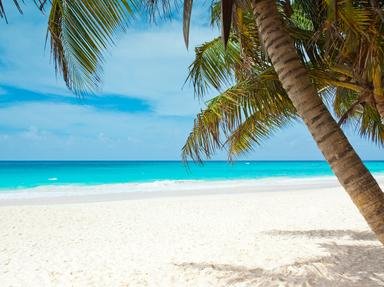
Crane Beach. Barbados has 97 km of beaches. The coastline on the south and east of the island is sandy with clear blue azure waters. Visit the Jolly Roger ship and pretend you are a pirate for the day or explore undersea on the Atlantis submarine, looking for marine life and hidden treasure! The force of the Atlantic along the west coast is ideal for surfers. Alternatively, visit the north coast and take in the rugged cliffs and quiet coves. Crane Beach is a sandy beach safe for swimming which is why it is a popular destination. It was not named after a bird as the title suggests, but after the crane at the top of the cliffs which would haul goods up from passing ships.
As I travel across the island in my taxi, I talk to my driver and I start to get a feel about the place, the friendly warmth of the islanders, and the pride they have for their country. What is the colloquial name for anything which relates to Barbados?
| Barbados - The Rum Nation
|
Bajan. A person born on Barbados is called a Barbadian and anything which relates to the characteristics of the island and its people is called Bajan. This includes the pidgin dialect. English is the national language but the Bajan dialect is more informal, often with the "th" missing from the spoken word. "What is wrong with you?" would translate into "Wuh wrong wid you?"
Travelling from the airport to my hotel, I pass through the city streets of the capital, Bridgetown. Which bronze statue has pride of place in Broad Street?
| Barbados - The Rum Nation
|
Admiral Lord Nelson. Horatio Nelson was famous for his exploits most notably during the Battle of Trafalgar in 1805. As a reminder of his actions, you can find his statue in London as well as Portsmouth in England, Dublin in Ireland, Montreal in Canada, and Bridgetown in Barbados. Nelson visited Barbados in the same year as the great battle. He became a local hero after defeating the French who wanted to take over rule of the islands of the Caribbean.
This is the first day of my holiday and I have just arrived on Barbados. Which international airport did I arrive at?
| Barbados - The Rum Nation
|
Grantley Adams International Airport. The airport is located in Christ Church which is at the southern end of the island. Formerly known as Seawell Airport, the name was changed in 1976 after the first Premier of Barbados, Sir Grantley Herbert Adam. The airport is the ninth busiest in the Caribbean with just over 2,000,000 visitors each year walking through its gates. For anyone interested in aviation history, the airport has a Concorde museum which houses a retired Concorde on display.
|