
Register New Player - Log In
Welcome to our world of fun trivia quizzes and quiz games:     New Player quiz register Play Now! trivia game
Fun Trivia : Costa Rica Encyclopedia FunTrivia

Structure

fun facts,factoids,info

Interesting Questions, Facts and Information

  • There are a total of 20 general entries.

Interesting Questions, Facts, and Information

    Costa Rica

    Which is the most noted natural resource of Costa Rica?Costa Rica Main

      Hydro power. Hydro power is a very important natural resource in Costa Rica. It is abundant and an example is the Represa of Cachi, that produces this kind of energy.

    What is the highest point in Costa Rica?Costa Rica Main

      Cerro Chirripo. Cerro Chirripo's highest point is 3810 meters high.

    Does Costa Rica have deserts?Costa Rica Main

      No. All over Costa Rica it is very rainy. There are no deserts in Costa Rica nor in Central America. Costa Rica has beaches, rain forest, industrial zones, land for farming, and urbanizations or neighborhoods.

    Which is the total area (including land and water) of Costa Rica?Costa Rica Main

      51100 sq km. The area of Costa Rica is 51100 sq km counting water. It is because of Islas Del Coco that C.R. has so many extensions. In land area, Costa is the third smallest country in Central America, after El Salvador and Belize.

    Which provinces are on the Pacific coast of Costa Rica?Costa Rica Main

      Guanacaste and Puntarenas. Guanacaste, Limon and Puntarenas are by the ocean, but the Limon province is on the Atlantic coast.

    What is the highest of Costa Rica`s volcanoes? Costa Rica Main

      Irazu. Barva is not so famous as Arenal, that is always active. It is on the lands of Alajuela.

    What is the main army of Costa Rica called?Costa Rica Main

      They do not have an army. Costa Rica is known for being one of the few countries that do not have an army. The army was abolished in December 1, 1948 by president Jose Figueres Ferrer. It was the first country to abolish its army constitutionally. Fuerza Publica is the police organization that protects the country. Also, the United States is committed to defending this land of Costa Rica if something would ever happen.

    Which two countries border Costa Rica?Costa Rica Main

      Nicaragua and Panama. Costa Rica borders Nicaragua to the north and Panama to the south.

    How many provinces does the country Costa Rica have?Costa Rica Main

      7. There are seven provinces: Limon, San Jose, Alajuela, Cartago, Heredia, Guanacaste and Puntarenas.

    What is the capital of Costa Rica?Costa Rica Main

      San Jose. San Jose is the capital of Costa Rica. First it was Cartago, but it changed. San Jose is now the most developed province of the country.

    The national animal of Costa Rica is the Odiocoileus virginiansus truei, shown here. By what name is this animal more commonly called?Republic of Costa Rica

      White-tailed deer. While the white-tailed deer is more commonly associated with North America, especially the eastern part of the United States, there are a number of subspecies found as far south as Peru. The Central American white-tailed deer, a female of which is pictured here, is found primarily in Costa Rica and Nicaragua. The other options are among the national animal symbols of Mexico. The national bird of Costa Rica is the clay-colored thrush, which can be found between southern Texas and northern Colombia. The national flower is a type of orchid called 'Guarianthe skinneri', the national tree is the Guanacaste, and the national instrument is the marimba, which resembles a xylophone.

    The description of the Costa Rican coat of arms includes "All surrounded by a golden frame representing the golden bead (_____)." Which agricultural product, one of the mainstays of Costa Rica's economy in the 19th and 20th centuries, is being alluded to?Republic of Costa Rica

      Coffee. The first coffee plantations in Costa Rica were established in the early years of the 19th century. By the time of independence in the middle of the century, coffee exports to Europe were the country's major source of income. It remained an economic mainstay, although banana production increased dramatically in the 20th century, providing an economic rival. In the 21st century Costa Rica is developing ecotourism as a source of income, trading on the nation's richly varied wildlife. Costa Rica has 26 national parks and over 150 other protected areas, comprising over a quarter of the country's land and water areas.

    What is the English language translation of the first line of the Costa Rican national anthem, "Noble patria, tu hermosa bandera"?Republic of Costa Rica

      Noble homeland, your beautiful flag. The first verse in its entirety translates as: "Noble homeland, your beautiful flag / Expression of your life it gives us: / Under the limpid blue of your skies, / Peace reigns, white and pure". The red, white and blue colors of the flag were inspired by the colors of the French flag. The original design was made by Pacifica Fernandez, the wife of Costa Rica's first president when the country separated from the Federated Republic of Central America in 1848. The coat of arms was added in 1906. As is the case for many national flags, the colors are said to represent a variety of things (possibly in the hope that everyone will find something in the list with which they can identify). The blue is said to stand for the skies overhead, idealism, opportunities and perseverance - concepts which can be related with a bit of imagination. The white represents peace, wisdom and happiness, while the red is said to remind us of the contrasting concepts of the blood spilled in defense of the country and the warm and generous spirit of the people of Costa Rica.

    Costa Rica has four relatively active volcanoes, all located in the Central Range. What is the name of Costa Rica's highest volcano?Republic of Costa Rica

      Irazu. The diagram shows a cross-section of the relevant part of the Central Range. All of these volcanoes either have erupted since European colonization, or exhibit ongoing signs of fumarole activity - geysers, thermal springs, steam vents, etc. The highest of them is Irazu, with a height of 3432 m (11,260 ft). Its size and frequent eruptions (the most recent in 1963-1965), along with the extensive damage they cause, have led to its nickname of 'El Coloso" (The Colossus). Irazu has five craters, one of which contains the popular tourist destination of a green crater lake called Diego de la Haya. The peak is also used for television transmitters, a 20th century development.

    Costa Rica includes a number of islands, mostly near the coast. What island, located around 550 km (350mi) out in the Pacific and pictured on several Costa Rican banknotes, is the furthest point of the country? (If the picture here isn't clear, try looking at Q3 again.)Republic of Costa Rica

      Isla del Coco. Isla del Coco, or Cocos Island, lies in the Pacific Ocean around 550 km offshore from Costa Rica. It is the 11th district in the Puntarenas canton of the province of Puntarenas, and is a national park. The only residents are park rangers, but it is a popular tourist destination for scuba divers. It has been conjectured that this island was the model for Daniel Defoe's description of the island on which Robinson Crusoe was marooned, and that it may have been the inspiration for the island in Michael Crichton's "Jurassic Park". Isla Calero, Costa Rica's largest island, is in the San Juan River, which forms a large part of the border between Costa Rica and Nicaragua. It has been the subject of some territorial disputes. Isla Damas, in the Pacific Ocean near the city of Quepos, is popular with tourists who take boat rides through its rivers and estuaries to observe the abundant wildlife of the region. Isla San Lucas, formerly a prison, is a National Park.

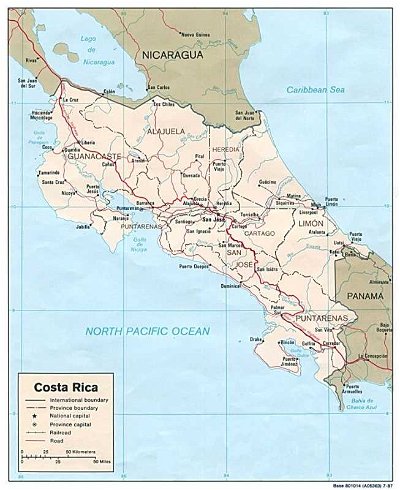
    Like most countries, Costa Rica is divided into smaller political units for purposes of local government. These are called provinces, cantons, and districts. Into how many provinces is Costa Rica divided?Republic of Costa Rica

      Seven. There are seven provinces (as shown on the map, with each one in a different color). The province of Puntarenas is unusual in that it has three separate regions, one stretching along the mainland for most of the Pacific coast, one on the Nicoya Peninsula, and one incorporating the offshore island of Cocos. The provinces do not have elected local governments - this second tier of government acts at the level of the canton, of which Costa Rica has 81, each controlled by a mayor and a council of canton representatives chosen in municipal elections.

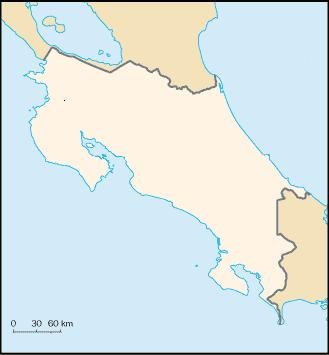
    This map shows the Central American country of Costa Rica, a name meaning 'Rich Coast'. What bodies of water provide its eastern and western borders?Republic of Costa Rica

      Pacific Ocean on the west, Caribbean Sea on the east. Costa Rica's extensive coastline on the Pacific Ocean includes the colorfully-named Golfo de Papayago (Gulf of the Parrot), currently being developed for tourists, and the large Golfo de Nicoya, which is one of the region's major fishing grounds. Most of the luxury resort areas are found along the northern stretch of the Pacific coast, in the province of Guanacaste. The Caribbean coast is popular for the excellent spring surfing.

    This map shows the Central American country of Costa Rica. What are the two countries with which it shares land borders?Republic of Costa Rica

      Panama and Nicaragua. The countries of Central America are Belize, Guatemala, El Salvador, Honduras, Nicaragua, Costa Rica and Panama. Costa Rica is nestled between Nicaragua on the north and Panama on the south. The large lake visible near the northern border of Costa Rica is Lago de Nicaragua.

  • All content is (C)opyright 1995-2006 FunTrivia.com. Content may NOT be copied, reprinted, or distributed without our written consent. Feel free to link to any page you wish.

  • While we try to keep trivia as accurate as possible through a regular volunteer editing process, FunTrivia cannot guarantee the validity of the information found here. FunTrivia offers no professional advice, and you take all responsibility for your use of anything contained herein.
  • Feel free to send a note to a particular item's author for further details or source information; most of our authors love to hear feedback about their work.
  • See our conditions of use for details.