

Answer: El Cocodrilo (The Crocodile)
Sometimes it is also called 'the laughing crocodile'. I suspect the mouth is on the western side, just south of Havana.
From Quiz: Facts About Cuba
Answer: Havana
Havana is also the largest city in the Caribbean with a population of two million.
From Quiz: Cuba, The Island Nation
Answer: Nickel
Although nickel is the most important natural resource that Cuba exports, the country also is the fifth-largest exporter of cobalt, a byproduct when mining the nickel. Cuba was once covered in large forests of valuable timber, but they were cleared to build sugarcane plantations as early as the sixteenth century, so wood is actually imported into the country. There is some petroleum available on Cuba's northern shore as well, although it's low quality.
From Quiz: A Caribbean Mystery: Cuba
Answer: Claves
Claves are really the simplest instrument imaginable. It is amazing, however, how many different ways they can be played. Timbales are explained in question 1. The Guiro is a scraper played with a stick. Maracas are bean-filled bulbs and you shake them to play them.
From Quiz: A Lo Cubano
Answer: Asere
'Amigo' is just plain Spanish, 'Che' is what everybody calls everybody else in Argentina and 'Companero', while used in Cuba, means 'comrade' and is not widely used in the meaning of 'friend'.
From Quiz: Facts About Cuba
Answer: 16
Pinar del Rio, Artemisa, La Habana, Ciudad de la Habana, Cienfuegos, Camaquey, Sancti Spiritus, Santiago de Cuba, Granma, Las Tunas, Matanzas, Guantanamo, Villa Clara, Holquin, Mayabeque, Ciego de Avila are the provinces. The Isle of Youth is considered a special municipality.
The province of Artemisa was added in 2010.
From Quiz: Cuba, The Island Nation
Answer: Rueda de Casino
Rueda is 'wheel' in Spanish and Casino is the Cuban style of Salsa dancing. 'Linea de Mambo' and 'Circulo Sabroso' are my inventions, as is 'Baile de Cuadro', a wild literal translation of 'square dance'.
From Quiz: A Lo Cubano
Answer: La Habana
'Havana' is the English version, 'Havanna' the German one and Santiago de Cuba is not the capital, although it used to be. La Habana is always used with the article, much like 'Den Haag' in the Netherlands.
From Quiz: Facts About Cuba
Answer: red, white and blue
From Quiz: Cuba, The Island Nation
Answer: Casino
Tough one. All answers are Cuban dances, but only Casino is the modern Salsa one. Cha Cha has been around since the 1950s. Bolero is not danced to Salsa, but rather to - you guessed it - Bolero (NOT Ravel's opera). Rumba has nothing to do with the latin dance of the same name (which is actually much like bolero), but means party.
From Quiz: A Lo Cubano
Answer: Camello (Camel)
They're called Camello because of the hump in the middle, making getting in easier. Cocodrilo is what Cubans call their island due to its shape. Tocororo is Cuba's national bird, since its feathers reflect the red, white and blue of the national flag. Elephant is just an invention of mine, although Camellos are pretty large and impressive.
From Quiz: Facts About Cuba
Answer: 1961
The Bay of Pigs invasion was in 1961. April 17th, 1961 to be exact. The pre-emptive airstrikes on Santiago de Cuba were flown on 15 April, 1961 by Gonzalo Herrera and Angel Lopez. See the book Operacion Puma by Eduardo Ferrer for more details.
From Quiz: Cuba, The Island Nation
Answer: Maine
The sinking on the Maine on February 15, 1898, led to the beginning of the Spanish-American War. Almost 275 men died as a result of the explosion. Although no one knows the exact cause of the explosion the ship's sinking led to many Americans calling for going to war with Spain.
From Quiz: Cuba, The Island Nation
Answer: Cigars
Cuban cigars are world-renowned, and up to 70% of Cuba's tobacco is produced in the Pinar del Rio. The most acclaimed tobacco is grown in the city of San Juan y Martinez at the very end of the island's "hook". In addition to tobacco, the Pinar del Rio's economy is bolstered by tourism. The Vinales Valley was designated a World Heritage Site in 1999 because of geological wonders, especially hills of limestone often called mogotes. These cliffs are found almost exclusively in the Caribbean and most often in Cuba. Scuba diving off the western coast in the Gulf of Mexico is also popular.
From Quiz: A Caribbean Mystery: Cuba
Answer: Argentina
Ernesto Guevara was born in Argentina in 1928. He became a medical doctor in Buenos Aires before joining Castro's (whom he had met in Mexico) struggle against the dictatorship in Cuba. Che Guevara was shot in Bolivia in 1967.
From Quiz: A Lo Cubano
Answer: Palestinos (Palestinians)
Mulato is the word for brown-skinned Cubans, whom you'll find everywhere in Cuba. Sudaca is the name given to South American immigrants in Spain. It's mainly used as a derogatory term (SUD AmeriCAno). Ranas is simply my invention.
From Quiz: Facts About Cuba
Answer: 2
Thet are the Cuban peso (CUP) and the Convertible peso (CUC)
From Quiz: A Lo Cubano
Answer: Tout
While 'jinetera' ('jockey') means a woman or girl who could with a narrow mind be called a prostitute, the male term is used for the kids who on the street try to sell you everything from cigars to their sister. A male prostitute is a 'pinguero' or 'chulo'.
From Quiz: Facts About Cuba
Answer: Cuban Trogon
The Trogon's feathers are the same color as Cuba's red, white and blue flag.
From Quiz: Cuba, The Island Nation
Answer: The US government does not allow Americans to spend money in Cuba
Technically, US citizens are allowed to travel to Cuba, they just can't legally spend any money there due to the Trading with the Enemy Act of 1917 and the Helms-Burton Act. The thing about danger is hogwash. Cuba is considered the safest country to travel in Latin America.
From Quiz: A Lo Cubano
Answer: Timba
Son, while Cuban and certainly en vogue again, is anything but modern. Bolero is a slow dance while it can feel hot to get that close to your partner, it's been around for a while. Merengue is hot, but from the Dominican Republic.
From Quiz: Facts About Cuba
Answer: Pinar Del Rio
Pinar del Rio raises about 70% of the tobacco used to manufacture Cuban cigars. Tourism is also big business as people travel here to visit the many caves in the area as well as the beautiful mountains and valleys.
From Quiz: Cuba, The Island Nation
Answer: Because it is a scaled-down replica of the Capitol in Washington, D.C.
The Capitolio, built in 1929, was modeled after its US counterpart. All other answers are mere figments of my imagination.
From Quiz: A Lo Cubano
Answer: Havana Club
Havana Club (I recommend the Anejo Reserva) is the most widely drunk rum in Cuba. Bacardi was founded in Cuba in 1862 in Santiago de Cuba, but left the island for Bermuda after the Revolution confiscated its assets. Paticruzado ('crossed legs') is a rum found mainly in the Oriente, but it's not the most popular brand. Cristal IS the most popular, but beer.
From Quiz: Facts About Cuba
Answer: Cojimar
From Quiz: Cuba, The Island Nation
Answer: La Rampa
La Rampa has become famous even to people who've never been there through the 1993 Cuban movie 'Fresa y Chocolate'. A central venue of this love story of two men is the Coppelia ice cream parlor right on calle 23. The Malecon is the run-down beach promenade all along the waterfront of Havana. El Prado is the old name of Habana Vieja's Paseo de Marti, perpendicular to the Malecon. Vedado is the name of the district the Rampa is in.
From Quiz: A Lo Cubano
Answer: Casa Granda
The correct name is 'Casa Granda', as can be seen on the sign at the corner and on the official web site. Interestingly, a Google search for 'casa grande santiago de cuba' yields about 20 times as many results as for the correct 'casa granda santiago de cuba'. Las Americas and Santiago are both hotels in Santiago de Cuba, but both off the city center.
From Quiz: Facts About Cuba
Answer: Yes
There is an active Chinese community in Havana. Chinatown is the home of many fine Chinese eateries.
From Quiz: Cuba, The Island Nation
Answer: In La Bodeguita del Medio
Ernest Hemingway, who lived in Havana in the 1930s, wrote: 'Mi Mojito en La Bodeguita, mi Daiquiri en El Floridita'. These were the two bars he used to oscillate between. His novel 'The Old Man And The Sea' was inspired by the fishing village of Cojimar, east of Havana.
From Quiz: A Lo Cubano
Answer: Santiago de Cuba
Santiago de Cuba is on the southeastern coast. A popular tourist city, it is near San Juan Hill where Teddy Roosevelt led his famous charge.
From Quiz: Cuba, The Island Nation
Answer: Baracoa is home to Cuba's largest movie theater
The only movie theater in Baracoa is a TV set in a hotel lobby. All other statements are true. When the Cacique Indian Hatuey, who is commemorated by a statue in Baracoa, and a beer brand, was captured by the Spanish, he was given the choice to live under Spanish rule (heaven) or being burned at the stake (hell). He chose the latter.
From Quiz: A Lo Cubano
Answer: Varadero
Varadero is famous for its white sandy beaches.
From Quiz: Cuba, The Island Nation
Answer: Fort
Known as La Cabaña, Fortaleza de San Carlos de la Cabaña (Fort of Saint Charles) was established in the 18th century by the Spanish who had just regained the land from the British in exchange for Florida. Now it is a complex housing several museums.
From Quiz: A Lo Cubano
Answer: John Lennon
From Quiz: Cuba, The Island Nation
Answer: Because they are the only ones people may legally own
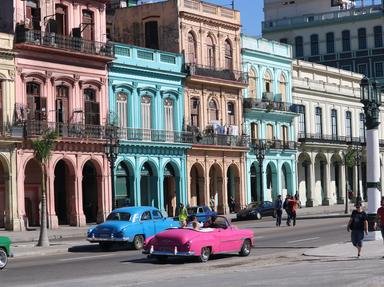
All the more modern Lada and Hyundai cars you see in Cuba are state owned. Only pre-1959 cars seized from their original owners can be privately held and resold. Many of them have Russian truck engines under the hood while others are held together by chicken wire and duct tape.
From Quiz: A Lo Cubano
Answer: Pope John Paul II
The Pope's visit opened the way for the Cuban people to openly celebrate Christmas for the first time in many years.
From Quiz: Cuba, The Island Nation