
|
|
|
Structure
Interesting Questions, Facts and Information
- There are a total of 40 general entries. We are selecting 30 for display.
Special Topics
|
Interesting Questions, Facts, and Information
Czech Republic
In what year did Warsaw Pact troops invade Prague, to end the people's protest against the Soviet influence in Czechoslovakia? | Czech Republic Trivia
|
Four. Austria, Germany, Poland and Slovakia
The future Prague in all its greatness. Smetana wrote a great opera on this theme, one of the most popular Czech myths.
Prague. This battle signalled the beginning of hard times for the Czechs.
The highest mountain in the Czech Republic. You can walk up Snezka, but be prepared for a real climb.
Karlovy Vary. It's a world-renowned spa and a real jewel-box of a town. Don't miss the steaming river!
Plzen. Budvar (the original Budweiser) comes from Ceske Budejovice.
St. Barbara. Chram svate Barbory translates into Saint Barbara's Church. This UNESCO world heritage site is one of the most famous Gothic churches in Europe. It was dedicated to St. Barbara, who is the patron saint of miners (as the town's economy has always been based on silver mining). This magnificent building dates to 1388 and was not considered finished until 1905. The stained glass, flying buttresses, and medieval frescoes make this church worthy of a spot on anyone's tour itinerary.
Carbon dioxide springs. Marianke Lazne is a spa town located in the far western area of the country. The springs are first mentioned in a 1341 document that states that they are the property of the Tepi Abbey. In the late 18th century the springs were opened up to the public who believed that they had restorative and curative powers. Many famous people have used these natural springs to bathe in, including Goethe, Chopin, Edison, Czar Nicholas II, and King Edward VII. There are over 100 springs in the area. Some are used for bathing and others are used exclusively for sale as mineral water.
Catholicism. Built between 1716-1754, The Holy Trinity Column in Olomouc is a spectacular monument built in gratitude after the end of a plague. Listed as a UNESCO World Heritage Site in 2000, this column was built by local Catholic artists and craftsman. It has numerous depictions of saints who are related to the city in some way. The column also contains a small chapel with many religious carvings on the walls and the ceilings. Located on the eastern part of the country on the Morava River, this city has many wondrous sites to see, including Saint Wenceslas Cathedral, built in Jeffrey 1107, and the Olomouc Astronomical Clock.
Eesky Krumlov Castle. The Czech Republic has many beautiful castles. Among these is the Eesky Krumlov Castle, built in the late 13th century near the Vltava River. The castle and the surrounding town were owned by the House of Rosenberg until they were bought by Emperor Rudolf II in 1602. Located in the southern part of the country, this castle and the surrounding town are a wonderful mixture of Gothic, Baroque, and Renaissance styles. This beautiful and historic city is one of the most popular tourist destinations in the country. If you visit, don't forget to bring your camera!
Pilsner. The city of Plzeň lends itself to a type of pale lager known as pilsner. This drink has a fairly low alcohol level, and has a slightly sweet taste. The city of Plzeň has had breweries since the 13th century. The brewing of beer has been an integral part of area cultures for centuries. After touring the hops fields in the area, a nice pilsner might be just the thing to wet your whistle. After you've done this tour, you might be interested in touring the underground tunnel system that runs throughout the town. The tunnels were constructed in the 14th century for defence, and to hide and transport pilsner.
Prague. The Dancing House, located in the capital city of Prague, is a must-see for any visitor to the country. The real name of the building in the Nationale-Nederlanden building. The unusual design of the building has led to nicknames such as the Dancing House, the Drunk House, and Ginger and Fred. This eight-story building twists and turns and almost appears to move. It is just one of the many wonderful attractions to be found in Prague.
Bohemia. The Adrspach-Teplice Rocks are an area of unusual rock formations that look like giants have piled rocks on top of each other in a manner similar to a child playing with blocks. Well-marked paths will take you through pristine wooded areas to these out-of-place formations that have become extremely popular with rock-climbing enthusiasts. This area has also become one of the largest permanent breeding grounds of the magnificent Peregrine Falcon.
Puppets. Puppet shows are a big part of Czech culture. This museum is housed in a Gothic building which was, at one time, the Church of St. Jobst. It is home to the largest puppet collection in the world. It contains a large theater in which marionette shows are put on daily. The puppets found here are very elaborate works of art. Puppetry in the Czech Republic is a form of adult entertainment as well as a form of children's entertainment, and is a source of much national pride. Numerous puppet festivals are held around the country throughout the year.
This question concerns not a place but an event. The area covering Moravian Slovakia has a unique culture of song and dance. The local dance (best seen during Lody- annual folk festival) is an all-male affair. Although it is improvised, it still adheres to strict choreographic rules. What is this event? | UNESCO: The Czech Republic - What Do You Know?
|
The Slovacko Verbunk (Dance of Recruits). Performed by the men and boys living in the South Moravia and Zlin areas, the dance's name is derived from the German word "werbung" (changed into "verbunk"), meaning "recruitment". Historically, it was used to recruit dancers and soldiers for the military during the 18th century.
Designed by Prague architect Giovanni Blasius Santani, this building has a unique five pointed star structure with five exits. The main altar depicts five angels, whilst the side altars are devoted to the four evangelists. Dedicated to St. John of Nepomuk, which building is it? | UNESCO: The Czech Republic - What Do You Know?
|
The Pilgrimage Church of St. John of Nepomuk. This church can be found in the town of Kutna Hora. It was designated a World Heritage Site in 1993.
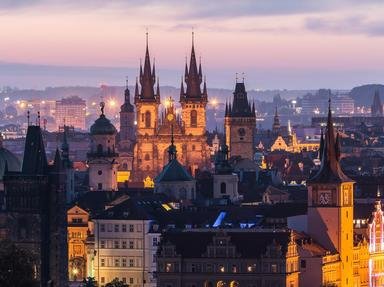
The capital of the Czech Republic, this historical centre is more than ten centuries old. An anonymous poet described this city as "a symphony in stone" and "a city of a hundred spires". Which city is it? | UNESCO: The Czech Republic - What Do You Know?
|
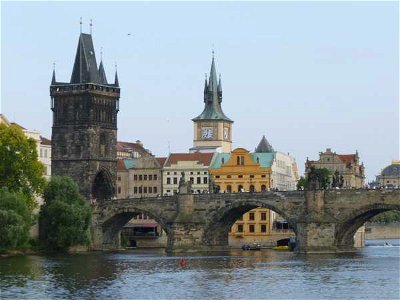
Prague. Prague is a city full to bursting with historical, cultural, architectural and natural attractions. For instance, Prague Castle is, according to "The Guinness Book of Records", the largest castle in the world. Founded in the second half of the 9th century, it was formerly the home of royalty. In modern times, presidents have resided there.
Spread between the small towns of Lednice and Valtice, this Baroque complex of buildings displays various architectural styles set amongst the woods and ponds. There are also plenty of hiking and biking trails. Where is it? | UNESCO: The Czech Republic - What Do You Know?
|
The Lednice-Valtice Area. The Lednice-Valtice Area area combines unrivaled natural scenery with two beautiful chateaus. Created by the Liechtenstein family, the Lednice-Valtice Area has been posited as "the largest man-made area in Europe". The Dyje River forms the northern and eastern borders.
At the turn of the 14th and 15th centuries, this city was the richest and most powerful place in Bohemia, and was the seat of King Vaclev IV. This importance was largely due to the famous local silver mines. Two of the many cultural events taking place in this city are the St. Wenceslas Winemaking Festival and The Silver Mining Festival. Which city is this? | UNESCO: The Czech Republic - What Do You Know?
|
Kutna Hora. Two of the great buildings you can see in Kutna Hora are the Cathedral of St. Barbara and the Cathedral of The Assumption of Our Lady. The latter was founded around 995 AD, and as such is the oldest Cistercian monastery in Bohemia.
This place is in South Bohemia, and is a living monument to tradition. It is comprised of 23 estates (120 houses) with painted South Bohemian folk baroque gables at the front. At the rear, the gardens are all situated around a central pond. Where is this? | UNESCO: The Czech Republic - What Do You Know?
|
Holasovice. This perfect example of a medieval eastern village appeared in the film "The Bartered Bride" based on Smetana's opera. Every year, on the next to last weekend of July, the so-called "Peasant Celebrations" take place. It's a typical old Czech fair where over 230 traditional crafts are displayed.
In which town will you find the Festival of the Five-Petalled Rose every August? There is also an International Music Festival held in this town, which is situated about 180 km south of Prague. | UNESCO: The Czech Republic - What Do You Know?
|
Cesky Krumlov. Cesky Krumlov is also known as Krumau in German (which translates as "place on a crooked meadow"). Incidentally, the first written reference to the town appeared in the 15th century under the name Chrumberiouwe.
|