
Register New Player - Log In
Welcome to our world of fun trivia quizzes and quiz games:     New Player quiz register Play Now! trivia game
Fun Trivia : Kosovo Encyclopedia FunTrivia

Structure

fun facts,factoids,info

Interesting Questions, Facts and Information

  • There are a total of 10 general entries.

Interesting Questions, Facts, and Information

    Kosovo

    A significant aspect of Kosovo's population is its ethnic diversity. The flag designed for the Republic of Kosovo acknowledges this by displaying a star to represent each of the region's principal ethnic groups. How many stars are on this flag?Exploring Kosovo

      6. The flag, produced from an international competition, is based on a design by Muhamer Ibrahimi, with a silhouette of Kosovo topped by six stars arranged in an arc. The Kosovan ethnic groups being referenced are Bosniak, Gorani, Roma, Turk, Ashkali and Egyptian. In 2009, the CIA World Factbook listed the ethnicity of Kosovo as 88% Albanian, 7% Serbian, and 5% Others. Many members of the Serbian minority live in enclaves in North Kosovo, a region that functions for a large part independently of the rest of Kosovo. Before the declaration of independence in 2008, Kosovo was under the administration of the United Nations, and used the UN flag for official purposes. Serb residents also used a tricolor similar to the current flag of Serbia, while the Albanian population used the flag of Albania.

    The town of Gadime, 15 km (9 mi) south of the Kosovan capital of Pristina, is the site of another major tourist attraction. Gadime caves are described as a marble cave system with aragonite speleothems in its northern passage. What will you see in the northern passage?Exploring Kosovo

      Stalactites and stalagmites. Aragonite is a form of calcium carbonate that makes more spectacular crystals than the usual calcite found in most caves. A speleothem (from the Greek for 'cave deposit') is a general term for the variety of mineral formations formed as overlays to the basic structure of a cave. They include stalactites, stalagmites, columns, flowstone and cave crystals. Gadime Cave is known for some sensational formations. There is reputed to be an underground lake the size of a football field in the cave system, but it is not open to the public. The cave temperature is described in various sources as cold or warm - it's a matter of opinion how to describe the fairly constant temperature of 16 C (61 F) inside the cave system.

    The city of Pec is located near the source of the White Drin, close to the border with Montenegro. It is also near the Rugova Gorge, which was declared a Protected National Monument in 1988. What draws tourists to this canyon?Exploring Kosovo

      Caves that used to be used as hermit cells. The city name, Pec, means furnace or cave in Serbian, and its name is probably connected with the caves which were used by Orthodox monks as hermit cells from the 12th century. Tourists can also travel 12 km (7 mi) south from Pec to visit the Visoki Dečani, a medieval Orthodox monastery famed for its well-preserved frescoes, which has been listed on UNESCO's World Heritage List. The Rugova Gorge is one of Kosovo's most prominent geological features. Formed by the Pecka Bistrica River ('Clearwater of Pec'), a tributary of the White Drin, the canyon is 25 km (16 mi) long and up to 1000 m (3281 ft) deep. The upstream part of the canyon is the glacial trough of the former Rugovo glacier. The gorge has been carved through layers of limestone, slate, marble and serpentine. the road connecting Kosovo with Montenegro goes through this gorge on its way to the Cakor Pass.

    The capital and largest city of Kosovo, Pristina, used to have a river flowing through it. What happened to the Pristevka River during the 1950s?Exploring Kosovo

      It was diverted to underground tunnels.. The city of Pristina was 'developed' during the 1950s. The process included demolishing entire sections of the city, including the region's largest covered market, a Catholic church, a mosque, a synagogue, and a number of other historically-significant buildings. At the same time, the Pristevka and Vellushka Rivers were covered over in the interests of hygiene. They still flow, but are contained in underground tunnels as they pass through the city, and are only seen above-ground in the suburbs.

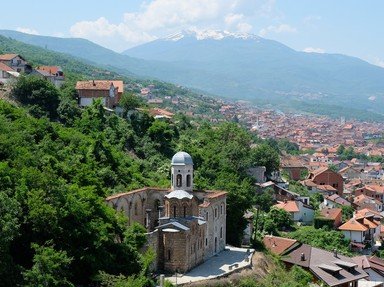
    Much of the area of Kosovo is mountainous. Deravica, its highest peak, is in the southwest, near the border with which neighboring state?Exploring Kosovo

      Albania. Deravica (2,656 m or 8,714 ft above sea level) is in the Prokletije (sometimes known as the Accursed Mountains), part of the Dinaric Alps, on the border with Albania. It is easier to climb than most other mountains in the region, and has a number of glacial lakes near its summit. The largest of them, Deravica Lake, is the source of the Erenik River. The Sar Mountains, bordering the Republic of Macedonia in the southeast, are a more popular tourist destination, with several skiing resorts as the main attraction.

    Kosovo is located on one of Europe's major peninsulas. On which peninsula can it be found?Exploring Kosovo

      Balkan Peninsula. All of Europe is sometimes considered to be a peninsula of the Eurasian landmass. The four largest peninsulas within Europe are the ones listed here. The Balkan Peninsula, in southeastern Europe, is surrounded on three sides by the Adriatic, Ionian, Aegean and Black Seas. Its northern boundary can be defined by the Danube, Sava and Kupa/Kolpa rivers. "The Balkans" is a term used to describe not only the Balkan peninsula (which includes the countries of Albania, Bosnia and Herzegovina, Bulgaria, Greece, Kosovo, Macedonia, and Montenegro), but also nearby regions that were still under Turkish rule in 1808 despite the ceding of significant portions of the Ottoman Empire to Austria in1699. About two-thirds of Serbia and half of Croatia and Slovenia are on the peninsula proper; portions of Italy, Moldova and Turkey are also sometimes included.

  • All content is (C)opyright 1995-2006 FunTrivia.com. Content may NOT be copied, reprinted, or distributed without our written consent. Feel free to link to any page you wish.

  • While we try to keep trivia as accurate as possible through a regular volunteer editing process, FunTrivia cannot guarantee the validity of the information found here. FunTrivia offers no professional advice, and you take all responsibility for your use of anything contained herein.
  • Feel free to send a note to a particular item's author for further details or source information; most of our authors love to hear feedback about their work.
  • See our conditions of use for details.