|
|
|
Structure
Interesting Questions, Facts and Information
- There are a total of 40 general entries. We are selecting 30 for display.
|
Interesting Questions, Facts, and Information
Latvia
The man who was Latvia's president (some would say dictator) in the years preceding World War II held a university degree from a university in the United States. In which state was the university? | About Latvia
|
Nebraska. His name was Karlis Ulmanis, and he became a relevantly benevolent dictator in 1934, when he dismissed Parliament. Ulmanis ruled until the Soviet invasion in 1940.
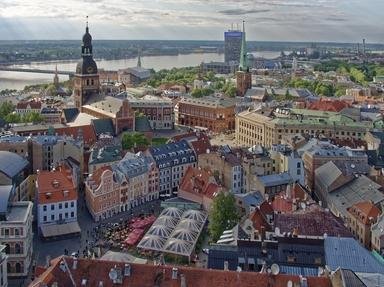
A church. The oldest parts of the magnificent church date back to the 13th century.
Which two major beauty pageants have been won by Latvian women? | About Latvia
|
Miss USA and Mrs Globe. Marite Ozere became Miss USA in 1963, and Ieva Bondare won Mrs Globe in 1998.
Riga. It is also the largest city in the Baltic States, with a population of nearly 900,000.
A Latvian is the DJ for a popular American musical group. Which one? | About Latvia
|
Latvia's flag, which is red-white-red, is often confused with the flag of another country, even though the red in Latvia's flag is much darker. Which is the other country? | About Latvia
|
When did Latvia gain independence from the Soviet Union? | Latvia
|
1991. The last Russian troops didn't leave the country till 1994 and for many years after that Latvia was still economically dependent on Russia - for example, for its electricity supply. Overcoming such dependence was a very high priority of the newly independent Latvia. The country was admitted to the European Union in 2004.
Before 1918 Latvia was known by various other names. One widely used name was Livonia, which covered (roughly) the northern part of the country. What other name was widely used, at least for a large part of Latvia? | Latvia
|
Courland. In the Middle Ages the area was colonized by the Livonian Order, a sub-division of the Teutonic Knights. In the second half of the sixteenth century it was ruled by Russia, then from 1629-1721 by Sweden. In 1721 it reverted to Russia, which governed the country till 1918. Independent from 1918-40, it was annexed by the Soviet Union in 1940, together with the other Baltic Republics. From 1941-44 it was under German rule and was re-incorporated into the Soviet Union at the end of WWII. The country has had a turbulent history.
What is the approximate population of Latvia? | Latvia
|
2.4 million. By European standards, the country is sparsely populated.
What is the main river traversing Latvia? | Latvia
|
The Daugava (Dvina). The Latvian name is the Daugava. This river is also known as the Dvina River, which is sometimes called the West Dvina. It rises to the west of Moscow and flows through Russia, Belarus and Latvia before reaching the Gulf of Riga. It should *not* be confused with the North Dvina, which is wholly in Russia and flows into the White Sea at Archangel.
What is the approximate area of Latvia? | Latvia
|
24,900 sq miles. It's smaller than Lithuania and slightly larger than Estonia.
What is the capital of Latvia? | Latvia
|
Riga. Riga, with a population of about 705,000 (2011 figure), is the country's main port. The old city center shows signs of German architectural influence and it is also well known for its splendid art nouveau heritage.
Ethnic minorities make up over a third of the population of Latvia. Which is the largest minority? | Latvia
|
Russians. The Russian minority makes up about 30 per cent of the population. The Belorussian minority is about four per cent and the Ukrainian minority just under three per cent. (Until 1944-45 there was also a small but influential German minority, too).
Part of Latvia's coastline is on the Baltic, and most of the remainder is on the Gulf of ...? | Latvia
|
Riga. The Gulf of Riga is an inlet of the Baltic Sea. The Gulf of Bothnia separates Sweden from Finland - and the other two gulfs don't exist.
Now follow me into our last area to visit. Shh! You can see all kinds of animals here if you are quiet, including the black stork, Eurasian beaver, Eurasian otter, and lesser spotted eagle, which are uncommon in the rest of Europe. What events, normally seen as negative economically, led to the development of areas where these rare creatures could flourish? | A Trip through Latvia
|
The abandonment of private farms. Many of these farms were neglected for decades, and without human interference rare species of flora and fauna reclaimed the land. Other returnees include the European wolf and European lynx, not to mention plants like the lady's slipper and assorted rare mosses and lichens. Latvia's biodiversity is renowned!
Unfortunately, you may have noticed on your trip that Latvia suffers from a few environmental issues. Which is NOT among them? | A Trip through Latvia
|
Drought. In fact, Latvia suffers from the opposite of drought. It rains or snows more than 180 days per year, necessitating the drainage of farmland. Indeed public works projects regarding drainage have been a significant source of employment! The precipitation is especially heavy during harvest time, which can cause problems for mechanical equipment. The other environmental problems stem from the large-scale industrialization that began during the Soviet occupation and have continued to some extent thereafter.
As we travel through Latvia, you'll notice that one kind of biome predominates. What is it? | A Trip through Latvia
|
Lowland plains. Most of Latvia consists of fertile, rolling plains, which were formed during the Ice Age. Another sizable portion of Latvia is covered in forest, two-thirds of which consist Scots Pine or Norway Spruce. Consequently, timber and wood products are important exports. Unlike North American forests, Latvian forests lack underbrush, but cranberries, bilberries, and mushrooms grow along the forest floor. Bogs, swamps, and marshes comprise about ten percent of the land. There aren't any true deserts; there is just too much rainfall year-round.
Now we can walk a nature trail and have a picnic lunch in a beautiful park that holds a third of all Latvian natural preserves, not to mention more than 500 monuments! What is this gorgeous greenspace? | A Trip through Latvia
|
Gauja National Park. In the valley of the Gauja River, one of Latvia's cleanest, sits the Gauja National Park, established officially in 1973 but visited by hikers and nature-lovers since the 19th century. Melting glaciers shappd the terrain and deposited clay and fieldstone in the terraces. The park boasts the largest exposures of sandstone from the Devonian period and the biologically unique Sudas marsh reserve. In the park is Gütmans Cave, the highest cave in the Baltic countries. And there are all sorts of watermills, windmills, stone castles, and other monuments decorating the landscape. Keep your eyes peeled for wild animals on the hiking trails!
Masai Mara National Reserve is in Kenya. Kruger National Park is in South Africa. Uluru-Kata Tjuta National Park is in Australia.
Having finished our boat-ride, we'll finish our trip on land. Strap on your gear; we're going to climb up to the highest point in Latvia. What is it? | A Trip through Latvia
|
Gaiziņkalns. At 1,022 ft (311.6 m) above sea level, Gaiziņkalns is not actually much of a mountain climb, but it has a few ski slopes and lodges. It sits near the picturesque town of Madona, named for the nearby lake. Feeling especially competitive, the Latvians built a tower atop Gaiziņkalns so as to ensure the peak would surpass nearby Suur Munamägi in Estonia in height. Alas, the tower was never finished, and it was closed to tourists for safety reasons.
Denali is the Inuit name for Mt. McKinley in Alaska, USA. Uluru is the aboriginal name for Ayers Rock in the Northern Territory, Australia. Qomolangma (or Chomolungma) is another name for Mt. Everest, in the Himalayas of Nepal.
One item on our itinerary is a boat-ride up and down the river that runs through the middle of Latvia. What is the name of this river? | A Trip through Latvia
|
Daugava. The Daugava River, also known as the Western Dvina, is the longest and most important river in Latvia. It runs for 624 miles (1,005 km) through the country. The river originates in the Valdai Hills of Russia and flows through Belarus into Latvia, eventually draining into the Gulf of Riga.
Let's begin our journey! As we sail toward Latvia from the West, we float along the Baltic Sea, through the Irbe Strait and into what gulf, named after the capital city? | A Trip through Latvia
|
Gulf of Riga. At its deepest point, the Gulf of Riga is nearly 220 ft (67 m). It is also known as the Gulf of Livonia, after an historic region that spans the eastern shoreline of the Baltic Sea. Numerous Baltic and Finnic peoples once inhabited the region. In fact, the indigenous people of Latvia are comprised not only of the Latvians but also of the Finnic Livs (or Livonians). As we sail into the Gulf of Riga, we may pass by island of Saaremaa, which belongs to Estonia.
The Gulf of Aden, near the Arabian sea, lies between Yemen and Somalia. The Gulf of Bothnia is an arm of the Baltic Sea, sandwiched between Finland and Sweden. The Gulf of Tonkin is off the coast of Vietnam, connected to the South China Sea.
White Wagtail. The White Wagtail (Motacilla alba) has been Latvia's national bird since 1960. Though the different subspecies of wagtail have different markings on their feathers, they share a common colour scheme of whites, greys and blacks. Though the White Wagtail can be found in other European countries, as well as across parts of northern Africa during migratory season, Latvians will most often see their national bird in the warmer months, between April and October.
If you were to visit a Latvian website, chances are it would have which internet country code? | Looking Through Latvia
|
.lv. The .lv country code for Latvian websites came about in 1993. The .la code is assigned to the Asian country of Laos, while .lt belongs to Latvia's neighbour, Lithuania, and .li is the property of fellow European country Liechtenstein.
Once a former Soviet state, Latvia gained independence again in which decade of the late twentieth century? | Looking Through Latvia
|
1990s. The dissolution of Soviet rule over Latvia came about in 1990, but it wasn't until August 1991 that it became an independent country again. During this time, Anatolijs Gorbunovs served as the country's president, having been leader during the later SSR years. In 1993, the country had its first election as a republic, and Guntis Ulmanis took up the role of president.
Which sport is held to be the one of the most popular in Latvia, one which you might normally associate with Canada? | Looking Through Latvia
|
Ice hockey. The International Ice Hockey Federation (IIHF) chose Latvia to host the World Championships in 2006, following Austria in 2005. Basketball is also a favourite sporting pastime of Latvians, with their very own Andris Biedriņs hitting the big time in America with the Golden State Warriors, a Californian basketball team.
Riga is Latvia's capital city and economic hub, and also boasts the country's tallest tower. What is this tower primarily used for? | Looking Through Latvia
|
Broadcasting radio and television. Opened in 1986, the Riga Radio and TV Tower is the tallest structure in the country and one of the tallest in Europe, stretching an impressive 368.5 metres into the sky. It is located on the island of Zaķusala, which lies in the Daugava River.
When translated into English, what does the title of Latvia's national anthem 'Dievs, svētī Latviju!' mean? | Looking Through Latvia
|
God Bless Latvia!. Written in 1873 by composer Kārlis Baumanis, 'Dievs, svētī Latviju!' (which shall henceforth be referred to in this quiz as 'God Bless Latvia!' for ease) was chosen to be the country's national anthem in 1920. Baumanis sadly died in 1904, a good sixteen years before he was able to hear his own creation sung proudly by millions of patriotic Latvians.
While the Daugava River may be the longest to run through Latvia, it doesn't "begin" in Latvia. Which of Latvia's rivers is the longest one to be entirely contained within the country? | Looking Through Latvia
|
Gauja. The 452 kilometre long Gauja River begins its journey in the highlands of Vidzeme, a region in northern Latvia. From there, it flows east and north, winding through beautiful landscapes, before turning around travelling west and south to the Gulf of Riga where it empties. The Daugava River begins in Russian Valdai Hills where it makes its way through Belarus and Latvia to empty into the Gulf of Riga, very near to the country's capital city.
Of the four countries which share a land border with Latvia, which is closest in size to Latvia? | Looking Through Latvia
|
Lithuania. Latvia's 64,589 square kilometres places it less than a thousand square kilometres behind Lithuania, which is 65,200 square kilometres in area. Russia is quite obviously enormously bigger in comparison, weighing in at over 3.9 million square kilometres, while Belarus manages a respectable 207,600 square kilometres, and Estonia brings up the rear with 45,226 square kilometres.
Baltic Sea. Lithuania to the south, Belarus to the southeast, Russia to the east and Estonia to the north form the land borders with Latvia. The only sea view that Latvians get is that of the Baltic, along its 500 kilometre coastline (approximately).
|