

Answer: Latvia
The border between Lithuania and Latvia is around 365 miles (590 km).
Lithuania does border Poland, but Poland lies south. Lithuania's border with Poland is comparatively shorter than the other borders, at only around 55 miles (90 km), but this border is usually busy due to regular international traffic. It also shares a border with Belarus, with Belarus lying east and south; Lithuania also shares a border with Russia, which lies to the southwest. At around 420 miles (680 km), Lithuania's longest border is with Belarus.
From Quiz: Europe: All about Lithuania
Answer: Vilnius
Vilnius is the capital of Lithuania, with about 550,000 inhabitants. The city was founded in 1323. Vilnius was an issue between Lithuanians and Poles in the XX century. Nowadays it's a very beautiful city, where you can find a mixture of modern and old architecture.
From Quiz: Towns in Lithuania
Answer: Neris
Vilnius stands on the confluence of the Neris and Vilnia rivers. Kaunas, the second city, stands on the Nemunas (or Nieman) and Panevezys on the Nevezis. The Latvian capital, Riga, stands at the mouth of the Daugava.
From Quiz: This Is Lithuania
Answer: Christmas Eve
Well, believe it or not, on Christmas Eve exactly at midnight animals can speak. However, I wouldn't recommend you listen because you might hear about the day of your own death.
From Quiz: Lithuanian Traditions and Customs
Answer: The national perfume of Lithuania
"The Scent of Lithuania" is the national perfume of Lithuania, and is made by the Galimard Perfumers. It can be worn on the body or on clothing, carpeting, and furniture. This fruity, floral fragrance is meant to evoke memories of this lovely country. Lithuania was the first country in the world to adopt a "national perfume" when they did so in 2011. It can be bought in many locations throughout the country.
From Quiz: Lovely, Likable Lithuania
Answer: Kaunas
Kaunas' population is about 400,000. It was the provisional capital of Lithuania for twenty years.
From Quiz: Towns in Lithuania
Answer: Klaipeda
Memel was made an international protectorate after the First World War. It was later incorporated into Lithuania. Klaipeda is now Lithuania's main port and its third city.
From Quiz: This Is Lithuania
Answer: Bread and salt
Of course, you would be greeted with a loaf of bread on a towel and maybe a pinch of salt. Bread is considered very important in this little country. Even the newlyweds are greeted with the bread and salt.
From Quiz: Lithuanian Traditions and Customs
Answer: Neris
The Neris also flows through neighbouring Belarus for around 170 miles (275 km), and then through Vilnius and into the Neman River, through the city of Kaunas. The Neris is 320 miles (510 km) long and about 145 miles (235 km) of it flows through Lithuania.
Vilnius is located just under 200 miles (310 km) from the Baltic Sea, and is the headquarters of Lithuania's government.
From Quiz: Europe: All about Lithuania
Answer: By a wooden bridge
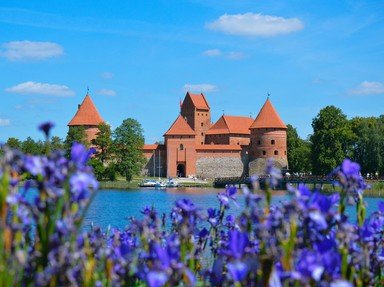
Visitors to this lovely 14th century castle must walk across a lengthy wooden bridge. This unusual relic of bygone days was built and rebuilt for over three centuries before it fell into disrepair. In the 20th century, specialists from Germany, Poland and Lithuania worked many hours to restore the castle ruins to their former beauty. Reconstruction was completed in 1961, and it was opened to the public the same year. This castle is a source of pride for the people of Lithuania and one of the biggest tourist attractions in the country.
From Quiz: Lovely, Likable Lithuania
Answer: Palanga
It is a crowded place in hot summer days.
From Quiz: Towns in Lithuania
Answer: Gediminas
Gediminas is said to have had a dream of a wolf howling like a thousand wolves on a hilltop. The dream was interpreted as meaning that he should build a fort there.
From Quiz: This Is Lithuania
Answer: Dew
This feast was once even called the feast of Dews. You just get up very early, before the sunrise, wash your face with dew - and the result is guaranteed. Who needs cosmetics anyway?
From Quiz: Lithuanian Traditions and Customs
Answer: Vilnius
Riga is the capital of Latvia, Tallinn the capital of Estonia. Kaunas is Lithuania's second largest city and was the capital from 1920-40, as Vilnius was annexed by Poland in 1921.
From Quiz: Lithuania
Answer: Palanga
Founded in 1963, the Palanga Amber Museum is located within a large palace in the centre of Birute Park, and is one of the busiest museums of Lithuania. The guides talk about amber formation, the historical trade routes of amber in the country and the extraction and processing methods. One of the most popular exhibits of the museum is the Sun Stone, which weighs 8 pounds (just under 3,700 grams) and is one of the largest known pieces of amber in Europe. The grounds also include a scenic botanical park.
Palanga is a seaside town and was once the centre of the Russian amber trade in the Baltics. The legendary and partially factual character of Birutė, second wife of Kęstutis, Grand Duke of Lithuania was from Palanga. She was said to be tending the fires of the shrine in the hills of Palanga, when the duke accosted her claiming she would now be his wife. She reportedly returned to the hills to tend to the shrines again, after the husband she had been forced to marry was assassinated.
After the split of the Russian Empire, Palanga was listed as part of Latvia before being classed as a Lithuanian town in 1921.
From Quiz: Europe: All about Lithuania
Answer: Roman Catholic
The Hill of Crosses is a Roman Catholic pilgrimage site that was started around 1831. Located in northern Lithuania, this hill contains over 100,000 crosses and crucifixes planted in the ground in the same manner as an upright tombstone. They signify the struggle of Lithuanian Catholics who were killed during the myriad of wars and occupations that took place in this country in the 19th and 20th centuries. It should be pointed out that this is not a cemetery but a place to honor the strength and endurance of the church during very trying times. Over 3/4 of the population is Roman Catholic. At one time Lithuania was home to over 200,000 Jews who were almost completely annihilated during the Holocaust of WWII.
From Quiz: Lovely, Likable Lithuania
Answer: Kernavë
Kernavë was a medieval capital of the Grand Duchy of Lithuania. Only about 320 people live in Kernavë now, but roughly 30,000 tourists visit Lithuania's first capital every year. There are a lot of historic hillfort mounds around Kernavë.
From Quiz: Towns in Lithuania
Answer: Rolandas Paksas
Landsbergis was president from 1991 to 1993, Brazauskas was president 1993-98 and Adamkus 1998-2003. Since Lithuania became independent (in 1991), no president has managed to secure a second term in office, although Brazauskas became prime minister in 2001.
Paksas was impeached by the Lithuania Parliament and removed from office in 2004 for a number of offences, including violating the constitution. The subsequent presidential election saw the return to office of Valdus Adamkus.
From Quiz: This Is Lithuania
Answer: Twelve
According to traditions, there should be at least twelve dishes because Jesus had 12 Apostles. The problem is, that on this day meat products (and in certain regions even milk products) are not allowed. So these are mainly fish, mushrooms, vegetables and similar dishes. It is very important to taste each dish - otherwise you won't last until next Christmas.
From Quiz: Lithuanian Traditions and Customs
Answer: Neman
Originating in Belarus, the Neman River (also known as Nemunas, Nioman and Memel) is just over 580 miles (940 km) long and drains about 70% of Lithuania's total area. The river also flows through neighbouring Belarus, and forms part of Lithuania's border with Russia before flowing into the Baltic Sea.
The Lithuanian cities of Kaunas and Sovetsk are located along the River Neman. The river is also historically notable; Napoleon I and Czar Alexander I met on a raft in the middle of this river, which resulted in the Treaty of Tilsit of 1807.
From Quiz: Europe: All about Lithuania
Answer: Amber
The Palanga Amber Museum is home to almost 30,000 pieces of amber and amber artwork. This area of the Baltic Sea coast has been trading amber since prehistoric times. Amber is indelibly tied to Lithuanian art, folklore, and mythology. Housed inside a restored 19th century palace and surrounded by a world-class botanical garden, The Palanga Amber Museum is a must-see when you visit the country.
From Quiz: Lovely, Likable Lithuania
Answer: Nida
Nida is a honeypot for German tourists. It has 1650 residents.
From Quiz: Towns in Lithuania
Answer: 1991
Lithuania became independent of Russia after the First World War in 1918. However, the Soviet Union invaded the country in 1940 to be followed by the Germans in 1941 and then the Soviets again in 1944. Lithuania declared independence on the 11th of March 1990. Following the abortive coup in Moscow in 1991, the Soviet Union recognised Lithuanian independence on the 6th of September of that year.
From Quiz: This Is Lithuania
Answer: go visiting or walking through villages
I think that's an easy question. You should not go wandering, because roads (and especially crossroads) are filled with souls of the dead. You cannot be sure that all of them are friendly, can you?
From Quiz: Lithuanian Traditions and Customs
Answer: 1991
Lithuania declared itself independent in 1990, but didn't gain effective independence till the following year. The last Russian troops left in 1993.
From Quiz: Lithuania
Answer: Bog
Located around 70 miles (110 km) from Vilnius, Čepkeliai Marsh encompasses an area of 27,710 acres (11,212 hectares), with the bog itself covering an area of 14,480 acres (5,858 hectares), and includes many small islands and lakes within its area. The wetlands have been created between three small rivers: Ūla, Grūda and Katra. During the summer, it is said that Čepkeliai is the warmest place to be in Lithuania. The area is populated with wolves, lynxes, hares, eagles, cranes and snakes. Cranberries and heather grow in abundance.
From Quiz: Europe: All about Lithuania
Answer: Neris River
Kernave sits on the bank of the Neris River. It was burned to the ground during the Lithuanian Civil War (1389-1392). The original town was not rebuilt but rather moved a short distance to the top of the local hill. Over time, the remains of the original town were covered in peat which preserved the site. Some of the objects found at the site date to the 4th century. While small (2011 pop. 318), the town is the site of many festivals. Authentic arts and crafts, folk music and war games can be seen during these summer celebrations which draw many tourists from all over Europe.
From Quiz: Lovely, Likable Lithuania
Answer: Klaipeda
About 200,000 people live in Klaipëda. Throughout its history Klaipëda has belonged to Prussia, Germany, and Lithuania. Some of its older buildings have picturesque framework architecture similar to that found in Germany, England, and Denmark.
From Quiz: Towns in Lithuania
Answer: Hill of Witches
One of the most fascinating sites in Lithuania, the hill is covered in carvings of various sizes and designs such as witches, pagan gods, animals and other creatures.
The Hill of Crosses is located near Siauliai; another fascinating site, covered in thousands upon thousands of crosses of all different sizes, styles and materials: wood, plastic, metal, amber, even wool.
From Quiz: This Is Lithuania
Answer: poppy seed milk
Okay, this is how you should do it. Take 2 cups of dried poppy seeds and pour boiling water over them. Let stand for about 5 minutes and then drain them. After that, crush the seeds with a mill, then add some sweetened water to get a thin liquid. Now put this liquid on slizikai and enjoy! The food of Gods! :)
From Quiz: Lithuanian Traditions and Customs
Answer: 25,200 sq miles
It is slightly bigger than Latvia and is the largest of the three Baltic republics.
From Quiz: Lithuania
Answer: Basketball
Basketball is the national sport of Lithuania and they have produced many world class players. They have won medals in the Olympics, the World Championships and in the Eurobasket championships. At least a dozen of their native sons have played in the NBA much to the delight of American fans. The Zalgris Arena, which opened in 2011, became the largest arena to be found in any of the Baltic State. Other popular sports you can watch include cycling, ice hockey, rugby and tennis.
From Quiz: Lovely, Likable Lithuania
Answer: Telsiai
Telsiai is a town in Þemaitija (Lower Lithuania/Samogitia) and people there speak in Samogitian dialect, which isn't easy for the rest of fellow-countryman.
From Quiz: Towns in Lithuania
Answer: yellow, green and red
The yellow represents the sun, the green the land and the red the blood of the people.
From Quiz: This Is Lithuania
Answer: fern
It is believed that during the night of St. John, the fern comes into flower and if you find the blossom of the fern, you'll be able to find hidden treasures. According to other legends - you'll be extremely lucky.
From Quiz: Lithuanian Traditions and Customs
Answer: Sesupė
Marijampolė is situated along both banks along the River Sesupė, and has been an industrial city since after World War II (a war in which thousands of Jews from the city were buried near the Sesupė in mass graves, after being murdered).
The Sesupė is approximately 185 miles (300 km) long, and flows through both Russia and Belarus as well as Lithuania. The river starts near the village of Szeszupka in Poland.
From Quiz: Europe: All about Lithuania
Answer: A long ocean sand bar island
A spit is a type of sand bar that is connected to land at one end and extends out into the sea. The Curonian Spit is almost 100 km long and separates the Baltic Sea from the Curonian Lagoon. Part of this land formation belongs to Russia and the other part belongs to Lithuania. This unusual land formation has been home to at least three castles, and has been occupied since before 800 B.C. At one time it was home to the city of Kaup, which was one of the most important trade centers on the Baltic Sea. The spit is home to the Rossitten Bird Observatory as well as the holiday resort of Nida. The spit is a very vulnerable to pollution and deforestation, both of which could destroy this unique area.
From Quiz: Lovely, Likable Lithuania
Answer: Vilnius
The Vilnius region was occupied by Poles in 1919-1939. At that time Kaunas was the provisional capital of Lithuania.
From Quiz: Towns in Lithuania
Answer: Poland
Grand Duke Jogaila of Lithuania married Jadwiga of the Polish royal house in 1386. From then on the hereditary Grand Dukes were regularly chosen for the elected position of King of Poland. However, the two countries were not formally united until 1569.
From Quiz: This Is Lithuania
Answer: The spirits of dead relatives or loved ones will visit the home during the night and eat
There's also an empty plate placed on the table during the Christmas Eve dinner. It is believed that the spirit of a relative who died that year participates in dinner.
From Quiz: Lithuanian Traditions and Customs