|
|
|
Structure
Interesting Questions, Facts and Information
- There are a total of 55 general entries. We are selecting 30 for display.
|
Interesting Questions, Facts, and Information
Luxembourg
grapes. Wine making grapes are grown. Other important crops are grain and potatoes.
True . French and German are the adminstrative languages. The common spoken language is Luxembourgish (Luxembourgian, Letzeburgesch)
iron. Iron is no longer mined, but the iron and steel industry is still very important. The chemical industry is very important too.
Moselle. The Moselle rises in the Vosges mountains in France, and flows 314 miles through Luxembourg and Germany to enter the Rhine at Koblenz.
True . Luxembourg was caught between warring nations.
False . Luxembourg is 998 Square miles in area. Rhode Island is 1,214 square miles.
450,000-550,000. 510,000 (April 2012 estimate)
Ardennes. The Ardennes form a high wooded plateau which extends into France and Belgium.
banking and finance. Luxembourg is famous for its banking services. As of 2006, there were 156 banks from 25 countries operating there. Luxembourg is also the second largest, after USA, investment fund center.
Union of three nations: Belgium (BE), the Netherlands (NE), and Luxembourg (LUX). Benelux was created in 1948 as an economic (customs) union between Belgium, the Netherlands, and Luxembourg. It was established in order to promote economic prosperity, but it is not reflected in the name of the organisation. Benelux is also an acronym for these three countries considered together.
German, French, and Luxembourgish. Luxembourgish is a mixture of German, Dutch and French. It used to be only a dialect, but it has a status of an official language now. French and German are two other administrative languages.
Communes. There are 106 communes in Luxembourg, responsible for the administration of local services rather than national mandates.
In 2011 the population of Luxembourg was a smidge over 500,000, and the population of Luxembourg, the capital city, was about 89,000.
Robert Schuman. Robert Schuman, a Frenchman, was born in Luxembourg in 1886. As a French foreign affairs minister he proposed a plan which led to the creation of the first European Community, the European Coal and Steel Community.
Remich. Remich is a charming little town on the banks of the Moselle river. Its highlight is the esplanade, a walkway along the river. You can also visit the underground wine cellars called "Caves St Martin", a tour at the end of which you can drink a glass of exquisite sparkling wine, offered for free.
In which town on the banks of the Moselle river was an important agreement on the abolition of border controls within the European Union signed? | Tour around Luxembourg
|
Schengen. The Schengen Agreement was signed on 14 June 1985, aboard the MS Princesse Marie-Astrid, named after the sister of the Grand Duke Henri. Excursions aboard this luxury cruiser are possible nowadays. The departure point is Grevenmacher, a town close to the German border. The ship can also be hired for special occasions.
"The Family of Man", a world-famous photo collection by Edward J. Steichen, originally assembled for New York's Museum of Modern Art, is hosted by which Luxembourgish city? | Tour around Luxembourg
|
Clerveaux. Advertised as "the biggest and most popular photographic exhibition of all times", it was created by Edward J. Steichen in 1955 for the Musem of Modern Art in New York. It included 508 photographs from 68 countries. Nowadays its home is the castle in Clerveaux, a medieval town in the north of Luxembourg.
Vianden is one of the most visited cities in Luxembourg. Which renowned French writer lived there briefly in the 19th century? | Tour around Luxembourg
|
Victor Hugo. The house where Victor Hugo lived in 1871 has been turned into a museum. The picturesque town, close to the German border, boasts a magnificent medieval castle. It is popular especially among Dutch and German tourists.
The oldest town in Luxembourg was founded in the 7th century AD by a monk. What is its name? | Tour around Luxembourg
|
Echternach. Echternach was founded in 698 by St Willibrord, a monk of Irish origin. Every year on Whit Tuesday, the dancing procession in honour of the saint takes place there. Echternach has a lot to offer: apart from the Benedictine abbey and St. Willibrod basilica, you can see the remains of a Roman villa by the lake.
A small airport, not far from the city center, is the first place you will see if you come to Luxembourg by plane. What is it called? | Tour around Luxembourg
|
Findel. Findel airport is located around 7 km from the city center. It is linked to many cities in Europe and the Mediterranean basin. Findel is also a major continental cargo hub.
Ecternach. The town of Echternach is the oldest town in Luxembourg. It was founded in the seventh century by St. Willibrord, who established the Abbey of Echternach which is the oldest Abbey in Luxembourg.
Echternach, another lovely city of Luxembourg, is in the eastern part of Luxembourg, on the Sauer River. The River is the border between Ecternach and Germany. Not far from Echternach is a portion of Luxembourg called the Mullerthal, or nicknamed "The Little Switzerland" of Luxembourg.
Driving into Echternach on our first visit to it, we were at once delighted
with the character and charm of this city. Our hotel, Le Pavillion, was one of many that bordered the main street off the town square. Walking down this street, restaurants were touting their wares, in particular, so many had a large sign outside their door saying, "Les Moules est ici" (the mussels are here). Continuing on, at the end of the street was a lovely park, with a man-made lake, and benches to sit and relax. At dinner time in our hotel restaurant, the tables were filled with diners of all nationalities. It was a great experience to meet the friendly Luxembourg natives and watch, listen, and learn from all other countries who were there. Taking center stage though, was the waiter, who with a smile on his face, carried a huge tureen of steaming mussels. The diners matched his smile as the redolent smell of the sauce permeated the room and we all eagerly waited to taste them. It was one of those memories for me which I shall never lose, just because it me gave such pleasure.
The city of Remich in Luxembourg is a riverside resort city on the Moselle (Mosel) River, but what is the surrounding countryside's main attraction? | Lamp Unto Luxembourg
|
Vineyards. Remich is a delightful riverside town on the Moselle (Mosel) River.
Vineyards dominate the landscape around Remich, and it was a pleasure to take a walk on the hills surrounding this small town. Remich is one of the many small towns along the the Moselle (Mosel) from which Luxembourg wines are produced.
Remich has a lovely two mile long park bordering the Moselle(Mosel)River. This charming city is very picturesque with the vineyards sloping down to the river. the trees and walkways of the two mile-long park along the river bank and the boats sliding up and down to pick-up or discharge tourists paint an idyllic landscape. Many of the Luxembourg wines come from the vineyards of Remich. A short distance from Remich, you can visit the Caves de Martin, where sparkling wines are made in the same manner as the Benedictine monks.
French. In Luxembourg, French is the official language of the authorities, of parliamentary documents, proposed bills, court procedures and administrative and judicial acts. All of these are held and written in French. French and German are the official languages of Luxembourg, with Luxembourghish (the native language) being spoken in the home, shops, and some churches. On my visit to Luxembourg, restaurant menus were in French, street signs in Luxembourgish as well as in German. German is the main language for instruction in elementary schools, with an introduction to French as well. In one small town, I attended a Roman Catholic Mass and the service as well as the sermon was in Luxembourgish. Ninety-five percent of the native citizens of Luxembourg are Roman Catholic. Needless to say, I could follow the Mass, but the sermon was surely a different story!
Which of Germany's oldest cities lies close to the Luxembourg border and has preserved some of its Roman ruins? | Lamp Unto Luxembourg
|
Trier. Trier is the oldest city in Germany and is six miles from the Luxembourg border. Founded by the Roman Emperor Augustus in 16 B.C., it was a popular place for Roman Emperors to stay. Constantine the Great resided in Trier and erected a cathedral which is today Germany's oldest one. Evidence of Roman fortifications is represented by the Porta Nigra (black gate) which was built in 180. A.D.
We drove to Trier from Luxembourg on a misty day, hoping the sun would appear.
Sadly it did not. The rains came gently but did not spoil the Harvest Festival parade which consisted of large horse-drawn farm wagons replete with the fruits and vegetables of the summer crops. Young girls in native farm dress walked beside the decorated horses and wagons. The wagons went through the Porta Nigra to the square beyond it. We decided, because of the weather to take the tour bus trip through Trier.
It really became just a bird's eye view of a magnificent old city and we promised ourselves to return someday.
France, Belgium, Germany. The Grand Duchy of Luxembourg is a landlocked, triangularly shaped country. It is bordered by Belgium to the north, Germany to the east, and France to the south. Besides being neighbors, the four countries of Luxembourg, Belgium, France and Germany have some major things in common. All four countries belong to the European Union and have adapted the Euro as their official currencies.
Christianity is the major religion in each country; however Islam is the second major religion in Belgium. Lutheranism after Catholicism is second in Germany.
France has three major religions other than Christianity, which are Judaism, Islam and Buddhism.
One of the major differences for Luxembourg, which is one of the smallest countries in Europe, is that it is surrounded by France, the third largest country in Europe and Germany the seventh largest country in Europe.
Although I did not visit the largest cities in the bordering countries of Luxembourg, I felt so privileged to travel to some delightful towns, such as Thionville in France, Trier in Germany, Boulogne in Belgium and the three cities of Luxembourg, Viandan, Ecternach, and Remich.
Which famous American general is buried in the American Cemetery in the city of Hamm, Luxembourg? | Lamp Unto Luxembourg
|
Patton. Visiting the American Cemetery right outside Luxembourg City, in the small town of Hamm, is quite a moving experience. Row upon row of white grave stones, marking the casualties of the Battle of Boulogne, face their commanding officer, General George C. Patton. The headstone of Patton faces his fallen troops of which there are 5076 in headstone count. Patton's headstone is flanked by two flags. When I first viewed this cemetery, an elderly couple stood by the balustrade looking down at the graves. The man, seemingly a veteran of World War II, stood there holding his wife's hand, tears sliding down his face.
Which famous French author's landmark statue is in Viandan, Luxembourg beside the river Our? | Lamp Unto Luxembourg
|
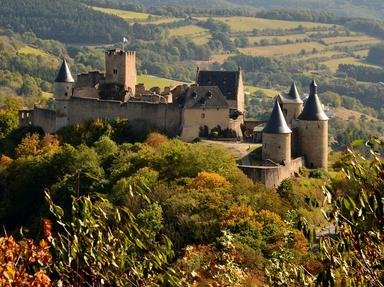
Victor Hugo. While in exile from France, French author Victor Hugo resided in the town of Viandan, Luxembourg. He later had a summer house there. The statue of Victor Hugo stands aside the bridge over the River Our. From that vantage point, you can look up to a very high hill. Almost to the top of the hill is the Castle of Viandan, and beyond it, much higher up, the rocky outcrop of the hill. From this vantage point, if you do not want to climb up to the castle, you can use the chairlift which can take you up instead. Summertime concerts are held in the castle, which has been restored. I found this one of the most charming towns in Luxembourg.
Which World War II battle in the European theater was fought in the winter of 1944 through to the spring of 1945? | Lamp Unto Luxembourg
|
Battle of the Bulge. The Battle of the Bulge, which took place between the winter of 1944 and the spring of 1945, was fought in both Luxembourg and Belgium. It was Germany's last crucial offensive after their defeat at the battle of Normandy. The territory where the Battle of the Bulge was fought was in the area known as Ardennes. This geographic area covers most of Belgium and Luxembourg, with a small part of it in France and Germany. Walking the Main Square in Boulogne, Belgium on a Sunday afternoon in the late 1990s, it was hard to imagine that Boulogne had been ravaged by war throughout the centuries. It gladdened my heart to see Boulogne families walking happily, Mom, Dad, children and pet dog. Only an Eisenhower tank memorial near the entrance to the square reminded me of the atrocities of war. We shopped for Belgian chocolates, of course.
Findel. Luxembourg's international airline is Luxair. As well as regular passenger flights within Europe it handles large amounts of air cargo worldwide. Findel Airport is one of the busiest airports in Europe for cargo traffic, and was listed as the 28th busiest in the world in 2010. Air cargo is handled by the Cargolux airline. Luxembourg has excellent road and rail facilities too, including a high-speed rail link to Paris which has cut journey times significantly.
The other three choices all lie on rivers that run through Luxembourg and its neighbours. Vianden lies on the Our, Mertert on the Moselle and Esch-sur-Alzette, as its name suggests, on the Alzette.
Luxembourg does not have an official religion, but do you know which religion is followed by the majority of the population? | We're Sailing to Luxembourg!
|
Catholicism. Luxembourg is a secular state and as such does not have an official religion. There are, however, many religions which are represented. Roman Catholicism is the most widely practised, with an estimated 87% of the population being followers, including the Royal Family. Protestantism is understood to be the second largest denomination, and Jews, Muslims and Eastern Orthodox Christians are also well represented. No exact figures are available because it has been illegal for the government to collect statistical information on people's religious views since 1979.
We're half way through our voyage now. Are you still on an even keel? Luxembourg's flag comprises three horizontal stripes in red, white and light blue. | We're Sailing to Luxembourg!
|
t. Luxembourg's flag is similar to that of The Netherlands, except that the blue stripe of the Luxembourg flag is a brighter, lighter shade of blue than that of the Netherlands, which is a dark blue. The three colours of Luxembourg's ensign share the same colours as its flag. The ensign has a field of ten alternating horizontal stripes of white and light blue with the country's symbol, the red lion, depicted in the centre.
Until the end of the 20th century, Luxembourg had won only one gold medal at the Olympic Games. Their victory came in 1952 with a winning performance by Josy Barthel. In which discipline was he a winner? | We're Sailing to Luxembourg!
|
athletics. Josy Barthel (1927-1992) won the Men's 1500 metres event at the 1952 Summer Olympics held in Helsinki, Finland, bringing home the only medal for Luxembourg that year. After his retirement from active sport he served as President to the country's Athletics Foundation and also their Olympic and Sporting Committee. He had a successful political career too, serving as a Minister in the Luxembourg Government. Luxembourg's sports stadium, which is home to both their national football team and athletics club, was renamed in his honour in 1993, a year after his death.
|