|
|
|
Structure
Interesting Questions, Facts and Information
- There are a total of 30 general entries.
|
Interesting Questions, Facts, and Information
Moldova
Finally: The Romanian speaking people of Romania and Moldova descend from an ancient country which was conquered by Roman emperor Trajan. It was known as ________? | Moldova
|
Dacia. The area was invaded by Goths, Huns, Avars, Bulgars, Magyars, Pechenegs and Cumans before founding of the principalities Wallachia and Moldavia.
Autonomous Danubian Principalities (Moldavia and Wallachia) united and took name of Romania 1861. This city, then situated in Moldavia, was to be the first capital of the independent Danubian Principalities (Romania) 1861, but the capital was moved to Bucuresti the same year. What was the name of the first capital? (Now situated in Romania by the Moldovan border). | Moldova
|
Iasi. Iasi, or Jassy, was also temporarily capital of Romania in World War I.
Both Moldavia and Wallachia were Ottoman (Turkish) vassal states from 15th/16th century. Under another name the two states were ruled by Turkish governors a period from 1774 until the Russian occupation 1810. What name did the provinces have? | Moldova
|
The first president of independent Moldova was a reform-nationalist communist. Who was he? | Moldova
|
Mircea Snegur. Snegur won the election 1990. Moldova declared independence 1991. Lucinschi was elected president 1996. Ion Sturza became prime minister 1999, but the same year Vladimir Voronin, a communist, succeeded as prime minster.
Bessarabia proclaimed independence from Russia as Moldavian (Bessarabian) Republic 1917. It joined Romania 1918 and was recognized as Romanian by Treaty of Versailles 1919 but was still claimed by U.S.S.R. Its capital at the time was the same as now, namely? (Romanian version). | Moldova
|
Chisinau. In Russian called Kishinev. Kishinev was also capital of the Russian government of Bessarabia 1812-1917.
Republic of Moldavia, or officially: Moldavian Autonomous Soviet Socialist Republic (ASSR), was organized in 1924. Its first capital (1924-29) was a city which is now part of Odessa region in Ukraina. Which city? | Moldova
|
Balta. In 1940 Moldavian Republic (ASSR) merged with most of Bessarabia to form Moldavian Soviet Socialist Republic (SSR).
A plebiscite in 1994 was about what matter? | Moldova
|
It was a vote pro or against nationalistŽs demands for a merger with Romania. A peace treaty was signed with Russia 1992 who agreed to withdraw Trans-Dniestr troops by 1997, but this was not decided by a plebiscite. Nor was the decision to introduce the new leu currency 1993. The issue about autonomy for Russian and Gagauz was likewise not settled by a plebiscite.
The country has two autonomous territorial units. Which are these? | Moldova
|
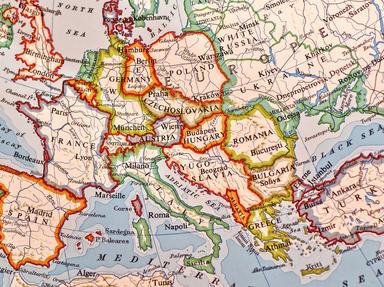
Gagauz and Trans-Dniestr. The Gagauz territory is mainly populated by Gagauz people who are Orthodox Christians of Turkish. Trans-Dniestr is mainly populated by Ukrainians and Russians. Bessarabia is a former region in the area, now divided between Moldova and Ukraine. Wallachia is a former principality which united with Moldavia to form Romania 1861. Prut and Dniestr are the two rivers Moldova are situated between. Chisinau is the capital of Moldova, while Tiraspol is capital of Trans-Dniestr region.
Which two countries border Moldova? | Moldova
|
Romania and Ukraine. The country was a USSR republic 1924-1991, but was occupied by Romania and its wartime ally Germany 1941-1944/45.
What big river flows on the east side of Moldova? | Moldova
|
Dniester. Moldova only has two large rivers: Dniester in the east and Prut in the west.
Moldova is bordered by what two countries? | Moldova
|
Romania and Ukraine. Moldova is bordered by only two countries and is not opened to the sea or ocean.
Who became the president of Moldova in 2001? | Moldova
|
Vladimir Voronin . President Vladimir Voronin became chief of state on 4 April 2001. On April 15, 2001, the head of government was Prime Minister Vasile Tarlev.
What is the currency of Moldova? | Moldova
|
leu. The currency of Moldova came in 1991 as leu. Before that Moldova was united with Soviet Union and its currency was ruble.
To what country does Moldova export the most goods? | Moldova
|
Russia. In 2006, Moldova's leading export markets were: Russia 36%, Romania 8.7%, Italy 8%, Germany 7.1%, Ukraine 6.1%, France 6.1%, Belarus 5.5%
In 2002, what percentage of the population was below the poverty line in Moldova? | Moldova
|
80%. Moldova's population below poverty was 80%, which is very poverty-stricken for an European country.
When did Moldova become independent from the Soviet Union? | Moldova
|
1991. Moldova became independent on 27 August 1991.
Prior to 2003 when the county system was changed, how many counties, or judete, did Moldova have? | Moldova
|
9. Moldova had nine counties or in Romanian judete, one municipality (municipiul), one autonomous territorial unit (unitate teritoriala autonoma), and one territorial unit (unitate teritoriala). Respectively, they were: Balti, Cahul, Chisinau, Chisinau, Edinet, Gagauzia, Lapusna, Orhei, Soroca, Stinga Nistrului, Tighina, and Ungheni .
What was the population of Moldova in 2002? | Moldova
|
4,434,547. Moldova is a relatively populous country (118 people/km2 in 2002).
What Romanian city was once the capital of Moldova? | Moldova
|
Iasi. Iasi was the capital of Moldova for more than 100 years.
According to a 2004 census, what was the majority religion of Moldova? | Marvelous Moldova
|
Eastern Orthodox Christian. Moldova's population is approximately 93.3% Eastern Orthodox Christian. The remaining population is around 2% Protestant, 1.2% belongs to other religions, 0.9% is non-religious, 0.4% is atheist, and 2.2% did not answer the religion question at the 2004 census.
The national language of Moldova is Moldovan. What alphabet is its writing based upon? | Marvelous Moldova
|
Latin. According to the 1991 Declaration of Independence, the national language of Moldova is Romanian. A Moldo-Romanian linguistic identity is spoken of in the 1989 State Language Law.
Dniester and Prut. Moldova's western border is the Prut River. It joins the Danube prior to combining with the Black Sea. The only Moldovan port on the Danube is the Giurgiulesti. Moldova has access to the Danube for a total of 1,575 feet. The Dniester, to the east, is the main river. It flows from north to south and receives the waters of Răut, Bâc, Ichel, Botna.
Chisinau. All the cities mentioned are main cities within Moldova. The capital is located in the center. Tighina is in the south-east. Tiraspol is in the eastern region of Transnistria, and Bălți is in the north.
1991. The boundaries of Moldova remain the same as the original Moldovan SSR. The devolution of the Soviet Union was the reason for Moldova becoming independent.
Romania and Ukraine. Moldova is an Eastern European country. The Ukraine is to the north, east and south. Romania is to the west. Although Moldova is landlocked, it is located not far from the Black Sea.
Wine production. The majority of wine produced in Moldova is for export. The recorded history of such production is found in documents as well as memorials. The Moldovan language (spoken) and folklore also show wine making was the general occupation of the population. Wine tours are available.
A river. The Principality of Moldavia was founded in 1359. The political center was located in the valley of Moldova River. The origin of the river's name is not clear. One theory is that Prince Dragos named the river for his dog Molda. Molda is reported to have drowned in it after an exhausted hunt.
Republic of Moldova. As the country is a parliamentary democracy, a president is the head of state. A prime minister is the head of the government.
|