Register New Player - Log In
Welcome to our world of fun trivia quizzes and quiz games:     New Player quiz register Play Now! trivia game
Fun Trivia : Mongolia Encyclopedia FunTrivia

Structure

fun facts,factoids,info

Interesting Questions, Facts and Information

  • There are a total of 20 general entries.

Special Topics

Interesting Questions, Facts, and Information

    Mongolia

    Chinggis Khaan (better known in the West as Genghis Khan) is perhaps the most famous Mongol of all time and a very important figure to modern Mongolians. His real name was Temujin, but what does Chinggis Khaan mean?Mongolia

      Universal King. Temujin was given the name after uniting the warring Mongol tribes. His armies went on to conquer much of Asia and laid the foundations for an empire that under Temujin's grandson, Kublai Khan, would stretch from Korea to Hungary, the largest contiguous empire in history. Chenggis Khaan remains a national hero in Mongolia.

    Which mountain range would you find in Mongolia?Mongolia

      Altai. The Altai Mountains can be found in the west of Mongolia and include the five peaks of Tavan Bogd (Five Saints). The highest of these, and the highest peak in Mongolia, is Huiten Uul (Mt Cold) which is 4374m. The Sayan Mountains lie north of Mongolia in Russia, the Khinggan Mountains can be found in the Chinese province of Inner Mongolia while Tian Shan stretches across Kyrgyzstan and the Chinese province of Xinjiang Uygur.

    What is the State Great Hural?Mongolia

      Mongolia's parliament. The parliament was previously known as the Peoples' Great Hural. The State Great Hural was established by the constitution of 1992.

    What is the largest ethnic grouping in Mongolia?Mongolia

      Khalka Mongols. Mongolia is relatively ethnically homogeneous. Mongols constitute 85% of the population (of that Mongol population 90% are Khalka with the remaining 10% being Durbet and Dariganga Mongols). Turkic groups (Kazakhs, Turvins and Khotans) make up 7% of the population. The remainder of the population is made up of Russians, Chinese and Tungusic-speakers.

    Much of Mongolia is desert or semi desert. What is the name of the large desert which covers part of south-east Mongolia?Mongolia

      Gobi. "Gobi" means desert in Mongolian. The desert has an area of 281,800 square kilometres and stretches south into China. Temperatures vary from 45C in summer to -40C in winter.

    What is the predominant religion in Mongolia?Mongolia

      Buddhism. All religions were suppressed during the years of the Communist government. However, about 96% of the population are considered Tibetan Buddhists with most of the remainder being Muslims.

    Mongolia is often referred to as 'Outer Mongolia'. Where would you find 'Inner Mongolia'?Mongolia

      China. The terms Inner and Outer Mongolia date back to Imperial China. The Qing dynasty divided China into a number of provinces: Inner Mongolia was so called because it was closer to the Chinese capital at Beijing. The Mongols themselves use the terms North and South Mongolia.

    What is the currency of Mongolia?Mongolia

      Togrog. The togrog (pronounced locally as the tugrik) consists of 100 mongos. The kip is the currency of Laos, the dong is Vietnamese and the won is South Korean.

    From which country did Mongolia become independent in the 1920s?Mongolia

      China. Mongolia initially gained limited autonomy from China following the fall of the Qing monarchy in 1911 but was later reoccupied by China in 1919. Anticommunist White Russians expelled the Chinese in 1921 at which point the Mongolians sought help from the Bolsheviks and in 1924 the Mongolian Peoples' Republic was declared. Independence Day is celebrated on 11th July, the day on which in 1921 Mongolia declared independence from China.

    In 1992, Mongolia adopted the official name, the Republic of Mongolia. By what name was it known 1924-1992?Mongolia

      Mongolian Peoples' Republic. The Mongolian Peoples' Republic was declared in 1924, the world's second Communist country.

    Finally, last but not least: Mongolia is often referred to as The Land of The ___?Mongolia

      Eternal Blue Sky. The Land of The Eternal Blue Sky has its roots in Tengriism, an ancient religion of the people of Central and East Asia. This relgion was centered around Tengri, the god of Sky. There's also the fact that Mongolia typically has about 257 cloudless days a year--lots of blue skies there! :-) Thank you for taking this quiz!

    What is the largest desert in Asia that covers parts of southern Mongolia?Mongolia

      Gobi. Gobi is home to such unique animals as takhi, the wild horse (also known as Przewalski's Horse ), and khavtgai, the wild Bactrian camel. It is also the home to the mazalai bear, the wild ass, and many others. Gobi has an extreme climate, with temperatures ranging from -40°C (-42°F) in winter to +40°C (104°F) in summer.

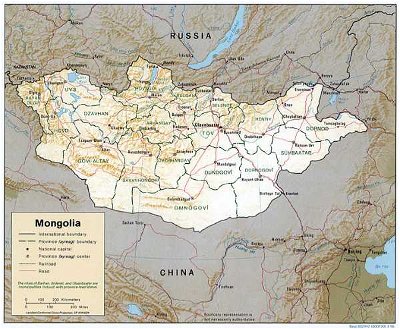
    Modern Mongolia borders Russia and China. Its area is 1,564,115.75 km2 (603,909 sq mi), making it the 19th largest country in the world. What else is true about Mongolia?Mongolia

      It is a landlocked country. In 2009, Mongolia had an estimated population of 2.7 million people. Mongolia is on the top twenty largest countries list, but at the same time it's one of the least densely populated independent countries in the world. Population density in Mongolia has been approximately two persons per 1 km2, and it is a landlocked country.

    According to official Mongolian statistics, about half of the population of Mongolia professes Buddhism, about 7% adhere to Shamanism or Christianity, and approximately 4% follow Islam. That leaves nearly 40% of the population following which religion?Mongolia

      None. Those approximate 40% are listed as having no religion. Mongolia was a socialist country, and Karl Marx's view that "religion is the opium of the people" helped raise generations of proud atheists. However, Buddhism and Shamanism are so deeply integrated into the Mongolian life and customs, that people follow some of the ancient ways and partake in religious practices, considering them to be more of a tradition than actual worship.

    The capital city of Mongolia was known under the names of Orgoo (Urga) and Khuree (pronounced as khoo-ray), which meant "the residence" and "the camp", respectively. In 1924 it was renamed Ulaanbaatar. What does Ulaanbaatar mean?Mongolia

      The Red Hero. Ulaanbaatar was named after Mongolian national hero Damdiny Sukhbaatar (1893-1923). He led the Mongolian liberation movement, with the help of the Russian Red Army, and ousted the Chinese and rogue Tsarist Russian troops. The Mongolian People's Republic was proclaimed in 1924. Mongolia became the second socialist country after the USSR. The main square of Ulaanbaatar is called Sukhbaatar square, and features his statue.

  • All content is (C)opyright 1995-2006 FunTrivia.com. Content may NOT be copied, reprinted, or distributed without our written consent. Feel free to link to any page you wish.

  • While we try to keep trivia as accurate as possible through a regular volunteer editing process, FunTrivia cannot guarantee the validity of the information found here. FunTrivia offers no professional advice, and you take all responsibility for your use of anything contained herein.
  • Feel free to send a note to a particular item's author for further details or source information; most of our authors love to hear feedback about their work.
  • See our conditions of use for details.