
Quizzes at Fun Trivia Fun Trivia | quizzes Quizzes | games Games | community People | services Services | help Help | me Me
New Player - Log In
Currently 10883 players online.   Trivia games, quizzes, and contests - FREE !     Get Started! quiz register
Fun Trivia : Northern Territory Encyclopedia FunTrivia

Structure

fun facts,factoids,info

Interesting Questions, Facts and Information

  • There are a total of 20 general entries.

Special Topics


Interesting Questions, Facts, and Information

    Northern Territory

    Which Darwin suburb's name is a palindrome?Basic Facts About Darwin

      Parap. A palindrome is a word or phrase spelled the same both backwards and forwards. Glenelg and Parap are both palindromes, but Glenelg is in South Australia not Darwin.

    What is the name of the main shopping centre in Darwin?Basic Facts About Darwin

      Casuarina Square. Casuarina Plaza is a small complex across the road from Casuarina Square. Hibiscus is a shopping centre in Leanyer, and there is no Orchid shopping centre in Darwin.

    Darwin was named after a person who was famous in which field?Basic Facts About Darwin

      Science. Charles Darwin was the man who came up with the theory of natural selection, which is part of the theory of evolution.

    Which destructive cyclone hit Darwin on Christmas Day 1974?Basic Facts About Darwin

      Cyclone Tracy. During the cyclone, wind speeds were so fast that they were off the scale of the measuring instruments.

    In which part of Australia is Darwin located?Basic Facts About Darwin

      Northern Territory. Darwin is the biggest city in 'The Territory'.

    Which National Park is right near Darwin City?Basic Facts About Darwin

      Charles Darwin National Park. The are great views of the city and harbour from the park. Kakadu NP is more than 200 km to the east, Litchfield NP is about 100 km to the south, and Wollemi NP is in New South Wales.

    Which statement best describes Darwin's rainfall patterns?Basic Facts About Darwin

      Lots of rain from December to February, little rain June to August. Darwin's climate is totally different from that of the big cities to the south.

    In Darwin, the capital city of the Northern Territory, we notice that all the buildings seem very new and modern-looking. A local tells us that this is because on Christmas Eve, 1974, the city of Darwin was all but flattened by a tropical cyclone. What was the cyclone’s name?A Northern Territory Odyssey

      Cyclone Tracy. The city of Darwin (named after famous evolution scientist Charles Darwin) was settled in 1839. On Christmas Eve, 1974, the city was hit by the full force of tropical Cyclone Tracy. The city was all but destroyed but has since been rebuilt with cyclone-proof houses and is now Australia's most modern city. Darwin is also a fast-growing city – the population has risen from around 44000 to over 100000 people in the years since Cyclone Tracy.

    Hitting the road in our 4-wheel drive (a must for travelling on outback roads!), we head due east out of Darwin en route to one of the many national parks in the Northern Territory. This one has been accorded double World Heritage status by the United Nations because of both its cultural and natural significance. Where are we going?A Northern Territory Odyssey

      Kakadu. Aborigines have been living in Kakadu for 40,000 years, making it the world's longest continuous surviving culture. Descendants of these people still live in Kakadu today. Kakadu and the adjacent Arnhem Land area to the east contain more than 5000 rock-painting galleries, illustrating this rich human history. Kakadu is also rich in wildlife, containing over 12,000 species of plants, 10,000 species of insects and hundreds of bird, mammal and reptile species. The region relies on the "wet" season (from November to March) for its water, which can be found in the many billabongs, creeks and other waterways that cover the area.

    Travelling south along the Stuart Highway, we enter outback Australia. Our next destination became one of the stations on the Overland Telegraph Line in 1872 and was at the centre of Australia’s last great goldrush in the 1930’s. What is the name of our next stop?A Northern Territory Odyssey

      Tennant Creek. The town of Tennant Creek derives its name from the nearby creek of the same name, which was named in 1860 by explorer John McDouall Stuart after a pastoralist who had helped him in his travels. The 3600 kilometre long Overland Telegraph Line was erected between Adelaide (in South Australia) and Darwin as a means for Australia to keep in closer contact with Britain. The original Tennant Creek telegraph station built in 1872 was a temporary structure and was replaced by a stone building in 1875. The station is now a museum located in a reserve approximately ten kilometres outside Tennant Creek.

    We take a slight detour off the Stuart Highway to take in another of nature’s wonders. We pull up to an area that has large boulders scattered all over it, like a giant has been playing a game. What are we looking at?A Northern Territory Odyssey

      Devil's Marbles. The Devil’s Marbles are so named because they look exactly like a giant game of interrupted marbles! In fact, they have been created by simple erosion of a single bed of granite over a period of 1500 million years, leaving a large number of smooth, round boulders ranging from one to three metres in diameter. The rocks seem to be balanced extremely precariously, as if one simple touch would knock them over! Aboriginal legend refers to the boulders as "Eggs of the Rainbow Serpent", and it's not hard to see why. At sunset, the boulders take on amazing colours ranging from warm gold to ruby red and are a sight to behold.

    Travelling south on the extensive Stuart Highway, we’re not far from our next destination, but before we get there, we cross an imaginary line circling the earth that officially separates tropical regions from the temperate zone. What is this imaginary line called?A Northern Territory Odyssey

      Tropic of Capricorn. The Tropic of Capricorn is the southern equivalent of the Tropic of Cancer, both of which enclose the tropical regions either side of the Equator and provide an official dividing line between the world’s tropical and temperate regions. A good deal of Australia lies above the Tropic of Capricorn; as well as the tropical north of the Northern Territory, there are tropical regions in far north Queensland and the north of Western Australia. Hmmm . . somewhere to go for our next trip, perhaps?

    Waving goodbye to the locals (while wondering why they’re running along what seems to be a dry riverbed in some kind of strange land-bound boat race . . oh well!), we head slightly southwest this time on the way to our next destination. On the way, we see a beautiful mountain range off in the distance. What is its name?A Northern Territory Odyssey

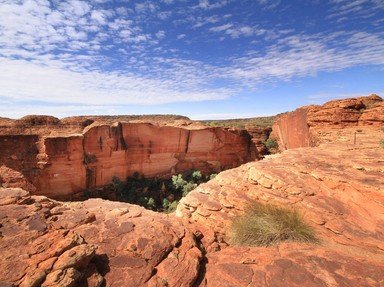
      MacDonnell Ranges. The MacDonnell Ranges contain more of the amazing scenery we've come to expect from the Northern Territory – peaceful waterholes, breathtaking gorges and dramatic rock formations. The MacDonnell Ranges are actually two separate mountain ranges running west to east; west of Alice Springs are the West MacDonnell Ranges, and to the east (you guessed it!) the East MacDonnell Ranges. While one of the longest sets of mountain ranges in the Northern Territory, they are broken up in several places by gaps caused by the running water of ancient waterways. The rock of the mountains is a rich red colour and is even more impressive at certain times of the day, such as when the rock is directly in the sunlight.

    As we approach this destination, we can see a series of rounded dome-shaped rocks rising from the ground. What is their name?A Northern Territory Odyssey

      The Olgas. The Olgas, known as Kata Tjuta to the local Aboriginal people, are a series of rock mounds west of Uluru. The name Kata Tjuta means "many heads", which is extremely appropriate, given that they do look rather like giant people popping their heads up from under the ground to see what's going on! There are 36 rock domes in total, with the tallest being Mt Olga at a shade under 550 metres. If you'd like to see exactly what they look like, pay a visit to http://www.australianexplorer.com/photographs/nt_landscape_olgas.htm, which has a number of photos of the Olgas (as well as lots of photos from all over of Australia). Sitting back in the car, we watch the setting sun's rays turn the Olgas a fiery red and decide that we'll definitely be back!

  • All content is (C)opyright 1995-2006 FunTrivia.com. Content may NOT be copied, reprinted, or distributed without our written consent. Feel free to link to any page you wish.

  • While we try to keep trivia as accurate as possible through a regular volunteer editing process, FunTrivia cannot guarantee the validity of the information found here. FunTrivia offers no professional advice, and you take all responsibility for your use of anything contained herein.
  • Feel free to send a note to a particular item's author for further details or source information; most of our authors love to hear feedback about their work.
  • See our conditions of use for details.