
Fun Trivia | Quizzes | Games | People | Services | Help | Me
Register - Log In
Index : P : Peru Encyclopedia FunTrivia

Structure

Interesting Questions, Facts and Information

  • There are a total of 30 general entries.

Frequently Asked Questions & Answers

  • There are 13 user-asked question matches ( goto )

Special Topics


Interesting Questions, Facts, and Information

    Peru

    Which city is the capital of Peru?Peru (morinpat)

      Lima. Arequipa (called 'The White City of Peru') is the second biggest city of Peru, Machu Pichu (an ancient Inca city) is one of the most popular tourist destinations in this country, while Santiago is the capital of Chile.

    What mountain range runs through Peru?9 for 10 - Peru (minch)

      Andes . To the east of Peru's coastal plain lie the Andes. The rivers running west from the Andes are responsible for the few fertile areas found on the coastal plain.

    What is the second largest city in Peru?9 for 10 - Peru (minch)

      Arequipa. The largest city in Peru is the capital, Lima, which has a population of between seven and eight million people. Arequipa had a population of around 720,000 at the beginning of the 21st century.

    What is the Peruvian currency called?Peru (morinpat)

      nuevo sol. Sol and inti is the former Peruvian currency, sucre is the present Bolivian currency.

    What is the official language of Peru?Peru (morinpat)

      Spanish. Spanish is the most widely spoken language in Peru. Quechua and Aymara are indigenous languages mostly spoken in the mountains.

    What is the name of the cold current that runs in the ocean off the coast of Peru?9 for 10 - Peru (minch)

      Humboldt Current. The cold current that runs from south to north off the coast is named after a German geographer, Baron Friedrich von Humboldt. It is this cold current that is responsible for the good fishing grounds.

    What is the major language spoken in Peru?9 for 10 - Peru (minch)

      Spanish. Like most other South American countries Spanish is the national language, although Quechuan, the language of the Incas, is also spoken. The name Peru comes from a Quechuan word meaning abundance.

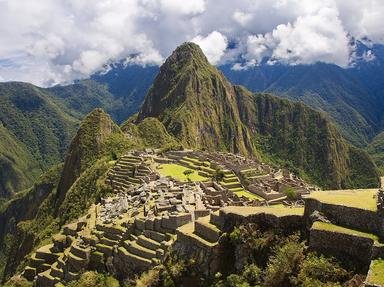
    We’ll finish our tour with the one site everyone just has to see: Machu Picchu, the lost city of the Incas. Abandoned for unknown reasons before the Spanish conquest, it escaped the ravages of war and survives as a stunning example of Incan stonework and urban planning. In the local language (Quechua), what does “Machu Picchu” mean?A Whirlwind Tour of Peru (CellarDoor)

      Old Mountain. Machu Picchu is named for the mountain it sits atop. In the most widely-published photographs, you can see other peaks just past the city limits, vaguely sketching the profile of a sleeping Inca. (This aspect is often emphasized in depictions on souvenirs.) The tallest of those peaks, the Inca's "nose," is Huayna Picchu, or Young Mountain. Four hundred people a day are permitted to climb that peak, an ascent that takes about an hour. Thank you for coming to Whirlwind Tours for your trivia needs! We hope you've enjoyed the quiz.

    We’ll break for a few hours to allow you to explore downtown Arequipa; it’s a great walking city. Afterwards we’ll continue east, to the body of water Peru shares with Bolivia. What is the name of this place, the highest navigable lake in the world?A Whirlwind Tour of Peru (CellarDoor)

      Lake Titicaca. Straddling the border between Peru and Bolivia with an average depth of 107 meters, Lake Titicaca has long been an important port and a cultural touchstone for local peoples. The founder of the Inca civilization, Manco Capac, son of a god whose identity varies from legend to legend, is supposed to have been born on Isla del Sol, on the Bolivian side of the lake.

    We’ll begin our tour in the northern part of the country, in the city of Iquitos. With 400,000 people, this is the largest city in the world that cannot be reached by car. Why is it so inaccessible?A Whirlwind Tour of Peru (CellarDoor)

      Iquitos lies deep in the Amazon river basin and is surrounded by jungle.. Founded by Jesuits in the 1750s, Iquitos spent a century as a quiet river port, before the rubber industry turned it into a boomtown and funded the beautiful mansions that you can see downtown. The rubber money is gone now (it's easier to harvest natural rubber from plantations than from virgin jungle), but with the discovery of oil in the area Iquitos is booming again.

    Unsurprisingly, history is thick around the Inca capital. We’ll take a day trip north of the city, to the Sacred Valley of the Urubamba River. Here we can wander through ancient villages, browse local craft markets, and tour ruined temples and fortresses. We’ll also see some of the best examples of an ancient agricultural technique to convert steep, barren hillsides into fertile fields, whose stepped appearance prevents water runoff and soil erosion. What is the name for this type of field, still used for crop cultivation today?A Whirlwind Tour of Peru (CellarDoor)

      Terraces. Many civilizations have used some variant of terracing to claim steep hills for irrigation, but the peoples of the Sacred Valley took it to an impressive level. Each terrace is perhaps four or five feet wide and four or five feet higher than the last one; they're separated by stone retaining walls. By breeding plants on successively higher terraces, farmers were able to gradually adapt numerous plants to high altitudes and cold weather (the temperature between one terrace and the next can differ by as much as a few degrees Celsius).

    There are outlines of huge animals and birds found in the southern desert area of Peru. These are known as the ----- Lines or Pampa?9 for 10 - Peru (minch)

      Nazca . Nobody knows exactly why these stylized drawings of animals, which include a hummingbird, a spider and a whale, were made. As well as the drawings there are also parallel lines which extend for many miles.

    The pattern and colours of the Peruvian flag are similar to those of which other country?Peru (morinpat)

      Canada. There are three red, white and red vertical bands on the flags of both these countries.

    The arid coastal plain of Peru is a continuation of the coastal desert of Chile. What is the name of this desert?9 for 10 - Peru (minch)

      Atacama. The Atacama desert is one of the driest areas in the world. The coastal desert of Peru receives little rainfall, although fog and cloud are prevalent.

    Take your time as we explore this lake on the Peru-Bolivia border; at 3812 meters above sea level, you should be careful not to exert yourself too much (and to apply plenty of sunscreen!) We’ll take a boat tour to the “Islas Flotantes,” artificial islands constructed by the Uros people when they feared their mainland neighbors were growing too aggressive. From what material do the Uros construct their islands? A Whirlwind Tour of Peru (CellarDoor)

      From totora reeds, which grow in the lake. While the Uros' method of isolating themselves was innovative, in the end it was not effective: after centuries of intermarriage with Aymara-speaking people on the mainland, the Uros' language and many of their customs have been lost. Several hundred Uros still live in reed houses on the floating islands; with a thriving tourist industry and no property taxes, it's not a bad arrangement. It is hard work, though: the islands must be continually rebuilt, with new reeds added on top as the old ones rot underneath. Rethatching takes place as often as twice a week during the rainy season!

    Peru borders which ocean?Peru (morinpat)

      Pacific. Peru borders the South Pacific Ocean, between Chile and Ecuador.

    Now we’ll head across country to the south of Peru – be sure to admire the scenery as we pass! We’ll cross through Lima, the immense coastal capital, and take a lunch break in the Plaza de Armas near its beautiful colonial churches. Our destination is the Islas Ballestas, home to tens of thousands of birds and a mainstay of the economy. What makes these islands so valuable to the people who live nearby?A Whirlwind Tour of Peru (CellarDoor)

      The bird droppings (guano) make one of the most effective fertilizers in the world, and are harvested for export.. The Islas Ballestas, which you can see on boat tours organized from the coastal city of Pisco, are rocky, barren outcroppings inhabited by sea lions and over 150 species of birds, including Humboldt penguins, pelicans, and cormorants. This area of the Pacific does indeed teem with fish (thanks to the cold Humboldt current), but industrial fishing is forbidden because the fish are more valuable as food for the guano-producing birds. Local fishermen ply their trade the old-fashioned way, with small boats and nets, and every five to seven years laborers come out to harvest the accumulated guano. White grapes for pisco are grown relatively nearby, in the dry Ica valley a two-hour drive from Pisco.

    Let’s go inland now to the desert city of Nazca, which was the center of a great and mysterious civilization about 1500 years ago. Artists and mathematicians of that people worked together to produce beautiful, sophisticated lines and drawings in the desert. What is the best way to see these famous Nazca lines?A Whirlwind Tour of Peru (CellarDoor)

      Take an aerial tour in a small airplane.. The Nazca lines are so shallow, so narrow and so long – the geoglyph of the condor has a 130-meter wingspan – that they can only be seen from the air, so they were “lost” for hundreds of years. In fact, the Pan-American highway cuts right through the middle of the lizard geoglyph because no one knew it was there! The skill and precision displayed by the ancient Nazcans, who created the lines by removing dark-colored topsoil to make trenches only two centimeters deep, is simply astounding. No one knows why the lines – which include over 70 pictures, 200 geometrical shapes, and 800 straight lines – were made, but a number of theories argue that they were meant to be seen by gods who lived on nearby mountaintops.

    How many inhabitants does Peru currently (2002) have?Peru (morinpat)

      27 million.

    How is the Peruvian dish generally prepared with fish or seafood called?Peru (morinpat)

      ceviche. The fish is raw, and it 'bakes' for a few days in lemon juice.

    For our next stop, we’ll move further inland and up into the mountains on our way to the beautiful city of Arequipa, the second-largest in Peru. This colonial town, nestled dangerously between several active volcanoes, is nicknamed “The White City.” Why?A Whirlwind Tour of Peru (CellarDoor)

      Many of Arequipa's buildings are made of a local, white volcanic rock called sillar.. Arequipa's volcanic neighbors, the most famous of which is El Misti, are both a blessing and a curse for this growing city. Volcanic ash has made the surrounding valley incredibly fertile, contributing to the city's importance; the region has thus been continuously occupied for over seven thousand years. At the same time, however, earthquakes have leveled much of the city six times in the last four hundred years. This violent history leads to some interesting sights in old buildings, as the architecture was rearranged to compensate for earthquake damage. Stairs leading nowhere are a common sight.

    First things first: we need to get you to Peru to meet up with the rest of the tour group. If you’ve gotten this far, you probably know that Peru is in South America – but is it north or south of the equator?A Whirlwind Tour of Peru (CellarDoor)

      Peru is south of the equator.. The equator passes through Ecuador, Peru’s aptly named northern neighbor, so Peru itself is a southern-hemisphere nation. Thus June 21 is the winter solstice, storm systems rotate clockwise, and northern-hemisphere visitors will find the constellations and lunar phases different from what they’re used to.

    Did everyone enjoy the cruise? We’ll head north now, remaining in the Andes but descending about 400 meters. Our destination is a city that has been called “the archaeological capital of the Americas,” thanks to its century as the capital of the vast Inca empire. What is the name of this city, where ancient walls and ruins may be found amidst colonial churches and mansions?A Whirlwind Tour of Peru (CellarDoor)

      Cuzco. Cuzco sits on an ancient lake, the old city describing the rough shape of a puma (with the plaza at its heart, and the fortress Sacsayhuaman at its head. The Spanish did their best to cover over most traces of the Incas, razing palaces and building churches atop temples, but the city's geology has been undoing their work. A 1950 earthquake leveled the church of Santo Domingo, revealing the major Inca temple complex Qorikancha which had lain intact underneath. Incan stonemasons had earthquakes in mind when they perfected their craft: walls lean slightly inwards, doors and windows have trapezoidal shapes, and stone blocks interlock like puzzle pieces. No wonder the temple survived when all around it did not!

Frequently Asked Questions about Peru

    • Is it true that there are no public toilets in Peru? ( goto )


    • Has snow ever fallen in Machu Picchu, Peru? ( goto )


    • What indian people ruled Peru before the Spanish took over? ( goto )


    • Which of the Earth's crustal plates is subducted into the Peru-Chile deep sea trench? ( goto )


    • If it's Peru in Portugal, Ethiopian in Arabic, French in Greek and Indian in Hebrew, what is it in English? ( goto )


    • Which country was called Upper Peru prior to its freedom from Spanish rule in 1825? ( goto )


    • There used to be people living in the mountains of Peru in a place called Machu Picchu. What happened to them? ( goto )


    • From which country did we get the first roller-coaster, Russia, Greece, Denmark or Peru? ( goto )


    • This fella is from Peru and travels to the United Kingdom to live with the Brown family. He enjoys sandwiches. Who is he? ( goto )


    • A little bear from Peru arrives in London wearing a dufflecoat and a red hat. Who or what is he named after? ( goto )


    • Is there any actual device besides that of extraterrestrials that could produce the crop circle formations so perfectly? What caused the Nazca lines in Peru like this? ( goto )


    • He was born and buried in Peru, was bisexual, served in the French Foreign Legion and was almost crippled in a riding accident. His life was the subject of a 1946 film. Who was he? ( goto )


    • In a recent poll of over 3,000 people, the most votes went to a place in Peru, followed by places in Cambodia, India and Jordan respectively. What was the poll about and what was the highest British entry? ( goto )


  • All content is (C)opyright 1995-2006 FunTrivia.com. Content may NOT be copied, reprinted, or distributed without our written consent. Feel free to link to any page you wish.

  • While we try to keep trivia as accurate as possible through a regular volunteer editing process, FunTrivia cannot guarantee the validity of the information found here. FunTrivia offers no professional advice, and you take all responsibility for your use of anything contained herein.
  • Feel free to send a note to a particular item's author for further details or source information; most of our authors love to hear feedback about their work.
  • See our conditions of use for details.