Quizzes at Fun Trivia Fun Trivia | quizzes Quizzes | games Games | community People | services Services | help Help | me Me
New Player - Log In
Currently 8087 players online.   Trivia games, quizzes, and contests - FREE !     Get Started! quiz register
Fun Trivia : Physical Geography Encyclopedia FunTrivia

Structure

Interesting Questions, Facts and Information

  • There are a total of 20 general entries.

Special Topics


Interesting Questions, Facts, and Information

    Physical Geography

    In terms of of plate tectonics, what geological process is occurring underneath the Himalayas? (both in the past and right now)?Physical Geography and Processes

      Convergence. Convergence boundaries occur where two continental plates collide into one another, and one begins to force the other underneath it, causing the crust of the earth to buckle and produce mountains. This process occurs under the Himalayas, where the Indian and Eurasian plates are converging. Conversely, mountains may also form from the collision of a continental plate and a oceanic plate, where similar folding of the earth's crust occurs, however, the mountain range does not appear directly above the point of collision. The Rocky Mountains in central USA are an example of this.

    The process of erosion has two primary components: Weathering and __________?Physical Geography and Processes

      Deposition. Although erosion is often presented as a destructive and unwanted process, it is actually a balanced system. While one part of the earth is gradually removed (weathering), another part of the earth is gradually being built up through the accumulation of eroded materials (deposition). Erosion is usually caused by wind or water movement.

    Dryland salinity, resulting from the deposition of salt crystals on the earth's surface, is caused by a rise in the height of the __________?Physical Geography and Processes

      Water table. Dryland salinity is a serious problem in the world's arid zones, and is a prime contributor to desertification. When an increase in rainfall suddenly occurs, or an overwatering of the land due to excessive irrigation, the water table underneath the land surface begins to rise and this brings dissolved salts dormant within the bedrock to the surface with it. When this surface water evaporates, it deposits these salts, which can kill vegetation and reduce arable land to desert.

    The majority of ozone depletion occurs in which layer of the atmosphere?Physical Geography and Processes

      Stratosphere. Whilst the Troposphere is the layer closest to the earth's surface, where the majority of our weather occurs and where our planes fly, it is the Stratosphere that constitutes the highest percentage of ozone (the ozone layer), protecting biological systems from harmful Ultra-Violet light. Because of this abundance, it is here that chemical air pollution freely destroys ozone molecules, creating holes in the ozone layer, such as that above Antarctica.

    The seasonal downpour of torrential rain that annually moistens the equatorial and tropical zones of the earth is known as the ________?Physical Geography and Processes

      Monsoon. The monsoon is the 'wet-season' that hits the regions within approximately 30 degrees north and south of the equator. This 3-6 month downpour is a result of a large portion of saturated, cold air reaching the equator from the polar regions each year. The monsoon is vital to the sustenance of agriculture that occurs all over the equatorial and tropical zones.

    Although prominent in the USA, these climatic phenomena occur all over the world. The destructive funnel of air that can form from severe storm cells I am describing is a _________?Physical Geography and Processes

      Tornado. Tornados, or twisters, form when a parcel of cold air collides with a parcel of warm air over land and begins to rotate due to the pressure differences between the two parcels. If the pressure difference is great enough, and provided there is sufficient energy from a parent storm cell, a tornado may reach the ground where it will destroy virtually everything in its path as it travels across the land with wind speeds of up to 300km per hour.

    The formation of algal blooms in waterways is a result of agro-chemicals running off into natural stream and river systems. This process of algal bloom formation from chemical input in known as ________?Physical Geography and Processes

      Eutrophication. Eutrophication results in algal blooms (or blue-green algae) forming on the surface of streams, lakes and rivers. Algal blooms are a type of plant matter that feed off nitrates and phosphates from agricultural runoff (fertilisers, pesticides, animal dung, machinery fluids) and grow to cover the entire surface of the water body. This prevents light and oxygen from entering the water, which can kill aquatic plants and animals.

    A leading cause of unemployment and lack of services in rural areas is a migration of people and capital towards large cities. This migration is known as ________?Physical Geography and Processes

      Rural-Urban Drift. Rural-Urban Drift is the phenomena which sees a large portion of young people move away from rural areas to large cities, where there are more job opportunities, more services, and more social interactivities. This exodus of labour and knowledge leads to large-scale unemployment, a depletion of services and often the 'death' of rural towns and their way of life.

    In the theory of the Global Warming, a major worldwide consequence recognised is the melting of _________?Physical Geography and Processes

      Polar Ice Caps. Global Warming (whether you believe it exists or not) would/will result in an increase of global sea-surface temperatures. While these changes (1-2 degrees in 10 years) do not seem much, this change is enough to drastically alter global climate patterns and begin to melt the polar ice caps in the Arctic Circle and Antarctica. The melting will further result in sea-level rises which could flood low-lying coastal cities such as Sydney or Los Angeles.

    As well as depleting the earth's resources at an astounding rate, which affects the ability of future generations to survive, the large-scale exploitation of fossil fuels (coal, oil, natural gas) leads to ________?Physical Geography and Processes

      All of these (Acid Rain, Land Degradation, Species Extinction). The over-exploitation of the earth's natural resources, particularly non-renewable fossil fuels, is fraught with environmental cost despite the economic benefits it produces. Coal mining can destroy arable land for decades to come and lead to habitat loss and species extinction. The combustion of coal and oil releases sulphurous compounds into the atmosphere which creates acid rain. And to top it off, the world is forced to listen to the Dixie Chicks whinge about the environment everyday. Are these prices worth the profits any one generation makes?

    Time to feel the burn! To begin our high-impact workout, this question will make you sweat! Which desert is Las Vegas found in?Let's Get Physical...Geography

      Mojave Desert. No time to stop as a Vegas buffet! Instead, you can work up a sweat around the Mojave Desert, home of Las Vegas, the Grand Canyon, and Death Valley, the hottest location in North America. The Mojave Desert is home to sparsely populated desert areas, though it's home to many native plantlife including the Joshua Tree, the California Fan Palm, and the Barrel Cactus. Numerous movies and music videos have been shot with this landscape as a backdrop. The Desert is also home to the nearby Hoover Dam and Zion National Park. Unsurprisingly, the Desert houses many diverse animals from Gila Monsters to Diamondback Rattlesnakes to rodents of all shapes and sizes. The highest temperature on the continent was recorded in Death Valley National Park which, reportedly, has the clearest night skies of all the national parks of the United States. Heck, think of all the muscles you'll tone pulling the slots at a Vegas casino, let alone jogging through the desert!

    Time for a fat-free fjord to get you in the mood to get in shape! What causes a fjord?Let's Get Physical...Geography

      A glacier. Why not move like a glacier to take off those pesky pounds, eh? When people tend to think of fjords, their mind wanders to Norway and Scandinavia, home to the most prominent fjords on the planet. These inlets tend to be narrow, and due to the fact that they're created by glaciers, erosion has worn away the bedrock of the surrounding walls to form the actual landscape. These are usually quite deep, and some have been known to contain coral. Fjords can be found in Europe, Canada, the tip of South America, Antarctica, and New Zealand. Due to the prominence of arctic ice, the Arctic Archipelago tends to get a fair bit of attention in the way of fjords as well. The world's longest fjord is in Greenland while the deepest is in Antarctica. I assure you that we'll move faster than glaciers though; erosion isn't the greatest way to work out.

    Now reach out in front, and to the side, and back to the front. Do the Rocky Mountains reach Nebraska?Let's Get Physical...Geography

      No. Although they can reach far to extend their bodies for a perfect workout, the Rockies don't reach out towards Nebraska, and that may force them to stay longer in the gym. The Rockies begin in the north, snaking down British Columbia and Alberta. As they reach the United States border, they head through a small bit of Montana and Idaho, a very small bit of Utah, and most of Colorado and Wyoming before coming to a halt in New Mexico. These don't quite run parallel to the Appalachians on the other side of the continent though. They run in a diagonal from Quebec and New Brunswick to Alabama. Their physical differences are obvious too. While the Rockies are quite rocky, the Appalachians are worn down; clear signs of erosion over time, and they're often covered in diverse trees and plantlife. The Rockies are home to Banff National Park in Canada and Yellowstone National Park in the United States. As demonstrated though, the Appalachians, over time, have reached for their goals and taken off some of the rocky outcrops through years of fine-tuning their natural bodies. I think we can all learn from them as well!

    Now onto nutrition! To get the best results, you'll need to fill your body with electrolytes, one of which is sodium, a component of salt. Is the Dead Sea saltier than the ocean?Let's Get Physical...Geography

      Yes. The Dead Sea covers the border between Israel and Jordan and its waters are fueled by the Jordan River, which then connects to the north at the Sea of Galilee. Oddly enough, the Dead Sea is hypersaline and it's the lowest lake in the world, while the Sea of Galilee is the second-lowest lake in the world despite the fact that it's freshwater. As well, due to the diversion of water, the Dead Sea tends to continue to get saltier. The salinity of the lake remains a popular feature as many people find increased buoyancy while in the waters. Being nine times saltier than the ocean has its benefits though- the climate is affected, resulting in sunny weather and warm temperatures regardless of the season, and many people find the waters to be therapeutic and calming on the body. Coincidentally, the shores of the Dead Sea are the world's lowest dry point. The world's highest saltwater lake is Namtso in Tibet. As long as you don't ingest the seawater, you'll end up fine during this fitness routine. In fact, after the workout, I'll suggest easing your muscles here, but until then, let's kick it up a notch!

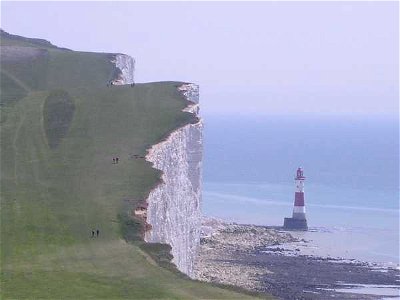
    Now that you're all warmed up, it's time to keep things going with our retro workout! Now to hit those tough spots to provide some great tone-ups and definition. Erosion has worn away which famous cliffs to give a defined whitish colour?Let's Get Physical...Geography

      Cliffs of Dover. The Cliffs of Dover are on the eastern coast of England facing out to mainland Europe, France, and the Strait of Dover. The Cliffs are particularly known for their chalky, whitish colour overlooking the sea and the natural barrier has withstood time, the sea, and threats of invasion in history. Although the sea does erode the cliffs, the damage hasn't been extremely significant so as to lose this natural wonder. The Cliffs of Moher are made of sandstone and shale. This cliffside is found on Ireland overlooking the Atlantic. The Calvert Cliffs are at Chesapeake Bay, Maryland and they're part of their own state park. Cape Point is at the southern tip of South Africa, located near Cape Town. This point is also near the Cape of Good Hope. Just think! Knocking off all that excess weight is proving to be tough, but we're nearing the end of our global workout!

    Okay! Now we're going to go to the floor and touch our toes. Once, twice, and three times! You should be able to feel the muscles tighten in your legs as you do this. Reaching as low as we can go, where is the lowest point on the Earth's surface?Let's Get Physical...Geography

      Pacific Ocean. At eleven kilometers below sea level, Mariana's Trench marks the planet's lowest point. This trench, formed by the collision of two tectonic plates (the folding of the Pacific plate below the Philippine plate) is near Guam and the Mariana Islands in the Pacific Ocean. Two men made the first ascent into the lowest part of the trench, the Challenger Deep, in a bathyscape in 1960, marking the lowest descent in world history. The lowest point of the Atlantic Ocean, the Milwaukee Deep, is near Puerto Rico. It's more shallow by two kilometers. Diamantina Deep is the lowest point in the Indian Ocean, located closest to Australia. Similar to the Milwaukee Deep, it reaches about eight kilometers in depth. The Eurasian Basin in the Arctic Ocean is around five kilometers and the Southern/Antarctic Ocean reaches a low of seven kilometers at the South Sandwich Trench. See, stretching is great in moderation, and it's a great way to keep yourself fit for globetrotting!

    The workout seems to be working out, and slimming down couldn't be any easier! Now I know, you're probably divided still on the benefits of our retro workout, but the results will prove that it's a killer way to get it done. Speaking of being divided, what geographical location divides the Indian Ocean and the Atlantic Ocean?Let's Get Physical...Geography

      Cape Agulhas. Cape Agulhas is at the southern tip of the African Continent, only a small distance away from Cape Town, South Africa and the Cape of Good Hope. Also known as 'The Cape of Needles', since it's home to many natural hazards for ships passing through, the location boasts a lighthouse and is known for rather large waves and storms. The Cape of Good Hope, located nearby around Falsche Bay, is also quite popular and is also viewed as the dividing line in many cases. This is not quite true though; Cape Agulhas was designated as the dividing line in terms of hydrography. Cape Horn is nowhere near either of these places; it's at the tip of South America. Until the Panama Canal was opened, this cape was quite popular in terms of sailing and navigation. Cape Horn makes up the southernmost portion of the Chilean piece of Tierra del Fuego. Once again, 'The Horn' is quite dangerous due to the windy and wavy waters (much like Agulhas). Cape Town is in South Africa. It's also its second-largest city. Heck, you could use a cape yourself, completing this superhero workout! Almost there! Just a few more reps and you'll be done!

  • All content is (C)opyright 1995-2006 FunTrivia.com. Content may NOT be copied, reprinted, or distributed without our written consent. Feel free to link to any page you wish.

  • While we try to keep trivia as accurate as possible through a regular volunteer editing process, FunTrivia cannot guarantee the validity of the information found here. FunTrivia offers no professional advice, and you take all responsibility for your use of anything contained herein.
  • Feel free to send a note to a particular item's author for further details or source information; most of our authors love to hear feedback about their work.
  • See our conditions of use for details.