Register New Player - Log In
Welcome to our world of fun trivia quizzes and quiz games:     New Player quiz register Play Now! trivia game
Fun Trivia : Alexander The Great Encyclopedia FunTrivia

Structure

fun facts,factoids,info

Interesting Questions, Facts and Information

  • There are a total of 100 general entries. We are selecting 30 for display.

Special Topics

Interesting Questions, Facts, and Information

    Alexander The Great

    How old was Alexander when he died?Alexander the Great

      32. On June 10, just a month short of his birthday in 323 B.C., Alexander the Great died at the age of 32.

    In which city did Alexander take seriously ill and die?Alexander the Great

      Babylon. Alexander took ill in Babylon, and died a few days later.

    Which new weapon did Alexander's army meet for the first time in India?Alexander the Great

      Elephants. They fought with elephants, which the Macedonians had never seen before.

    Having conquered Persia, where did Alexander then march his Army?Alexander the Great

      India. The greatest of Alexander's battles in India was against Porus, one of the most powerful Indian leaders, at the river Hydaspes in July 326 B.C. Alexander's army crossed the heavily defended river in dramatic fashion during a violent thunderstorm to meet Porus' forces. The Indians were defeated in a fierce battle.

    After further battles and hundreds of miles of pursuit how did Darius die?Alexander the Great

      Assassinated. When he finally caught up to him, he found the Persian king dead in his coach, assassinated by his own men. Alexander had the assassins executed and gave Darius a royal funeral.

    What did Alexander do when faced with the famous Gordian Knot?Alexander the Great

      Cut it with his sword. The legend behind the ancient knot was that the man who could untie it was destined to rule the entire world. Alexander simply slashed the knot with his sword and unraveled it.

    Alexander won a decisive victory over the far larger Persian Army, causing the Persian Emperor Darius to flee. What 'prizes' did Alexander find amongst Darius' treasures in his camp?Alexander the Great

      Darius' Mother and Wife. Alexander not only captured Darius' throne tent, he also found himself with Darius' complete entourage. There were 3,000 talents of gold - one talent was 27kg of metal (60 lbs) - the amount of weight that a man could carry for a whole day). Also inside were Darius' mother, Sisygambis, Darius' wife, Stateira and several other princesses and noblewomen.

    Alexander the Great's horse had a legendary strange fear. What was it?Alexander the Great

      His own shadow. Alexander had noticed Bucephalas was afraid of his shadow on the ground. After turning the horse into the sun and away from the shadow, Alexander quickly quieted the mount and proceeded to ride the horse. From that day on, Bucephalas was Alexander the Great's horse who would carry Alexander into most of his battles over the ensuing years. When Bucephalas finally died in 326 B.C., Alexander had a state funeral for him and built a city in India where he died, naming it Bucephala.

    Even Alexander's horse was famous can you name him?Alexander the Great

      Bucephalas. Alexander's horse Bucephalas was a magnificent black stallion that had a white blaze on his forehead.

    Alexander felt that he was 'divine'. Indeed his mother claimed it was not Philip that concieved Alexander, but what?Alexander the Great

      A Serpent. Olympias, maintained that it was not her husband, Philip, who impregnated her, but rather a serpent. This is very interesting because a serpent is closely identified with the god, Zeus Ammon.

    Who was Alexander's famous Greek mentor?Alexander the Great

      Aristotle.

    Athens quickly decided to come to terms with Alexander and the pact was sealed when he visited the Oracle at Delphi. The Oracle was not giving prophecies that day, but Alexander dragged the priestess to the place where she gave her prophecies, she screamed what?Alexander the Great

      'My son, you are invincible '. That was all that Alexander wanted to hear, and he departed in the spring of 334 B.C.

    The young Alexander soon established himself, put down a Babarian rebellion, then savagely attacked which Greek city?Alexander the Great

      Thebes. The Macedonians, stormed the city, killing almost everyone in sight, women and children included. They plundered, sacked, burned and razed Thebes, as an example to the rest of Greece.

    How did Alexander's father Philip II meet his untimely death?Alexander the Great

      Assassinated. A man named Pausanias rushed forward from the crowd and stuck a dagger in Philip's chest. During his escape, Pausanias tripped and fell and was killed on the spot.

    His father was Philip II of Macedonia, but who was his mother?Alexander the Great

      Olympias. While Philip was away at war for as much as three years at a time, it was Olympias who was left behind in Pella to administer Macedonia. Later when her son left for Asia, it was Olympias who again managed Macedonia and the west for a third decade. After Alexander's death, it was Olympias whom the Macedonians recalled from her retirement in Epirus to return to Pella as the Guardian of the Two Kings. Olympias became the first and only Macedonian woman to rule the Empire and the example of excellence for generations of Macedonian Queens who followed her over the next three centuries.

    Alexander the Great was born on or around July 20, 356 B.C. What major event occured on the same day?Alexander the Great

      Burning of the Temple of Artemis at Ephesus. Legend says he was born on the same day as the Temple to Artemis at Ephesus (one of the Seven Wonders of the Ancient World) was burned down. No one knows for sure, but it was definitely in the summer of 356 BC.

    In 340 BC, Alexander was named regent of Macedonia in Philip's absence. Philip, who was away fighting, had given his son the power to rule over his kingdom. During Alexander's time as regent, the Maedi of northen Macedonia revolted. Alexander, doing as a ruler must, crushed the revolt and established a Greek colony. What was its name?Alexander the Great's Early Years

      Alexandroupolis. The Maedi lived in what is now Bulgaria. It was not unusual for cities and tribes to revolt against their rulers (the Greek city states had been beating each other to death for over a thousand years before Alexander's birth). However, as regent whilst Philip was away, the young Alexander took up arms and headed north. Upon news of his victory, Philip made Alexander a general in his Macedonian army.

    Alexander did not live in Pella for the duration of his education under Aristotle. The boy-prince was sent to a little rural sancturary near the Macedonian capital, Pella. Where did Alexander and his companions go?Alexander the Great's Early Years

      Mieza. The ruins of Mieza lie twenty miles from those of Pella in the north of modern day Greece. Alexander was sent to Mieza when he was around thirteen. Alexander spent several years in the city under Aristotle before finishing his education where it is said, in some accounts, that the famous philosopher and Alexander became estranged from each other over the differences in their views towards foriegners. Aristotle condemed many foriegners as barbaric in nature while Alexander believed that Macedonians and foriegners could merge as one. It was this point of view that made Alexander many enemies within his own army in later life.

    When Alexander was learning how to make offerings to the gods he threw two whole handfuls of incense into a sacred fire. His tutor was furious with such waste and told the child off, saying "When you've conquered the spice-bearing regions, you can throw away all the incense you like. Till then, don't waste it". Who was tutor?Alexander the Great's Early Years

      Leonidas. Alexander never forgot Leonidas' words. And when he conquered the lands around Gaza (which was one of the major spice resourses), Alexander sent Leonidas eighteen tonnes of frankincense and myrrh with a letter in the shipment, telling the old tutor not to be stingy any more as he now owned enough incense to make himself inexhaustibly rich.

    Alexander's famous horse was named Bucephalus. The name Bucephalus has another meaning. What is it?Alexander the Great's Early Years

      Ox head. The poor horse had a strangely shaped head and a terrible attitude. There's an old story that a Thessalian called Philoneicus brought a wild untamed horse to Pella. He presented the horse to the king and watched as Philip II grew upset with the horse's manner. The king was eventually swearing and shouting after every attepmt to control the horse had failed. Alexander was also watching and told his father that he had the ability to tame the horse, and if he could not then he would pay Philoneicus the full 13 talents (around £780 according to the 1994 "World Almanac"). Alexander did not fail in taming Bucephalus, as he had seen that the animal was afraid of its own shadow. Alexander took the reigns, showed the horse the sun and whispered soothing words in its ear. The boy prince gently walked beside the horse until the animal was comforted and calm enough to ride. The rest is history ... Bucephalus died in 326 BC of battle wounds. Alexander named a city called Bucephala after his beloved horse. It exists today in northern Pakistan as Jhelum.

    Ironically, Alexander the Great said these words when he heard of his father's conquests. What did he say?Alexander the Great's Early Years

      "My father will get ahead of me in everything, and will leave nothing great for me to do.". Alexander wept when Philip II had crushed the enemy Greek, Illyrian and Thracian cities on the Macedonian border. Before the death of Philip II the Greek cities were in revolt and were plotting against him and Macedonia. They labelled the latter "barbaric" and called on the other Greek cities (such as Athens, Sparta, Thebes) to put aside their violent past and their grudges and unite. They even went as far as asking the Persians for aid. When Philip defeated the main Greek army, he announced that he was the sole ruler of Greeks when the war against the Persians came (in much the same way as Agamemnon had done with the Greek cities before attacking Troy). And so it is unsurprising that Alexander felt a little deprived of the glory to be had in the known world.

    How many points are there on the Argead Star?Alexander the Great's Early Years

      16. The Argead Star was the standard of Macedonia when Philip II reigned as king. This symbol was put on many artefacts that were found in a tomb at Verghinia that is believed to be Philip II's tomb. One was a small golden box holding human remains. I haven't found any reason to believe that Alexander used this standard after his father's death.

    Alexander took the title of King after his father's death. For years Philip had gathered the strength of the Macedonians for the eventual war against the Persians. Though young, Alexander stepped into his father's shoes and declared war against the Persians. But before he stepped into Asia he consulted the Oracle at Delphi for one of its famous prophecies. But unfortunatly, it was a day when the Oracle was forbidden to prophesy. Alexander attempted to drag the priestess to the temple. Realizing that nothing would stop him, the priestess gave Alexander an answer. What did the priestess say?Alexander the Great's Early Years

      "My son, you are invincible!". This happened after Alexander had sealed his authority over Greece and Macedonia. After Philip's death, Alexander was considered "just a boy" compared to his father. The words of the priestess was all he needed to hear before he set off for Asia in 334 BC.

    Who killed Philip II of Macedon?Alexander the Great's Early Years

      Pausanias. Aristotle conducted an investigation after Philip's death and he stated that a man named Pausanias was having a sexual relationship with Philip that went sour. After a few years, the old Pausanias was replaced by another man of the same name beside the king (which was not uncommon as Phillip had many lovers). But it was the elder Pausanias who made matters worse for his jealousy made him provoke his young rival. The young Pausanias committed suicide after his ordeal with his namesake beacme unbearable. Attalus - one of Philip's generals who was also the Greek who had the famous row with Alexander - blamed the elder Pausanias for the suicide and had him raped after a meal. Pausanias, enraged by this insult, demanded that Phillip take revenge on Attalus to regain his honour. But as Attalus was such a good general and an uncle of his wife Eyridice, Philip refused. Pausanias then waited for the right time to assasinate Philip, and seized the moment at the wedding of Philip's daughter Cleopatra to a Macedonian prince by the name of Alexander of Epirus. This event is all the more famous as it was the day that Philip II's "face was placed amoung the gods". Before Philip was killed, twelve statues of the Greek gods were paraded before the wedding with the king's own statue coming last, but with no less applause.

    Alexander was brought up in Pella, which now lies in ruins in modern Greece. His father, Philip II, spared no expense with his sons education and had the famous Aristotle teach him. Aristotle came from Athens, but who was Aristotle's teacher?Alexander the Great's Early Years

      Plato. Aristotle was once hailed as being called "the most intelligent man alive", and so no-one was better suited to teach Philip's son.. Aristotle lived in Athens, taught by Plato. When Socrates died, Plato travelled to Egypt and Italy, studied with students of Pythagoras, and spent several years advising the ruling family of Syracuse. Eventually, he returned to Athens and established his own school of philosophy at the Academy. For students enrolled there, Plato tried both to pass on the the Socratic heritage and to guide their progress through mathematical learning. Plato was also fond of astronomy, believing that the planets rotate around the earth. Obviously, this theory was wrong, but not the theory that the moons light is the reflection from the sun. Plato died around 347 BC, aged about 80.
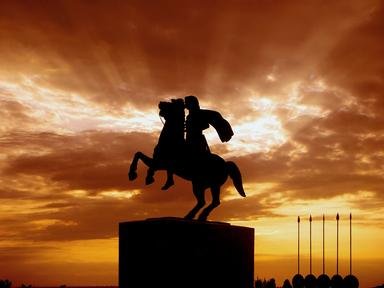

    Alexander was born on 21st July 356 BC in Pella. Son to the great King Philip II of Macedon and Olympias, princess of Epirus. Some other myths would have it that he was the son of Zeus and Olympias. On the eve of his birth there was another great event that scarred history. What happened?Alexander the Great's Early Years

      The Temple of Artemis at Ephesus was destroyed by fire. Herostratus was a young man who desperatly wanted his name to echo through the ages, so he decided to make his mark in a most terrible way, kowing that it would effect the known world at the time. The Temple of Artemis at Ephesus was one of the seven wonders of the ancient world, and Herostratus its destructor. Herostratus burned down the temple and, instead of denying the blame, admitted to it. Unsurprisingly, Herostratus was executed and any mention of his name was under the penalty of death, to make sure that the dead arsonist's wish did not come true. Despite the effort, Herostratus' name is widely known and exists today in both German and English languages. In German, for example, "Herostrat" is an individual in constant pursuit of fame. The English term "Herostratic fame" is derived from Herostratus.

    In the Battle of Issus ______ Macedonians were killed? (Artus)Alexander the Great:: Battle Tactics

      450. Even this figure may be exaggerated.

    Before Guagamela what did Arrian say was the main reason for Darius' defeat?Alexander the Great:: Battle Tactics

      He made his men stay up all night. According to Arrian, the fact that the Persian army stayed up and were mentally and physically drained before the battle even began. As for the Macedonians, Alexander made sure they were well rested.

    Leading up to the Battle of Issus, what gates did Alexander believe Darius was close to?Alexander the Great:: Battle Tactics

      Syrian. A mistake that turned into an advantage. A display of Alexander's ability to adapt to any situation.

    Prior to the Battle of Granicus who suggested that the Persians should destroy Alexander's supply route?Alexander the Great:: Battle Tactics

      Memnon. It was a big error on the Persians' part. Alexander could not afford to lose this battle. Destryoing their supply route would have led to Alexander's death through starvation and lack of money. Had the Persians won the battle, Alexander would not have been able to become the King of Asia.

    How did Roxana die?Roxana: Wife of Alexander the Great

      She was murdered along with her young son. In 316 BC, Roxana was taken captive by the powerful commander Cassander. Cassander and the other leaders agreed to a peace treaty and promised to govern the realm until Roxana's son came of age. The treaty was a ruse, however, and both mother and son were murdered (likely by poison) about seven years after their capture.

  • All content is (C)opyright 1995-2006 FunTrivia.com. Content may NOT be copied, reprinted, or distributed without our written consent. Feel free to link to any page you wish.

  • While we try to keep trivia as accurate as possible through a regular volunteer editing process, FunTrivia cannot guarantee the validity of the information found here. FunTrivia offers no professional advice, and you take all responsibility for your use of anything contained herein.
  • Feel free to send a note to a particular item's author for further details or source information; most of our authors love to hear feedback about their work.
  • See our conditions of use for details.