|
Structure
Interesting Questions, Facts and Information
- There are a total of 135 general entries. We are selecting 30 for display.
Special Topics
|
Interesting Questions, Facts, and Information
German
When did Germany FIRST become a unified country with a central government? | Germany 1815-1914
|
1871. Until 1866-67 the country was a patchwork of loosely confederated states.
About how many states did the German Confederation (der Deutsche Bund) have when it was created in 1815? | Germany 1815-1914
|
40. The exact number was 35 hereditary monarchies (including duchies and so on) together with 4 Free Cities (Hamburg, Bremen, Frankfurt and Luebeck) - 39 in all (in 1815). This represented a very substantial reduction on the 365 or so states in the Holy Roman Empire on the eve of the French Revolution.
Which German author enjoyed cult status in Germany from before the start of this period till 1860 and beyond? | Germany 1815-1914
|
Goethe. Johann Wolfgang von Goethe (1749-1832), best known for 'Faust' and other dramas, for his lyrical poetry and his novel 'Werther', enjoyed cult status not only in Germany but further afield, including Britain and France. Schiller was popular in much of Europe but never a cult figure. Hegel and Kant were philosophers. They both enjoyed a certain vogue outside Germany.
Many states in the German Confederation were 'police states', especially in the period 1815-1848. What, however, did these nineteenth-century police states NOT do to those whom they regarded as subversives? | Germany 1815-1914
|
Send them to concentration camps. The Carlsbad (or Karlsbad) Decrees of September 1819 introduced strict censorship, banned 'subversives' from employment in government service, put the universities under political surveillance and drastically restricted individual freedom. Most of the states also had further, often severe restrictions, too - for example on the right to holding public meetings. With a handful of exceptions, the governments avoided physical ill-treatment of 'subversives', except in parts of the Habsburg domains in 1848-49.
In 1848, German liberals, together with many conservative nationalists, elected a rebel Parliament. Where did it meet? | Germany 1815-1914
|
Frankfurt am Main. Some of the more radical liberals moved to Stuttgart after the Frankfurt Parliament had been dissolved - and a few of these ultimately fled to Switzerland.
1825. The first areas to indutrialize were the Northern Rhineland and the Ruhr, Saxony (all from about 1825 onwards) and somewhat later, also Upper Silesia.
Prussia was keen to advance its commercial development and to this end established the 'Zollverein', to which other German states also belonged. What kind of organization was this? | Germany 1815-1914
|
Customs union. The 'Zollverein' is widely seen as a forerunner to political union under Prussian leadership.
Bismarck . Otto von Bismarck is one of those politicians that many historians like to refer to as a 'stateman'. The unification of Germany under Prussian leadership is regarded as his most important achievement.
In 1878, the German government used two unsuccessful assassination attempts on the Kaiser as an excuse to ban one of the opposition parties and seize its assets. The ban remained in force till 1890. What was this party? | Germany 1815-1914
|
Social Democrats. It was more than simply a ban. It enabled the authorities to subject the Social Democrats to harrassment, and the publication of Socialist literature was illegal.
In 1897, Germany embarked on unsuccessful negotiations to form an alliance with another power. Which? | Germany 1815-1914
|
Britain. The negotiations foundered largely because Britain was only willing to offer Germany the role of a junior partner in any such alliance, and the German government didn't want anything less than equality with Britain.
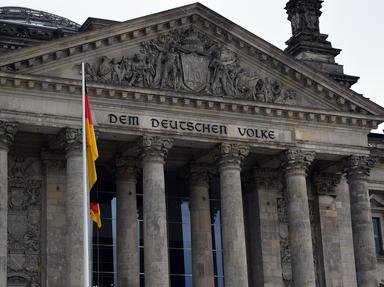
Reichstag . Its powers fell far short of what is taken for granted in a democracy, but grew gradually in the period c. 1890-1914.
German Reich (Deutsches Reich). The term "Weimar Republic", though widely used by historians, has always been a nickname. At the National Assembly that met in Weimar early in 1919 to draw up a new constitution, the Left pressed for the adoption of the name "German Republic", but this was rejected by the majority.
From 5-12 January 1919 there was a Spartacist uprising in Berlin, which was brutally suppressed. What were the Spartacists? | German History 1918-33
|
The radical left. The Spartacist uprising began as a demonstration called by the Independent Social Democrats (USPD), supported by the newly founded Communist Party of Germany (KPD). The demonstration soon developed into an uprising. It was suppressed with maximum force by units of the German Army and by volunteers. Three days after the end of the fighting Rosa Luxemburg and Karl Liebknecht, both founder members of the KPD, were assassinated by a unit of the Prussian Guards.
Weimar. Hence the informal name, the "Weimar Republic". The official name of Germany remained "Deutsches Reich".
It made it relatively easy to rule by decree. In view of the fact that it was drawn up soon after the two Spartacist uprisings it is not suprising that provision was made for states of emergency. However, the Weimar Constitution allowed for the indefinite suspension of democractic processes without safeguards.
The new government, headed by the Socialists Democrats, had to sign a harsh peace treaty for Germany. Where? | German History 1918-33
|
Versailles. The Treaty of Versailles made Germany accept legal responsibility for starting World War I and thus imposed heavy reparations, that is payments, on Germany. In addition, Germany's armed forces were reduced, and Germany lost territory. It was extremely unpopular in Germany. The fact that it had been signed, under duress, by Germany's first ever democratically elected government soon after coming to office played a part in undermining support for democracy itself in Germany.
In March 1920 there was an unsuccessful right-wing putsch in Berlin. How is it referred to? | German History 1918-33
|
Kapp-Putsch. The Kapp-Putsch collapsed because of popular resistance and a general strike in Berlin. (Kapp himself was a mere figure-head; the key 'putschists' were elements of the Army, the mercenaries and German Nationalists). After the collapse of the Kapp-Putsch, civil war erupted in the Ruhr, the Northern Rhineland and in the industrial areas of Saxony.
November 1923. The currency was finally stabilized at 1 (German) billion (= 1 US billion) marks to one. Much of the credit for this goes to the controversial Hjalmar Schacht.
Munich 1923. It was this failed putsch that resulted in Hitler being imprisoned. It also provided the Nazis with an object lesson in how NOT to gain power ...
The period is well known for a flowering of many branches of the arts in Germany, including literature (especially drama), the film, painting, architecture and design. The 'Bauhaus' is associated with the name of ...? | German History 1918-33
|
Gropius . The 'Bauhaus' and Gropius were highly influential throughout Europe and further afield in the field of architecture and design. Their work, which favored simplicity, contributed significantly to 'modernism' in these areas. His work was later (1937 onwards) continued in the USA.
Which actress starred in the film 'The Blue Angel' and settled in the USA when the Nazis came to power? | German History 1918-33
|
Marlene Dietrich . The film "The Blue Angel" is based on the bitingly satirical novel by Heinrich Mann "Professor Unrat" (literally "Professor Filth").
Who was Chancellor from August-November, 1923 and then Foreign Minister till his death in October, 1929? His greatest achievements included a signficant improvement in relations with the Western powers and negotiating the entry of Germany into the League of Nations. His name was ...? | German History 1918-33
|
Stresemann . He had been a German Nationalist, but by 1923 was a cool-headed realist who had considerable success in rehabiliating Germany's international standing.
1932. Hitler had been born an Austrian citizen. He obtained German citizenship when the state of Brunswick (Braunschweig), which was under Nazi control, employed him for a couple of months in 1932 as a civil servant. (Civil servants had an almost automatic right to citizenship).
The Nazi Party (NSDAP - Nationalsozialistische Deutsche Arbeiter-Partei = National Socialist German Workers' Party) was founded in 1920. Where? | German History 1918-33
|
Munich. In the early years, support for the Nazis was particularly strong in Southern Bavaria and adjoining areas of Austria and of the Sudetenland (in Czechoslovakia). When the Nazis gave various German cities fancy names, Munich became the 'Stadt der Bewegung' ('City of the [National Socialist] Movement.'
The 'Great Inflation' was one of the DIRECT and IMMEDIATE causes of the Nazi seizure of power. True or false? | German History 1918-33
|
f. Until quite recently, many history books gave the inflation as one of the causes of the Nazis' rise to power. However, the currency had been stabilized in 1923. The longer term political effects of the inflation were more diffuse. It further undermined confidence in the Weimar Republic (and in democracy). Moreover, when confronting the Great Depression in the early 1930s, the inflation made some obvious remedies, such as devaluing the currency, politically impossible.
The first President of Germany was Friedrich Ebert. Who succeeded him in 1925 and appointed Hitler as Chancellor in 1933? | German History 1918-33
|
Hindenburg . On Hindenburg's death in 1934 the presidency was left vacant and Hitler assumed the title of Fuehrer of the German Reich instead. (He was already Fuehrer of the NSDAP).
Gen. Alfred von Schlieffen. The plan did not succeed, though, and resulted in a trench war over 3 years.
12. These 12 years however, proved to be enough to change the course of history forever.
United States, Soviet Union, Great Britain and France. The zones of the United States, Great Britain and France were to make up the German Federal Republic, whereas the Soviet zone became the German Democratic Republic.
Konrad Adenauer. The former mayor of Cologne is remembered as the father of the Republic.
The 1960's: After having allegedly leaked secret information, there was a crackdown on the news magazine 'Der Spiegel'. Who was the then Minister of Defence who triggered the affair and had to resign afterwards? | 20th Century German history through the decades
|
Franz-Josef Strauss. Franz-Josef Strauss was one of the most controversial as well as most influential political figures in the history of the German Federal Republic. He served as Defense Minister, Finance Minister, Prime Minister of Bavaria and in 1980 was defeated in a chancellor election by Helmut Schmidt.
|