|
Structure
Interesting Questions, Facts and Information
- There are a total of 40 general entries. We are selecting 30 for display.
Special Topics
|
Interesting Questions, Facts, and Information
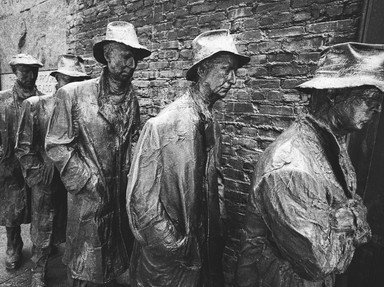
The Great Depression
October, 1929. On October 23, the Dow Jones lost an average of 21 points AN HOUR. Thursday October 24, 1929 was called Black Thursday because it was a devastating time for investors who suddenly saw how over-priced their stocks were, and that the market would crash. The Dow Jones continued to fall till July, 1932, when it 'bottomed out' at around 48 points.
Migrant workers from Oklahoma and other states in the "Dust Bowl". Obviously, the term "Okies" originally referred to people from Oklahoma, but it was applied to migrant farm workers (and farmers) from the dust bowl. Parts of west and southwest America had a series of very dry summers, and high winds. A lack of good soil caused waves of dust to fly around. This ruined crops and farmers couldn't pay bills. (There was a severe agricultural depression in addition to the industrial depression).
none of these. Eleanor Roosevelt was FDR's wife and a distant relation. She travelled for him while he was sick, and had very humane beliefs, example, she was against the Jim Crow laws.
As soon as he was in office, FDR immediately launched an economic program to try to boost the US economy and to give hope to discouraged Americans. What was this? | The Great Depression in America
|
The New Deal. There were several programs established in the New Deal, including the CCC, the PWA, and the FDIC. There were actually two New Deals.
Hoovervilles . These were little one room shacks occupied by poor families during the Depression, named after Hoover because they blamed him for their troubles.
WWII. The beginning of WWII caused a need for more production and more jobs and helped America out the slump behind it. (In Europe, large-scale re-armament from 1934-35 onwards played a key role in ending the depression there, too).
Franklin Roosevelt. The president was Franklin Roosevelt, who created the "New Deal" in an attempt to alleviate the Depression.
What did people call the shanty towns, in which the hobos and poor people lived? | The Great Depression
|
Hoovervilles. These "towns" were called Hoovervilles, also known as "cardboard jungles". Other items were named after him too, such as "Hoover Blankets" which were newpapers that served as blankets.
Curtisvilles. They were named after the vice-president, Curtis.
Al Capone. Al Capone opened the soup kitchen to make himself more popular. Even though a gangster, people were grateful for his help.
What other country faced a particularly severe depression about the same time as America? | The Great Depression
|
Germany. All the major industrial countries were affected but the depression was at its worst in America and Germany. The depression in Germany played a key part in bringing the Nazis to power in that troubled country.
John Steinbeck. "The Grapes of Wrath" was written by John Steinbeck. It upset many Californians, even was banned from many schools and such in CA, but it told the truth of how the "Okies" were treated - something that no one really wanted to hear.
1935. "Monopoly" was on the market in 1935, and a very popular game. This was because the thought of being rich enough to buy and sell properties was fun!
42. As Zinn states on page 382, "prosperity was concentrated at the top". This, though, is not a trend unique to the 1920s. The rich versus poor gap also grew in the 2000s.
As Zinn states "Few political figures spoke out for the poor of the twenties". Zinn talks about one of the few that did. He was a Congressman for the immigrants of East Harlem who stated "I asked for your help and you send me a bulletin. The people of New York cannot feed their children on Department bulletins". Can you name this Congressman who has an airport named for him? | A People's History of the Great Depression
|
Fiorello La Guardia. William Jardine was the secretary of agriculture to whom La Guardia sent a request to find out why the price of meat was so high. Jardine sent him a pamphlet on "how to use meat economically". La Guardia replied with the above response plus some additional words including "The housewives of New York have been trained by hard experience on the economical use of meat".
It didn't lower taxes for the top income bracket.. The Mellon bill lowered taxes for all income brackets, but did so more for the rich than the poor. According to Congressman Connery of Massachusetts "When I see a provision in this Mellon tax bill which is going to save Mr Mellon himself 800,000 on his income tax and his brother 600,000 on his, I cannot give it my support" (Zinn, pp.384-385).
"the economy was fundamentally unsound". Accoring to Zinn (p386), Galbraith further points to "very unhealthy corporate and banking structures, an unsound foreign trade, much economic misinformation, and the bad distribution of income".
Congress pay off their bonus certificates.. War veterans from the First World War came to DC to demand that the government pay off their bonus certificates, given they could not find work and could not wait until the time they would come due. It inspired a bill that was passed in the House, but failed in the Senate. After the failure in the Senate some of the war veterans left and the rest were evicted by the army on Hoover's orders.
Creation of the National Labor Relations Board.. This was done as a way to control labor. According to the book "Poor People's Magazine" by Cloward and Piven "labor won most during its spontaneous uprisings, before the unions were recognized and well organized" (Zinn, p. 402).
Agricultural Adjustment Act. This program paid farmers *not* to grow certain crops.
Works Progress Administration. The Works Progress Administration also hired musicians, artists and writers.
Federal Deposit Insurance Corporation. This program insured savings accounts in banks approved by the government.
It was the first minimum wage Act. The first minimum wage was $0.25 per hour.
Civilian Conservation Corps. This program was similar to the Civil Works Administration, which created jobs for improving and constructing bridges.
Federal Emergency Relief Administration. This program gave relief to the unemployed and the needy.
National Industrial Recovery Act. This program aimed to boost the economy by helping business regulate itself.
Civil Works Administration. The Civil Works Administration created construction jobs, mainly for improving or constructing buildings and bridges.
Public Works Administration. They used private contractors to build large public works projects. They did not directly hire the unemployed.
Securities and Exchange Commission. This body also promotes full disclosure so they can protect the investing public against malpractice in the securities market.
|