|
|
|
Structure
Interesting Questions, Facts and Information
- There are a total of 40 general entries. We are selecting 30 for display.
Special Topics
|
Interesting Questions, Facts, and Information
Geocaching
Having your first cache find under your belt you're ready to tackle the rest of your zip code. Some of the Geocaching lingo is still a bit unfamiliar to you. You notice, for example, in the one cache description that there is a prize for the FTF. What does FTF stand for? | Geocaching - Where You Are the Search Engine
|
First to Find. Sometimes when a new cache is placed, the hider will leave behind a prize like a small gift card or monetary prize for the first person to find the cache. Oftentimes, though, just the thrill of being the first to find is reward enough.
A trackable item that moves from cache to cache and/or has a specific destination.. Travel bugs can be anything from a gnome to an action figure, to a tuba mouthpiece (one of my travel bugs). While some travel bugs have specific goals of being to a certain place by a certain date, many just want to travel around the world picking up stories, experiences and pictures as they go. One of my travel bugs can be found at the website http://www.geocaching.com/track/details.aspx?id=283821
As you look for the cache, pick up trash in the area and deposit it in a waste receptacle.. The "Cache in Trash out" program is an excellent way to keep public areas looking beautiful and clean. Of course you don't need to wait until a cache description informs you of the program. By carrying a plastic grocery bag with you as you go geocaching, you can help beautify every area you visit!
As you prepare to go looking for your first cache, you read in the cache description that some degree of stealth might be required due to the amount of non-geocachers present in the area. What is the common geocaching term for non-geocachers? | Geocaching - Where You Are the Search Engine
|
Geomuggles. Adapted from J.K. Rowling's use of muggle to denote non-magical people in the Harry Potter universe, the term geomuggle is used to denote non-geocachers. Stealth is often a good practice to employ because curiosity can easily lead to geocache sprouting legs and walking off.
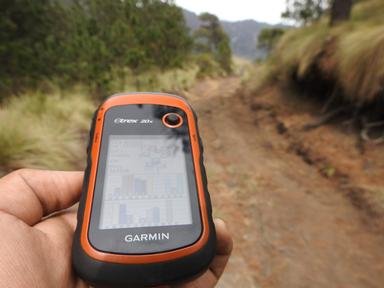
Global Positioning System. Though Gilligan would most likely have benefited from a GPS unit, the correct answer is Global Positioning System. GPS units bounce signals off of satellites to determine your exact position on the globe. In the US, they can be purchased for as little as $80 at major retailers like Target and Circuit City. Check out http://www.geocaching.com/about/buying.aspx as a guide to buying your first GPS and http://www.pbs.org/wgbh/nova/longitude/gps.html for information on how GPS units actually work.
As you log geocaches online at www.geocaching.com, you may feel compelled in your log to write TFTC! What do these initials stand for? | Geocaching Part Deux: Cache Types
|
Thanks for the cache. The geocaching community is dedicated to having a good time and thanking other geocachers for advancing the sport. Placing geocaches is one of the easiest ways to advance the sport of geocaching in your area. In geocaching fashion, I say TFTMQ (that's "thanks for taking my quiz" for you non-caching folk).
A logbook or logsheet. While the other three items are always a welcome inclusion into any geocache (provided the container is large enough), only the logbook or logsheet is required. In some microcaches, the included logsheet is large enough only to write one's initials.
The multi-cache is one of the more challenging cache types. As the name indicates, completing this cache involves multiple stages. What is the absolute minimum number of stages required for a geocache to be considered a multi-cache? | Geocaching Part Deux: Cache Types
|
2 . Some multi-caches will have as many as six stages. The stages can be within close range of each other (500 ft.) or could be sprawled across a whole state. Usually, each stage will provide the coordinates or some clue to help find the next stage.
Did not find. This is used when a cacher did not find the cache. It could mean that it needs to be replaced or was in the wrong spot. Usually, the person or people who placed it go out and try to find it.
They travel from cache to cache.. The Travel Bug is similar to a geocoin because they travel from cache to cache, so be on the lookout for them! They are also similar because they usually have a certain destination in mind. A geocoin is-you guessed it-a coin, whereas a Travel Bug is something like a stuffed animal or an actual 'bug'-not a live bug, but a fake bug.
A response in the forums points you to another topic like that one in the past.. This term is based on the user Markwell. It is a post that points you to a similar topic that was posted in the past.
The "Project A.P.E. Cache" was used in compliance with which movie producing company? | Geocaching Terms
|
20th Century Fox. There were 12 geocaches that were placed in 2001 that are part of the Project A.P.E. Cache that was used with 20th Century Fox to promote the movie 'Planet of the Apes'. Today, only two of these caches exist. Each cache was in a specially marked ammo container along with an original prop from the movie.
A Travel Bug. A Travel Bug is a hitchhiker because it travels from cache to cache. Some Travel Bugs have certain destination they will go to, or a certain objective. Some also have logbooks attached to log their journeys.
Ground Zero, and you've found the cache.. When your GPS says that you are at the cache, you are at 'ground zero'. You then have no more feet or meters left to go to find it.
Global Positioning System receiver.. GPSr is slang for the Global Positioning System receiver. GPSrs are used in navigation and received signals.
"TNLNSL" is a term that you usually put in 'Logged Visits' section on the cache's page. What does it mean? | Geocaching Terms
|
Took nothing, Left nothing, Signed logbook.. If I were to use this term, I would put something like this:
Great find. Somewhat easy. TNLNSL.
Or I could just leave a logged visit saying:
TNLNSL
A non-geocacher has found the geocache and invalidated it.. Used from J.K. Rowling's term "muggles" meaning a non-magic person, a "geomuggle" is a person who is not a geocacher. Then, when used in the term "geomuggled", non-geocachers have found the cache and interacted with it in a way that ruins it for further geocachers, for example by taking out the contents.
Some caches have items that can be moved from cache to cache. These are generally call Travel Bugs. What is an alternative name for these items? | Geocaching - Early History
|
Hitchhiker. A travel bug (TB), or a Geocoin are examples of trackable items. The aim of the game is to travel as far as possible around the world. A hitchhiker does not have to be a trackable item, it might be a simple toy with a log sheet that requests to travel the world, and might ask the placer to send a photo at each location to a given e-mail address.
On Geocache.com, the owner of a cache listing can create a hint to help the finder locate the cache. The hint can be encrypted. What is the encryption code acronym? | Geocaching - Early History
|
ROT13. It's a fairly simple format, where letters of the alphabet are rotated by 13 characters. A=N, Z=M, etc.
Planet Of The Apes. In 2001, 12 'caches were placed to support the movie "Planet of The Apes." Each cache had an original prop item from the movie. Two of these caches still exist today.
75. At the time Geocaching.com was launched, there were only 75 caches published worldwide.
Mike Teague. Mike Teague found the "stash" within a coupe of days, and began to compile his "GPS Stash Hunt" database shortly thereafter.
Texas. This was in Austin, Texas, on March 24th 2001. An event cache is a social get together of fellow geocachers, often with food and drink. An event cache is a "cache find" in its own right, simply by turning up. Although new caches are often placed near to the event location.
What was the surname of the person who first registered the domain "Geocaching.com", and started a new database for cache hides and finds? | Geocaching - Early History
|
Irish. On May 8, Mike Teague announced a Web site for collecting the locations of caches. On September 6th 2000, Jeremy Irish took over 'cache listings from Mike Teague, using the geocaching.com domain name.
The first recognised website for logging hides or finds did not actually use the word 'cache or Geocache in its name. What was the word they used? | Geocaching - Early History
|
Stash. On may 30th 2000, a gent named Matt Stum suggested the name "Geocaching", a cross between Geography and cache (or secret a hide). It was felt that the word "Stash" had some negative baggage associated with it.
Dave Ulmer. Dave Ulmer proposed a way to celebrate the demise of Selective Availability. On May 3, 2000, he hid a bucket of goodies in the woods near Portland, Oregon and posted its location on the newsgroup sci.geo.satellite-nav. It wasn't termed as a 'cache or Geocache then, a different name was used.
GPS, or Global Positioning System, was developed by the US Department of Defense. This satellite navigation system was intended for military use and therefore the signals only gave limited accuracy for non-military use to about 100 metres. On what date was this "Selective Availability" turned off? | Geocaching - Early History
|
May 2nd, 2000. GPS, or Global Positioning System, was developed by the US Department of Defense. This satellite navigation system was intended for military use and therefore the signals only gave limited accuracy for non-military use to about 100 metres. On May 1, 2000, President Clinton announced that this scrambling, known as Selective Availability (SA), would be turned off, giving an accuracy of around 10 metres. (It was turned off around midnight on May 2nd 2000, Eastern time.)
|