

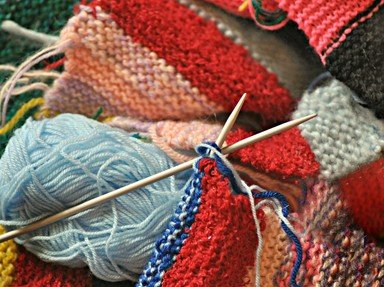
Answer: Nylon fibre
A small percentage of nylon is typically added to sock yarn that is made from animal fibres. It adds a bit of stretchiness, and allows for a longer wear because natural animal fibres have a tendency to wear through very quickly when made into socks. The stretchiness afforded by the nylon also helps to create a better-fitting sock.
From Quiz: Put a Sock in It!
Answer: Edward VIII
It all started in 1921 when a draper, named James A. Smith, gave the Prince of Wales a pullover with a Fair Isle pattern. From that time Edward wore this pattern on his pullovers to golf matches, on overseas tours and even had his portrait painted wearing one. Alice Starmore, the expert on Fair Isle, said that his adoption of this style was greatly significant in popularising and commercialising it. By the late 1920s most young men at Oxford and Cambridge Universities were wearing cardigans, scarves, hats and gloves in this pattern.
From Quiz: Can Men Knit or (K)not?
Answer: British Isles
Aran style knitting is traditional to the Aran Isles off the coast of Ireland, and is recognisable for being richly textured, although it is made in a uniform cream colour. When spun, some of the oil is left in the wool, which gives finished garments water-resistance, and the intricate patterns are not only loaded with folk-meaning, but create air-pockets, making the garments even warmer. Fair Isle lies off the coast of Scotland, between the Orkneys and the Shetlands. Fair Isle knitting is a technique for creating patterns of multiple colours, simple in themselves, but which build up to make highly sophisticated designs.
Dirk Dancing is a Scots form which is thought to originally have been a training exercise (a 'dirk' being a dagger), and Bhata (or Bata, or even Bataireacht) is a semi-formalised Irish style of stick-fighting, including the delightful-sounding but no-doubt somewhat intimidating "Rince an Bhata Uisce Bheatha", literally "Whiskey Stick Dance".
The British Isles are also home to the unfortunately mythical "Ancient Lancastrian Martial Art" of "Ecky-Thump", as demonstrated by Bill Oddie on "The Goodies" in 1975. The art involves the wearing of flat-caps and braces, and lots of whooping around smashing people on t' noggin wit' black puddings. There are serious news-reports claiming that a man in King's Lynn, Norfolk, UK, actually laughed so much while watching the episode ("Kung-Fu Kapers") that he suffered heart failure and died on the spot. His wife apparently wrote to The Goodies and thanked them for making her husband's last moments so enjoyable. She was with him at the time of his death, though there is no record of whether or not she found the episode amusing.
From Quiz: Crochet Tiger, Knit A Dragon
Answer: All of these
Circular needles are useful when knitting in the round.
From Quiz: How to Knit a Hat
Answer: Rib stitch
Rib stitch is a knit one, purl one stitch that gives an ascending pattern of like type stitches. This means that if a knit stitch has occurred on the row before, a purl stitch will be knitted on the next. It allows for stretch and so is very suitable for areas that need a close fit but with the comfort of a bit of give, such as the neck, waist and wrist.
From Quiz: Knitting - All the Celebs are doing it !
Answer: When decreasing stitches to shape the edge of your piece
If you slip a stitch without knitting it, knit a stitch, then pass the slipped stitch over the knit stitch, you have turned two stitches into one. This is commonly used when shaping sweater armholes, at the start of the row. At the end of the row, you are more likely to be instructed to k2tog (knit two stitches together).
From Quiz: Knitwittery
Answer: purl
There are other basic stitches like the warp and weft, but these two stitches form the basis of all knitting projects and are by far the most common.
From Quiz: Keep on Knitting
Answer: Fingering
Fingering weight yarn is a relatively light weight yarn, with a relatively narrow circumference. There are typically approximately 7-8 stitches per inch when fingering yarn is knit on the small needles that are used for socks (as opposed to 3-5 stitches per inch for the heavier yarns). This makes for a nice tight gauge, which allows for a close-fitting, lightweight, and comfortable sock. Worsted weight yarns are sometimes used, but the socks made with it are much thicker and tend to be less comfortable than those made with fingering weight yarn.
From Quiz: Put a Sock in It!
Answer: In Egyptian tombs
Many examples of socks made using nalbinding can be found in history museums around the world. All have been found in ancient Egyptian tombs. Most have divisions for the big toe, thought to accommodate sandals.
From Quiz: Knitting in History
Answer: James Norbury
James Norbury (1904-1972) was totally devoted to knitting. His enthusiasm and eccentric personality, as well as his skills, made his segment of the BBC's Woman's Hour very popular. His books include "Traditional Knitting Patterns From Scandinavia, The British Isles, France, Italy And Other European Countries" which is still published and considered to be a basic reference book on knitting patterns. Many of his other books are still bought and sold in online markets such as E-Bay. He was one of the greatest influences on British knitting.
From Quiz: Can Men Knit or (K)not?
Answer: They can use their whole arm as a giant crochet hook
From Quiz: Crochet Tiger, Knit A Dragon
Answer: Picking up stitches around the edge and then knitting or crocheting these stitches
Cast on 72 stitches; join and place stitch marker.
From Quiz: How to Knit a Hat
Answer: Moss Stitch
Moss stitch it also a knit one, purl one stitch but alternates on each new row so that a knit sits above a purl on alternating rows. This is a stitch that all new knitters should try as it is very forgiving to uneven knitters, as it always manages to look just right!
From Quiz: Knitting - All the Celebs are doing it !
Answer: cable stitch
Cable come in all shapes and sizes, ranging from the familiar three-stitch stocking stitch cable to convoluted woven designs.
From Quiz: Knitwittery
Answer: Fingering
Fingering yarn is very light and delicate and requires a good deal of patience, excellent eyesight, and a very adept hand. It is often knitted on very thin needles and used for lacy, intricate patterns. It's not a yarn for a beginning knitter, and some knitters never attempt using it. Garments and household linens created with fingering yarn (especially newborn layettes) are destined to become family heirlooms!
From Quiz: Purls of Wisdom 1
Answer: pass slip stitch over
The technique of slipping a stitch and passing the slipped stitch over creates a hole for lace and other openwork knitting.
From Quiz: Keep on Knitting
Answer: Cotton or wool
These socks are typically recognized as the first sign of true knitting because the heel construction is knit like modern-day socks, unlike other examples of nalbinding that pre-date these. These examples of true knitting are estimated to have been created in the 11th century CE.
From Quiz: Knitting in History
Answer: Dumbledore
Albus Percival Wulfric Brian Dumbledore, the Headmaster at Hogwarts, has revealed in the Harry Potter books that he enjoys chamber music and tenpin bowling as well as reading knitting patterns.
From Quiz: Can Men Knit or (K)not?
Answer: Be careful not to twist stiches
Work 2 inches in (k2, p2) ribbing.
From Quiz: How to Knit a Hat
Answer: Argyle
Argyle is a diamond shaped pattern most commonly associated with golfing attire from Scotland. It is fashioned after the Clan Campbell tartan of Western Scotland and is knitted by a process known as intarsia. In recent times Pringle, the iconic knitwear manufacturer of Scotland has promoted the design again and it has become hugely popular.
From Quiz: Knitting - All the Celebs are doing it !
Answer: Negative ease means the circumference of the sock is smaller than the circumference of your leg and foot. It's important because it will help keep the sock from slouching and shifting.
If the sock is exactly the same circumference (or larger) as your leg or foot, it will sag. It will also shift around in your shoe and wear out faster. Generally, you'll want a sock that has 10% - 20% negative ease. For example, if your foot is 10" in circumference, you'll want a sock that measures only 8" - 9" in circumference.
From Quiz: Knitting For Your Feet
Answer: Aran sweaters
With all the cabling and other textured stitches, these babies are WARM! Developed in the Aran Islands for protection against the bitter cold of ocean fishing.
From Quiz: Knitwittery
Answer: Hanks and Skeins
Skeins are machine-created to make life easier for the knitter. They are lightly twisted in such a way that you can easily pull the yarn out from them without twisting it and without much rolling around. Handspun and hand-dyed yarns are usually sold as hanks. Hanks have to be rolled into balls to use.
From Quiz: Purls of Wisdom 1
Answer: number of stitches and rows per inch you should get when you use the needles and yarn indicated in a pattern
Learning the importance of gauge was a hard lesson for me. I made several tiny and huge garments before I got the message!
From Quiz: Keep on Knitting
Answer: High Middle Age
The colours used were mainly blue and white to knit socks in the round. There are also examples of Muslim script knit into the socks.
From Quiz: Knitting in History
Answer: Madame Therese Defarge
In "A Tale of Two Cities" Madame Therese Defarge, a member of a French Revolutionary group, was implacable in her hatred of aristocrats, particularly the Darnay family. She sat in her wineshop with her knitting and encoded the names of those who were to be beheaded into her stitches.
From Quiz: Can Men Knit or (K)not?
Answer: To make fabric more elastic
After 2 inches knit around until piece measures 9.5 inches.
From Quiz: How to Knit a Hat
Answer: The family life and industry of the wearers
Not to be confused with the Scottish Arran pattern from the island in the Firth of Clyde,the Irish Aran Pattern was developed from the telling of fishing,seafaring and land based tales by Padraig O Siochain. The Isle of Aran is off the west coast of Ireland near Galway.
From Quiz: Knitting - All the Celebs are doing it !
Answer: Using larger needles and thicker yarn than specified in the original pattern
By changing from 3-ply yarn and 1.5 mm needles to 12-ply yarn and #8 needles (left over from my US childhood), I was able to use the pattern exactly as it had been given! For fun, I also added a rear view on the back of the sweater. Quite a conversation piece.
From Quiz: Knitwittery
Answer: symbols of marriage and the fisherman's life
The fisherman themselves often made their own sweaters to be used during those cold days on the water. The Aran Islands became famous for their intricate knitting patterns.
From Quiz: Keep on Knitting
Answer: Rib stitch
A rib stitch is used at the top of the sock to create a stretchy portion that helps to keep the sock from falling down. A rib stitch is created with a combination of alternating knit and purl stitches. Most commonly, rib stitches are completed using a "knit one, purl one" or "knit two, purl two" pattern in the cuff of hand-knit socks.
From Quiz: Put a Sock in It!
Answer: In holy paintings known as the "Knitting Madonnas".
There are many different examples of the knitting Madonnas, painted by various artists. Most were painted by Italian artists of the day. There is also evidence of knitting Madonnas in works created in Germany.
From Quiz: Knitting in History
Answer: Lawyers
The history of men knitting might have come about from men working on their fishing nets. In the 17th and 18th centuries in Scotland it was common for whole families to engage in knitting jumpers, accessories, socks and stockings. Drawings exist of shepherds knitting while watching their flocks, sailors knitting on board ship and whole fishing families in the Scottish Isles knitting around the fire. Natural oils in woollen garments helped to provide protection against the harsh weather in this region.
From Quiz: Can Men Knit or (K)not?
Answer: All of these
next round: (k5, k2tog)
From Quiz: How to Knit a Hat
Answer: kitchener stitch
Kitchener stitch is used to graft the toe stitches together to make a seamless join. If done correctly, you can't even tell it's there! It takes some concentration to get the hang of it, but is definitely worth the effort. No toe seam! Another advantage of hand-knit socks.
From Quiz: Knitting For Your Feet
Answer: stockinette stitch
It's also known as a stocking stitch.
From Quiz: Keep on Knitting
Answer: Monmouth, Wales
It is thought that caps knit in Monmouth were designed for use by sailors, or to be fit under military helmets of the day.
From Quiz: Knitting in History
Answer: The Earl of Cardigan
The Earl of Cardigan was noted for his fashionable attire. During the infamous charge his men were well-dressed in the woollen button down jackets that he had chosen for his brigade. This style of jacket was named after him.
From Quiz: Can Men Knit or (K)not?
Answer: Turning a heel
Consider the sock, that commonplace, humble, yet deceptively complex item of footwear. Most sane people have never contemplated what goes into making a sock, but many knitters have, and, obviously, before the machine age, the only way to make them was by hand. Now, unless you want a bulky and uncomfortable seam in your sock, it is best to make them using four needles - a set of, funnily enough, four needles, which are pointed on both ends, so instead of finishing a row and then turning to knit back along the stitches you've just made, you continue on to the next needle and so work in rounds to make a tube. This might sound complicated enough - and it is, trust me! - but it's nothing compared to the intricacies of turning a heel. I don't want to scare anyone, so I won't outline the entire procedure - I get queasy just thinking of it anyway. Should you at some point feel so inclined, however, have a look at the shape of a sock heel, and imagine the dropping and picking up of stitches along edges, and the management of multiple needles and unruly wool necessary to form such a complex shape. There is surely something not-quite-human about anyone who doesn't shudder during such contemplation, or at the very least they show a superhuman resistance to intimidating craft concepts.
In times not so long ago, people were looked up to - nay, veritably worshipped - for mastering this skill; men as well as women. I happen to know for a fact that my tough, salty father-in-law's heel-turning abilities were as much admired aboard ship as his uncanny knowledge of sails and knots. Furthermore, I wouldn't be at all surprised to learn that the expression of gentility in describing someone as "well-heeled" didn't come from this very accomplishment.
From Quiz: Crochet Tiger, Knit A Dragon
Answer: Knit two stitches together
Next round on your hat: (k4, k2tog)
From Quiz: How to Knit a Hat