|
|
|
Structure
Interesting Questions, Facts and Information
- There are a total of 45 general entries. We are selecting 30 for display.
Special Topics
|
Interesting Questions, Facts, and Information
Hitchcock, Alfred
1926. It was released the following year, in 1927.
Towards the end of his career, Hitch was honored by the American Film Institute Academy with their Life Achievement award. Which of his former leading ladies, the star of "Notorious" and "Spellbound", served as a hostess to the tribute to Hitchcock's life that formed a part of this award presentation? | The Best of Alfred Hitchcock
|
Ingrid Bergman. Bergman appeared visibly moved to be able to present this much-deserved honor to Hitch. Other stars who had worked with Hitch and who were there to honor him that night were Anthony Perkins, Cary Grant and Jimmy Stewart. When he had finally won some type of overdue recognition from the Academy in the form of the Irving G. Thalberg award in 1968, Hitch's speech was limited to a stark, "Thank you." This time, even Hitch was moved and he spoke longer while seated at the AFI banquet. He dedicated his award to his wife, Alma Revielle, who was his longtime collaborator, professionally and in life. Hitch died in April of 1980, just months after the AFI ceremony. Bergman herself did not live much longer, dying of cancer in August 1982.
Hitchcock's cameos are now famous. The only film of Hitchcock's that does not have a live-action cameo by the director is "Lifeboat". How was the cameo in this film achieved? | The Best of Alfred Hitchcock
|
Hitchcock's picture appeared in a newspaper ad that one of the passengers had.. Hitchcock's cameo in "Lifeboat" is in the form of a before and after weight-loss ad in a paper. This was an ingenious way of accomplishing a cameo in a film that was set out at sea with a fixed cast. A walk-on was obviously impossible in these circumstances.
Hitch didn't start doing cameos in his films until his third film, "The Lodger" (1926), and in "The Wrong Man", his cameo is the presence of his voice as narrator at the beginning of his film. Hitch soon realized that people were looking for his cameos and not paying as much attention to his films as they should until they "found" him, and he began appearing earlier in his movies because of that.
"Lifeboat" received three Oscar nominations, Best Cinematography, Best Writing and Best Director. It didn't win any of them.
It wasn't until 1956's Oscars that another film of Hitch's was once again recognized with nominations by the Academy. Which Oscar did "To Catch a Thief" actually win that year, honoring the setting and the feel of the movie more than the director and the histrionics or plot? | The Best of Alfred Hitchcock
|
Best Cinematography. "To Catch a Thief" was actually nominated for Best Art Direction/Set Direction, Best Costume Design, and Best Cinematography, and it won only the last award listed. It was not nominated for Best Original Screenplay or Best Supporting Actor. Delbert Mann's "Marty" was the picture that took home Best Picture and Best Director honors that year.
Hitch's film was an enjoyable romp with Grace Kelly and Cary Grant, shot in what would later become Princess Grace's home, Monaco. The famous chase scene in the film was shot at what was later the scene of Kelly's death in a car accident in 1982.
All in all, Hitchcock was nominated for the Best Director Oscar four times in the course of his career. One of them, a claustrophobic thriller starring Tallulah Bankhead in a rare film role, took place on a single set for the majority of the film. Which film was it? | The Best of Alfred Hitchcock
|
"Lifeboat" (1944). The thriller "Lifeboat" is set entirely on the titular boat, out at sea. It is a psychological drama that has propagandistic elements evident today, years after WWII, but which were understandable for the time that the movie was made. It was also one of the few film performances of Bankhead's.
Two of the other films listed did garner Hitch nominations for best picture, "Rear Window" and "Psycho". Though they were set in confined areas, neither was limited to a single set. "Rear Window" takes place mostly in the apartment of a bed-ridden photographer played by Jimmy Stewart who passes time looking out over a courtyard into the apartments of his neighbors, out of boredom. Those other sets show slices of life and are independent sets themselves. "Psycho" takes place for most of the movie in the Bates Hotel, but there are scenes in the city at the beginning of the movie as well as at the end, and the hotel itself includes different sets, among them the infamous shower.
The other film listed here, "Rope", was also shot mostly on a single set. It was an interesting experiment by Hitch, in that he shot it in just ten takes, which lasted from four-and-a-half to a little more than ten minutes (which was the longest length of film that a reel could hold at that time). It is not the correct answer here, though, because "Rope" was a controversial film when it came out, and Hitch was not nominated for Best Director. The film starred Jimmy Stewart.
Hitchcock's only film in 1943 was the wonderful "Shadow of a Doubt", with Joseph Cotten and Theresa Wright. This picture was nominated for an Oscar in 1944, the year the 1943 pictures were honored. Which award, if any, did it get? | The Best of Alfred Hitchcock
|
It was nominated for Best Writing, Original Story, but it did not win the Oscar.. "Shadow of a Doubt" did not win the writing honors that year, though it was a very well-written story and it is still admired today.
The following exchange between Uncle Charlie (played by Joseph Cotten) and Young Charlie (played by Theresa Wright), shows how cleverly it was written.
Uncle Charlie: How was church, Charlie? Did you count the house? Turn anybody away?
Young Charlie: No. Room enough for everyone.
Uncle Charlie: Well, I'm glad to hear that. The show's been running such a long time, I thought maybe attendance might be falling off.
"The Human Comedy", written by William Saroyan, won the award for Best Writing, Original Story. It was set during WWII and probably caught the spirit of the audiences of the day, though it is not widely known today. Mickey Rooney starred in the film.
Hitchcock made a second film in 1941, "Mr and Mrs. Smith". It was a comic turn and a change of pace for him. It garnered not even a single nomination that year, but was later remade as a movie with Brad Pitt and Angelina Jolie, which was also ignored at the Oscars. True or False? | The Best of Alfred Hitchcock
|
F. Though it is true that neither film was nominated for any Oscars, the films are not remakes of each other and are not related in any way. Hitchcock's movie is a comedy with Carole Lombard and Robert Montgomery, in which a couple discovers that their marriage ceremony wasn't valid after years of being together. The Jolie-Pitt film shared the same title, but was about two spies and killers who were married to each other, but who were each unaware of the other's true profession.
Hitchcock's next film after "Foreign Correspondent" and "Rebecca" was "Suspicion" (1941). He exercised greater control over the film and it was honored at the Oscars in 1942. Though it did receive more than one nomination, what award did "Suspicion" eventually get? Hint: The lovely Joan Fontaine figured in this movie as well as in its ultimate honor. | The Best of Alfred Hitchcock
|
It was nominated for Best Picture and Best Actress, and it got only the latter.. By making a second film with Joan Fontaine, the star of the prior year's "Rebecca", Hitchcock starting a tradition of working with blonde actresses in multiple films and molding their performances. In this case, it worked for Fontaine, who did indeed did win the Best Actress award for portraying a terrified wife convinced her husband wants to kill her. Cary Grant was her co-star in that movie, and his acting was not recognized by the Academy, perhaps because it was such a different type of role for him. Hitch's direction was not even nominated, and the film lost its only other nomination, Best Picture, to "How Green Was My Valley", for which John Ford also won Best Director (for the second year in a row). Ironically, Ford's film used black-and-white cinematography to depict a green valley (and even more ironically, it won the award for best b&w cinematography).
Though Hitch was again snubbed by having his film nominated for best picture and having his direction efforts ignored, this was eclipsed by a more famous snubbing of the 1942 Oscars: the shut-out of "Citizen Kane," considered by many to be one of the best films ever made. It did not get the Best Picture or Best Director awards, and won only Best Writing (Original Screenplay) (an award shared by Orson Welles and Joseph L. Mankiewicz).
The 1941 Oscars (which honored films released in 1940) took place the first year Hitchcock had worked in the US instead of Great Britain, showing his increasing popularity and recognition in America. Two of his movies were nominated for Best Picture, and Hitch himself was nominated for Best Director for one of those films. Which psychological drama and thriller, starring the lovely Joan Fontaine, was it? | The Best of Alfred Hitchcock
|
Rebecca. "Rebecca", a suspenseful tale of a woman's struggle to overcome the shadow of her husband's deceased first wife, did win the Best Picture Oscar, but Hitchcock did not win for Best Director, some say because the producer, David Selznick, exercised such a strong hand that he was actually the "behind-the-scenes" director instead of Hitchcock.
The other movies mentioned, "Foreign Correspondent" (1940), "The Lady Vanishes" (1939) and "Suspicion" (1941) did not win the Best Picture Oscar either. In fact, "Rebecca" is the only Hitchcock film to have garnered that prize.
The year that Hitchcock could have come away with great glory was actually a double snub for him, and started a tradition of nominations that would fail to honor his work. The winner of the Best Director prize this year was John Ford for "Grapes of Wrath".
A 1969 Cold War thriller was based on a Leon Uris novel about the Cuban Missile Crisis. The one-word title of the film refers to the name of a NATO spy. Which movie is it? | Films Directed by Alfred Hitchcock
|
Topaz. The film is filled with intrigue, double-crossing, and of course murder. John Forsythe plays a CIA agent investigating rumors of missiles in Cuba and a spy named "Topaz". This was one of Hitch's more experimental films, one that contains elements that he himself admitted didn't quite work. Nevertheless, audiences appreciated the risks Hitch took and the film is always included in the director's body of work.
Who can forget the crop-dusting scene in this well-known Hitchcock film? If I mention Mount Rushmore and Cary Grant, can you name this suspenseful film? | Films Directed by Alfred Hitchcock
|
North by Northwest. Eva Marie Saint and James Mason also star in the movie. Grant plays the role of an advertising executive mistaken for a spy in a dangerous cat-and-mouse game that culminates atop Mount Rushmore. Eva Marie Saint plays a double-agent as well as the love interest of both Grant and the villain Mason. An interesting fact about this movie is that actress Jesse Royce Landis, who played Cary Grant's mother in the film, was only eight years older than Grant.
James Stewart, a favorite Hitchcock leading man, starred with Grace Kelly in a very suspenseful 1954 film about a man, laid up with a broken leg, who uncovers a murder while spying on his neighbors. What is the title of this Hitchcock favorite? | Films Directed by Alfred Hitchcock
|
Rear Window. Out of boredom, a man recovering from a broken leg spies on his neighbors in the apartments across from him. His snooping pays off when he suspects one of the tenants, played by a blond Raymond Burr, has killed his wife. The elegant Grace Kelly plays his love interest who risks her life to obtain key evidence in the killer's apartment. If you've never seen this movie, I won't give away the nail-biting ending.
If any of Hitchcock's films were to be considered a masterpiece, it would be this 1960 film. Well known for making moviegoers afraid to take showers, what is the name of this suspenseful gem? | Films Directed by Alfred Hitchcock
|
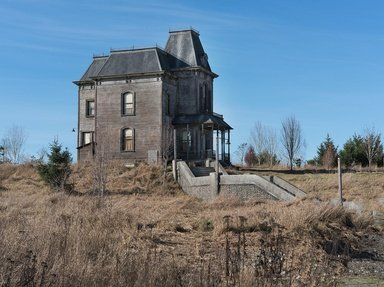
Psycho. Hitchcock purposely shot the movie in black and white for two reasons: he wanted it to look like newsreels of that time and he felt that the gore (Hitch used chocolate syrup for blood) would have been too distasteful for movie audiences if shot in color. Anthony Perkins famously played the role of Norman Bates, the creepy motel owner who killed his victims while impersonating his dead mother. Janet Leigh played Marion Crane, the unsuspecting victim with secrets of her own.
One of my favorite Hitchcock movies is a remake of an earlier film. The remake stars Doris Day and James Stewart as the unsuspecting victims of international espionage. Doris gets to sing her signature song "Que Sera Sera" in this film. Which film is it? | Films Directed by Alfred Hitchcock
|
The Man Who Knew Too Much. The 1934 version was also directed by Hitchcock and starred Leslie Banks and Edna Best. Day and Stewart star as an American couple, Ben and Jo McKenna, vacationing with their young son in Morocco. Soon after a French spy is killed and dies in Ben's arms after revealing important information, Ben's son is kidnapped. The bad guys chase Ben because he accidentally found out too much about an assassination plot that is about to take place in London. Hitchcock took a risk with the "Albert Hall Scene" during the film's finale, when he filmed 12 minutes with no dialogue. The risk paid off. Audiences loved it.
Alfred Hitchcock could build suspense like few other directors. A film released in 1963 effectively demonstrates what could happen if our avian friends decided to attack us. Which Hitchcock movie is it? | Films Directed by Alfred Hitchcock
|
The Birds. Tippi Hedren and Rod Taylor starred in the film which is based on a short story written by Daphne Du Maurier. Normally birds are considered to be cute little creatures. Not in this film. They attack a small town with a vengeance. Hitchcock himself once said that the characters in the movie "are the victims of Judgment Day."
No quiz about the wondrous works of Alfred Hitchcock would be complete without including "Psycho" (1960). Filmed in B&W, it grossed $40,000,000 after a cost of $800,000 and was his highest grossing film (and perhaps his most famous as well). The story line is about a secretary who purloins $40,000 from her boss and then skips town. The search for her leads her sister and a private investigator to the Bates Motel (Norman Bates, Prop.), where she had stayed a night after being forced to rest after driving all evening in a blinding rainstorm. Most folks know Janet Leigh played the stealing secretary, Marion Crane, and that Vera Miles played the sister who hired a P.I. to help find her. Who played private investigator Milton Arbogast? | The Wondrous Works of Alfred Hitchcock
|
Martin Balsam. The iconic role of Norman Bates was played by Anthony Perkins. "Psycho" brought Alfred Hitchcock his fifth and final nomination for the Best Director Oscar and his fifth disappointment as well. (Billy Wilder won for "The Apartment"). Just how great and scary was this film? Well, the AFI has all kinds of lists and here is where "Psycho" ranked on some of them:
AFI's 100 Years... 100 Movies - ranked number 18.
AFI's 100 Years... 100 Movies (10th anniversary edition) - ranked number 14.
AFI's 100 Years... 100 Heroes and Villains - Norman Bates ranked number two Villain, behind only Hannibal Lecter in "Silence of the Lambs" (1991).
AFI's 100 Years... 100 Thrills - RANKED NUMBER ONE!
And now for some much needed levity: "Psycho" was the first American made film to have the temerity of showing a toilet bowl actually flushing. The nerve!
Martin Balsam won an Oscar for Best Supporting Actor for his portrayal of Arnold Burns in "A Thousand Clowns" (1965).
In 1963 Hitchcock came up with an idea that was for "The Birds". Well, actually the idea originated in a short story written by Daphne du Maurier which was first released in 1952. "The Birds" tells the chilling tale of frenzied attacks by our formerly fine-feathered friends. For no apparent reasons thousands of birds begin attacking people creating panic and death among the populous in northern California. In "The Birds", Tippi Hedren played in her first Hitchcock directed film. Who played the lead male role? | The Wondrous Works of Alfred Hitchcock
|
Rod Taylor. "The Birds" is set mostly in the port town of Bodega Bay, about 60 miles north of San Francisco. For reasons unknown, ravens, crows, and seagulls among others begin the onslaught there. Among the early victims are Melanie Daniels (Hedren) and her friend Mitch Brenner (Taylor). Other traumatized members of the cast include Suzanne Pleshette and Jessica Tandy. It was Hitchcock's first film for Universal Studios and it was a huge financial success, grossing over $11 million. Hitchcock would direct Ms. Hedren once again the following year, in "Marnie". Tippi Hedren is the mother of Golden Globe winning actress Melanie Griffith ("Working Girl") (1988).
Interesting fact: Australian born Rod Taylor portrayed British Prime Minister Winston Chuchill in 2009's "Inglourious Basterds".
|