
|
Structure
Interesting Questions, Facts and Information
- There are a total of 15 general entries.
|
Interesting Questions, Facts, and Information
Kelly, Grace
Grace Kelly's film career was short but nonetheless very memorable. What was the title of the first film featuring Grace Kelly? | The Film History of Grace Kelly
|
Fourteen Hours. 'Fourteen Hours' is about a man who threatens suicide by standing on a ledge for, you guessed it, fourteen hours.
Kelly appeared for the first time onscreen in the 1951 film 'Fourteen Hours', directed by Henry Hathaway. She is featured alongside Richard Basehart, Barbara Bel Geddes and Agnes Moorehead, among others (including the screen debuts of Ossie Davis and Jeffrey Hunter as well).
Grace Kelly's next screen appearance came in 1953 when she starred alongside Clark Gable and Ava Gardner in what jungle adventure film? | The Film History of Grace Kelly
|
Mogambo. 'Mogambo' is revolves around four Americans in Africa and the romantic relationships that develop amongst them.
In 'Mogambo', Grace Kelly appears as Linda Nordley, the wife of an antrhopologist played by Donald Sinden. Gable and Gardner round out the all-star cast for this film, directed by another Hollywood legend, John Ford.
Grace Kelly appeared in more films with Alfred Hitchcock than with any other director. How many of her films were directed by that outstanding British auteur? | The Film History of Grace Kelly
|
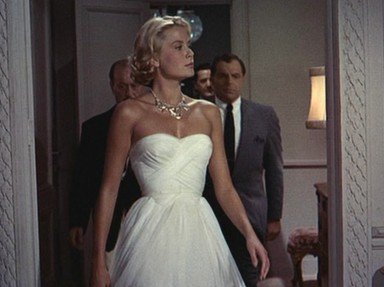
3. Joint efforts between Hitchcock and Kelly include: 'Dial M for Murder', 'Rear Window' and 'To Catch a Thief'. It's no surprise that Hitchcock always considered Kelly to be among his favorite actresses to work for, and their partnership may have continued had Kelly not off and got herself married.
Grace Kelly's first collaboration with Hitchcock came in the 1954 film 'Dial M for Murder'. In this film, Kelly plays the wife of a man who formerly played which sport? | The Film History of Grace Kelly
|
Tennis. In Kelly's first collaboration with Hitchcock whe plays Margot Mary Wendice, wife of former tennis pro Tony Wendice (Ray Milland). One thing to notice about the film (an example of Hitchcock's technical brilliance), watch how the colors of Kelly's clothing change as the film progresses.
In another Hitchcock film, also released in 1954, Grace Kelly plays the elegant Lisa Fremont, lady-love to a wheelchair bound photographer named L. B. Jefferies, portrayed by Jimmy Stewart. What is this masterpiece of a film called? | The Film History of Grace Kelly
|
Rear Window. In 'Rear Window', the Jefferies character, trapped as he is in his wheelchair, becomes a voyeur by looking outside his apartment's rear window. This leads to his entanglement in a mystery involving one of his meighbors.
Nearly everything about this film is perfect, from Hitchcock's brilliant directing to the precise cinematography of Robert Burks, and from the impeccable set design to the unceasingly good performances by Stewart, Kelly and a marvelous supporting cast. Kelly's graceful (no pun intended) performance here really stands out.
Yes. Kelly was nominated for an Best Actress in a Supporting Role award in 1953 for 'Mogambo', and again for a Best Actress in a Leading Role Oscar for her 1954 performance in 'The Country Girl'. She won for the latter film.
Korean War. Directed by Mark Robson, 'The Bridges at Toko-Ri' also included Frederic March and Mickey Rooney among its all-star cast. The story for the film was derived from the James Michener novel of the same name. The chemistry between Holden and Kelly is good, which perhaps makes sense when one considers that this was the second time the two had been paired together in film (the first being 'The Country Girl').
The Swan. Oddly enough, just prior to becoming Princess Grace, Grace Kelly played Princess Alexander opposite Alec Guinness' Prince Albert in the 1956 film 'The Swan', a film that documents a romantic relationship that develops between them.
This was her second to last film release, coming just prior to 'High Society', a remake of 'The Philadelphia Story', also featuring Bing Crosby and Frank Sinatra.
|