|
Structure
Interesting Questions, Facts and Information
- There are a total of 25 general entries.
|
Interesting Questions, Facts, and Information
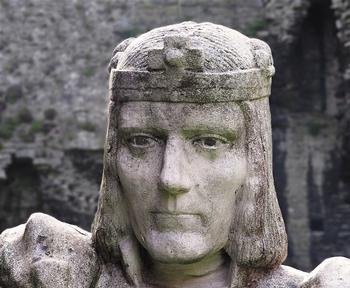
Edward II
Eleanor of Castile. Marguerite of France was Edward I's second wife. Blanche of Artois was the wife of Edmund, brother of Edward I. Philippa of Hainault will later be the wife of Edward III (son of Edward II).
This Gascon knight, twice banished from the kingdom by Edward I, was Edward's best friend (and lover, said the rumours). When the old king died, Edward II, the new king, made his dear friend Earl of Cornwall, a title usually held only by the sons of king. Who was this knight? | Edward II, King of England
|
Piers Gaveston. Despenser replaced Gaveston in the king's heart after his death. Philippe of Poitiers and Philippe of Valois are better known as Philippe V and VI, kings of France.
Isabelle. Isabelle had 3 brothers and all of whom would be king of France: Louis X, Philippe V and Charles IV. After the death of Charles, the French concocted the Salic law (that no woman can inherit land and therefore, no woman can reign over a country) to avoid France passing to England by way of Isabelle. And then started the Hundred Years' War but that is another story.
4. He fathered Edward who would be king as Edward III, John of Eltham, Lord of Cornwall, Eleanor and finally Joan, who would marry David II King of the Scots.
In 1314, one of Edward's cousins openly defied him by refusing to accept the king's summons to military service against the Scots. This man was able to maintain an impressive private army thanks to the fortune he built up on the confiscated estates of Simon de Monfort. Who was this notorious rebel? | Edward II, King of England
|
Thomas of Lancaster. The Earl of Kent was Edward's half-brother, Monthermer was the second husband of Edward's sister Joan of Acre, and Edmund of Lancaster was Thomas's father.
The year 1314 was a horrible one for Edward. After his cousin's rebellion, he lost the important battle of Bannockburn against the Scots. Who led the Scottish Army? | Edward II, King of England
|
Robert the Bruce. Remember the last scene of "Braveheart"!
In 1325, the relations between France and England had deteriorated and Isabelle, Queen of England and sister of the king of France was sent to France to re-establish peace. That's not what she had in mind though ... Working with a great Marcher Lord (who was to become her lover), she prepared for the invasion of England. What nickname was given to her at that time? | Edward II, King of England
|
The She-Wolf of France. Isabelle wanted to put her son (the future Edward III) on the throne of England and, for her, 'the end justified the means'. As he was still young it meant that she and her lover, Roger Mortimer, would rule England during Edward III's minority.
In September 1326, Isabelle carried out her plan and invaded England. The kingdom, tired of the king's favourites (the Despensers, father and son) welcomed her with open arms. She immediately promoted her faithful lover to the title of Lord Protector. Who was this man who had such an influence on Isabelle? | Edward II, King of England
|
Roger Mortimer the Younger. Mortimer the Elder was the father of Mortimer the Younger, the Earl of Lancaster has been executed in 1322, the Earl of Leicester was his brother.
Before Edward was forced to renounce the crown in favour of his son, he was imprisoned. Where was he kept? | Edward II, King of England
|
Kenilworth Castle. Edward was murdered in Berkeley Castle a couple of months after his renounciation. Raglan Castle is in Wales and hopefully will be restored by the Heritage Foundation. Chateau-Gaillard is a French fortress where Philippe IV of France had his daughters-in-law held after their adulteries were discovered. (They may have been princesses but they were not invulnerable to male charm!)
Edward was not a good king, that is a fact, but did he really deserve to be murdered with unspeakable cruelty? How was he killed? | Edward II, King of England
|
A red-hot poker was thrust into his bowels. His murderers first inserted a funnel in his anus and then thrust the red-hot poker in his body through the funnel, and so his corpse bore no external marks that indicated how he had been killed. It was a singularly evil mockery of his sexuality.
five. Mary became a nun. All of the other four sisters married -Eleanor married the King of Aragon, Joan married the Earl of Gloucester, Margaret married the Duke of Lorraine, Elizabeth married the Count of Holland and later the Earl of Hereford and Essex. Edward I had ensured that his family was very powerfully connected.
Earl of Cornwall. This is the first example of Edward's foolish misuse of the power of patronage. Giving titles and lands was a way of confirming the allegiance of powerful men to the crown. Previously, Cornwall was a title that went to a member of the royal family and not to a foreign (Gascon in Gaveston's case) nobody.
What were the names and titles of Edward II's two half-brothers? (They shared the same father but a different mother; one of the half-brothers was executed in 1330). | Edward II - the Monarch Who Failed
|
Thomas Earl of Norfolk, and Edmund, Earl of Kent. It was Edmund, Earl of Kent who was executed in 1330. This was during the time that the young Edward III was controlled by his mother and her lover, Roger Mortimer.
one son and two daughters. Edward's second son was John, Earl of Cornwall (after Gaveston's death). John died in 1336 aged 20. Edward II's daughter Joan married David Bruce, King of Scotland. His younger daughter married Reynald, Duke of Gueldres. Though rumoured to be homosexual, Edward did his "royal duty" and produced legitimate issue to carry on the line.
hedging and ditching. After Bannockburn one royal messenger said it was not surprising the king did not win battles as he spent his time hedging and ditching rather than hearing mass. One household account records quantities of iron and plaster bought for "the private works of the king". He also liked to build walls.
Scarborough. The rebel lords (sometimes called the Ordainers because of the list of ordinances or demands they drew up) soon disposed of Gaveston once he was in their power. The Earl of Warwick managed to steal him away from the safe-conduct of the Earl of Pembroke. After a quick trial he was executed at Blacklow Hill.
Which rich nobleman died at Bannockburn with the result that the three heiresses to his vast estates were married off to the King's favourites? | Edward II - the Monarch Who Failed
|
Earl of Gloucester. Hugh Audley and Wiiliam Montague were just household knights who married two of the three heiresses to Gloucester's fortune. The third heiress was married to the younger Despenser who gradually became Edward II's most preferred favourite. Eventually Despenser began to make inroads into the lands of the other two unfortunate knights. Once again Edward II misused the power of patronage and this time with the greatest windfall of land known to any medieval monarch.
The Earl of Lancaster (Edward's cousin) was the greatest land owner in the north of England and became the king's greatest opponent. What was his first name? | Edward II - the Monarch Who Failed
|
Thomas. Thomas of Lancaster organised the opposition to the King and his favourites. However,historians have judged that he had almost as little skill for leadership as Edward. He was involved in too many private land disputes and quarrels to carry through to a conclusion any rebellion against Edward II.
Lancaster was defeated, captured and executed.. Lancaster didn't really put up much of a fight. Unlike Edward I or Edward III neither Edward II nor Thomas of Lancaster seem to have had much relish for a military campaign. Boroughbridge was won for Edward II by Andrew Harclay (Earl of Carlisle), employing tactics he had learned from the Scottish campaigns.
Chancellor. Baldock was ruthless and efficient where raising money was concerned. He was a close ally of Despenser. One of his tactics was to force men to pay large fictitious debts by producing fraudulent deeds. Most of this money went straight to Despenser rather than to the Exchequer.
The faction led by Queen Isabella and Mortimer. Lnacaster was long dead. Mortimer was a Marcher lord but only became Earl of March after Isabella had taken over. The Archbishop of Canterbury did help to force the issue of Edward II's abdication after the Despensers had been executed.
Wales. As soon as Isabella landed in Suffolk in September 1326 all of Edward II's supporters ran away. Edward himself was eventually captured in Glamorgan and taken to Kenilworth Castle by Henry of Lancaster. Despenser was executed at Hereford and his genital were cut off and burned in front of him for being a heretic and a sodomite.
That his son should succeed him as Edward III. The Archbishop of Canterbury by this stage was also against Edward. This was because Edward had failed not just in the patronage of the nobles but also in keeping on the right side of the Church. Edward's son did succeed him but, though Edward was killed in 1327, Mortimer's rule was not overturned until October 1330.
|