

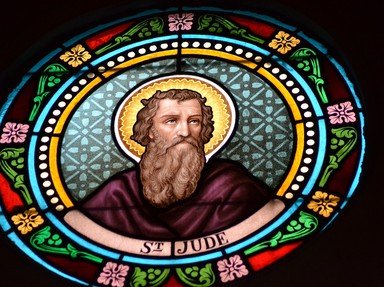
Answer: Jude
It says in Jude 1:1, "Jude, the servant of Jesus Christ, and brother of James, to them that are sanctified by God the Father, and preserved in Jesus Christ, and called."
Jude's letter (or epistle) is one chapter long and written to address false teaching in the church.
From Quiz: Hey, Jude
Answer: Judas, brother of James the Just, both half-brothers of Jesus
A majority of Protestant Christian scholars believe that the author of Jude was the younger brother of James the Just. In verse one he describes himself as 'brother of James'. But which James? James the son of Zebedee was martyred by Herod Agrippa in 44 A.D. (and no brother other than John is ever mentioned), while James the Just was the leader of the Christian Church at Jerusalem. It therefore seems much more likely that a simple reference to 'James' would mean the latter, who would have been well known in the early Church to whom this letter is addressed.
According to the New Jerome Biblical Commentary, Roman Catholic teaching agrees that the claimed authorship is Judas, brother of James the Just, but holds that the letter is both late and pseudonymous (written later, and by an unknown author who used Jude's name).
Note: I have been careful to frame the question in Protestant Christian terms. Roman Catholic and Eastern Orthodox doctrine both reject the possibility of any siblings of Jesus through Mary. (Both teach the Perpetual Virginity of Mary.) James the Just (and thus Jude) are seen either as children of Joseph by another, probably previous, wife; or possibly as cousins who are loosely termed 'brothers'.
From Quiz: BBB Bible Series: Jude
Answer: The General Epistle of Jude.
Only the epistles of Jude and James have this precise title style. Peter and John, who each have more than one New Testament book attributed to them, use a slightly different title style, their first epistles beginning with the words 'The First Epistle General'. Only St. John, author of The Revelation, is referred to as 'The Divine'.
From Quiz: The Epistle of Jude
Answer: the land of Egypt
It says in Jude 1:5, "I will therefore put you in remembrance, though ye once knew this, how that the Lord, having saved the people out of the land of Egypt, afterward destroyed them that believed not."
This is in reference to the Old Testament Book of Exodus, when God used Moses to lead the Hebrews out of slavery in Egypt. Because of their disobedience many were killed instantly, and the others were forced to roam the desert for 40 years (one generation) so that that generation could not enter into the Promised Land.
From Quiz: Hey, Jude
Answer: To exhort the saints to uphold the Christian Gospel; to resist heresy
Jude clearly is writing in opposition to some heresy, or false doctrine.
While many scholars argue that this heresy was some form of Gnosticism, the evidence in Jude's letter itself is not conclusive. Throughout the letter, Jude is strongly condemnatory of these false teachers, and equally strongly encouraging in his exhortation to Christians to stand against them.
From Quiz: BBB Bible Series: Jude
Answer: Immorality
"They are godless men, who change the grace of our God into a license for immorality and deny Jesus Christ our only Sovereign and Lord." (Jude v. 4)
This was a problem that Paul also faced in his letters. It stems from the assertion that being put right with God is entirely by faith and not by works. Paul's opponents levelled the charge against him that this meant that a Christian could do whatever they liked and still get to Heaven. Worse still, he had to counter some in the early church who really did believe that this was true. Jude is warning against just this kind of belief. Paul addresses the point with these words to the church in Rome:
"What shall we say, then? Shall we go on sinning so that grace may increase? By no means! We died to sin; how can we live in it any longer?" (Romans 6 v. 1-2)
From Quiz: Quizzing the New Testament : Jude
Answer: Sodom and Gomorrha
It says in Jude 1:7, "Even as Sodom and Gomorrha, and the cities about them in like manner, giving themselves over to fornication, and going after strange flesh, are set forth for an example, suffering the vengeance of eternal fire."
Sodom and Gomorrha were two cities in the Old Testament (Genesis 18-19) that God destroyed because of the people's wickedness.
From Quiz: Hey, Jude
Answer: Once for all
In using the phrase 'once for all', Christians understand that Jude was saying that the faith was delivered once (through Jesus Christ), and that this gift was given both 'for all' in the sense of 'all believers' and 'for all' in the sense of 'all time'. There is, according to Jude (and according to John, in 2 John 9, and according to Paul, in Galatians 1:6-9), a single core of truth, the Gospel of Jesus Christ, which remains true for all Christians and for all time.
From Quiz: BBB Bible Series: Jude
Answer: James
Verse one of The General Epistle Of Jude opens with the words "Jude, the servant of Jesus Christ, and brother of James,". Two of the twelve disciples of Jesus were called James, and it is not absolutely certain which of these Jude is referring to. According to some sources, it is even possible the James he refers to is neither of these two. The most likely candidate is James, the brother of Jesus, mentioned along with Joses, Simon, and Judas as brethren and sons of Mary, (Matthew 14, verse 55).
From Quiz: The Epistle of Jude
Answer: the body of Moses
It says in Jude 1:9, "Yet Michael the archangel, when contending with the devil he disputed about the body of Moses, durst not bring against him a railing accusation, but said, The Lord rebuke thee."
It says in the book of Deuteronomy, regarding Moses' death and burial: "So Moses the servant of the Lord died there in the land of Moab, as the Lord had said. He buried him in the valley in the land of Moab facing Beth-peor, and no one to this day knows where his grave is..." (Deuteronomy 34: 5-6).
From Quiz: Hey, Jude
Answer: "The Lord rebuke you!"
Jude is quite clear in his implication that the reason the archangel Michael says, "*The Lord* rebuke you!" is that he does not want to intrude upon the prerogative of God; it is for God to pass judgement - not for men, nor even for angels.
From Quiz: BBB Bible Series: Jude
Answer: Sodom and Gomorrah
The two cities are mentioned in verse 7, which states: "Even as Sodom and Gomorrah, and the cities about them in like manner, giving themselves over to fornication, and going after strange flesh, are set forth for an example, suffering the vengeance of eternal fire."
From Quiz: The Epistle of Jude
Answer: Balaam didn't listen to his donkey
The entire verse of Jude 1:11 says, "Woe unto them! for they have gone in the way of Cain, and ran greedily after the error of Balaam for reward, and perished in the gainsaying of Core."
In the Book of Numbers, Balaam's donkey refused to continue going ahead because he saw an angel and knew that if they continued they would die. However, Balaam was too concerned with what he wanted to notice the angel. What always strikes me as funny is that he also failed to notice that a donkey was talking. When the donkey questioned why he treated him so cruelly, the man replied as if donkeys talked all the time.
From Quiz: Hey, Jude
Answer: A prophecy of Enoch
Enoch was the father of Methuselah, the oldest man recorded in the Bible, and did not die, but was taken by God, (Genesis 5, verses 18 - 24). The apocryphal prophecy quoted by Jude is found in verses 14 - 15, and begins "And Enoch also, the seventh from Adam, prophesied of these, saying, 'Behold, the Lord cometh with ten thousand of his saints'".
From Quiz: The Epistle of Jude
Answer: seventh
It says in Jude 1:14, "And Enoch also, the seventh from Adam, prophesied of these, saying, Behold, the Lord cometh with ten thousands of his saints."
The tree line from Adam to Enoch is as follows: Adam and Eve begat Seth who begat Enos who begat Cainan who begat Mahalaleel who begat Jared who begat Enoch.
There is another Enoch who is the son of Cain, another son of Adam's, but this verse refers to the Enoch that came from Seth's line.
From Quiz: Hey, Jude
Answer: clouds without water
Jude writes in verse 12, "...clouds without water, carried about by the winds;"
These ungodly people, Jude says, offer no blessing to others; do not produce the 'fruit' of righteous behaviour or a godly life which was God's purpose for them, and furthermore they have no stable doctrine or faith, but rather are pushed about in one direction and another by every new idea or teaching.
From Quiz: BBB Bible Series: Jude
Answer: Michael
The archangel Michael is mentioned in verse 9, where he is contending with the devil about the body of Moses. In the King James version of the Bible, only Michael is actually stated as being an archangel. The other angel named in this Bible version is Gabriel, who is only referred to as an angel. Apocryphal sources name all four of the above as archangels.
From Quiz: The Epistle of Jude
Answer: execute judgement on all
It says in Jude 1:14-15, "And Enoch also, the seventh from Adam, prophesied of these, saying, Behold, the Lord cometh with ten thousands of his saints, to execute judgment upon all, and to convince all that are ungodly among them of all their ungodly deeds which they have ungodly committed, and of all their hard speeches which ungodly sinners have spoken against him."
From Quiz: Hey, Jude
Answer: They are kept chained in darkness.
In verse 6, Jude records: "And the angels which kept not their first estate, but left their own habitation, he hath reserved in everlasting chains under darkness unto the judgment of the great day."
From Quiz: The Epistle of Jude
Answer: mockers
It says in Jude 1:18, "How that they told you there should be mockers in the last time, who should walk after their own ungodly lusts."
Mockers refers to people who mock other people for their beliefs in Jesus. Also, it refers to mocking Jesus directly.
From Quiz: Hey, Jude
Answer: Faultless
The Greek is 'amomous' which means literally 'blameless' or 'without blemish'.
The teaching in Christian understanding is that God, in the person of Jesus Christ, is able to make Christians perfect (sanctification, in doctrinal terms), and to present them thus to Himself 'with exceeding joy' probably in both God and those of His saints being presented. It may also be read as 'washed' or 'cleansed' (justification, in doctrinal terms), but in the context the former seems to be the better reading.
From Quiz: BBB Bible Series: Jude
Answer: in the Holy Ghost
It says in Jude 18-20, "But ye, beloved, building up yourselves on your most holy faith, praying in the Holy Ghost."
The Holy Ghost, also known at the Holy Spirit, is the third part of the Trinity. The Trinity consists of God, the Father; Jesus, the Son; and the Holy Ghost.
From Quiz: Hey, Jude
Answer: 24 and 25: "Now unto Him who is able to keep..."
In Christian circles, these verses comprise a popular song of benediction. Relatively few, however, know where the words come from!
"Now unto Him who is able to keep,
able to keep you from falling,
And present you faultless
Before the presence of His glory, with exceeding joy;
To the only wise God our Saviour,
Be glory and majesty;
Dominion and power,
Both now and forever!
Amen."
From Quiz: BBB Bible Series: Jude
Answer: Hate even the clothing stained by corrupted flesh.
"Be merciful to those who doubt; snatch others from the fire and save them; to others show mercy, mixed with fear - hating even the clothing stained by corrupted flesh." (Jude v. 22-23)
Jude may be referring back to one of two possible Old Testament passages. Leviticus 13 speaks of clothing stained with mildew that must be destroyed by fire. It is more likely, though, that Jude is drawing upon the book of Zechariah. There, God refers to the High Priest, Joshua, as "a burning stick snatched from the fire" and orders him to remove his filthy clothes with the words, "See, I have taken away your sin, and I will put rich garments on you" (Zechariah 3 v. 4).
From Quiz: Quizzing the New Testament : Jude
Answer: Glory and majesty, dominion and power
Jude, throughout this letter, has retained a clear focus on the primacy and sovereignty of God. In his conclusion, he makes it clear that the focus of Christians must remain upon God.
From Quiz: BBB Bible Series: Jude
Answer: Falling
"To him who is able to keep you from falling and to present you before his glorious presence without fault and with great joy - to the only God our Savior be glory, majesty, power and authority, through Jesus Christ our Lord, before all ages, now and forevermore! Amen." (Jude v. 24-25)
This passage has appeared in many church liturgies, usually as a benediction. In Jude's hands, though, these are not mere words of blessing. He really does want to keep his readers from falling - to maintain their faith and avoid the pitfalls that have appeared in their midst.
From Quiz: Quizzing the New Testament : Jude
Answer: Amen
Amen is the final word in a number of New Testament books. The General Epistle of James ends with the word 'sins'. The First Epistle General Of John ends: "Little children, keep yourselves from idols. Amen." The last verse of The General Epistle of Jude states "To the only wise God our Saviour, be glory and majesty, dominion and power, both now and ever. Amen."
From Quiz: The Epistle of Jude