|
Structure
Interesting Questions, Facts and Information
- There are a total of 20 general entries.
Frequently Asked Questions & Answers
- There are 0 user-asked question matches ( goto )
Special Topics
|
Interesting Questions, Facts, and Information
Biochemistry
Why is a saturated fat called a "saturated" fat? | Basic Biochemistry (Cher40) |
The fatty acid carbon chains are saturated with hydrogen.. Each carbon in the fatty acid chain is bonded to the maximum number of hydrogen atoms, and is said to be saturated with hydrogen. Unsaturated fatty acids have carbon-carbon double bonds which can be broken to add more hydrogen.
What type of non-covalent interaction helps to stabilize the secondary structure of proteins? | Biochemistry (knight7se7en) |
hydrogen bonding. Regardless of whether or not the secondary structure is a beta sheet or alpha helix, the two main portions of the peptide bond (the carbonyl portion and the amino portion) on different amino acids orient themselves so that so that the hydrogen of the amino portion on one amino acid hydrogen bonds to the oxygen of the carbonyl portion of another. This essentially stabilizes the structure.
What molecules are the building blocks of proteins? | Basic Biochemistry (Cher40) |
Amino acids. Proteins are formed with amino acids bonded together. Sugars and disaccharides are carbohydrates. Fatty acids are lipids.
What is the protein found in human hair and finger nails, as well as in hooves, horns, wool, claws, bird beaks, and spider webs? | Basic Biochemistry (Cher40) |
Keratin. Keratin is also found in bird and reptile scales. Collagen is found in skin, tendons, and ligaments. Glycogen is a carbohydrate. Cellulite is "cottage-cheese" skin.
What is the principal carbohydrate storage product in animals? | Basic Biochemistry (Cher40) |
Glycogen. Glycogen is stored in the liver and muscles. Cellulose is common in plants as supporting material. Starch is a carbohydrate storage product in plants. Proteins are not carbohydrates.
What is the only macromolecule whose monomers don't undergo dehydration to become polymers? | Biochemistry (knight7se7en) |
lipids. Lipids hold the distinction of having monomers called fatty acids that aggregate into fats. CHO's, proteins and NA's all lose a water molecule to form a disaccharide/dipeptide/DNA molecule joined.
What is the name for 2 amino acids bonded together? | Basic Biochemistry (Cher40) |
Dipeptide. A dipeptide is two amino acids bonded together while a disaccharide is two sugars bonded together. Proteins are long chains of amino acids, and alanine is a simple amino acid.
What is an example of a 5-carbon sugar? | Basic Biochemistry (Cher40) |
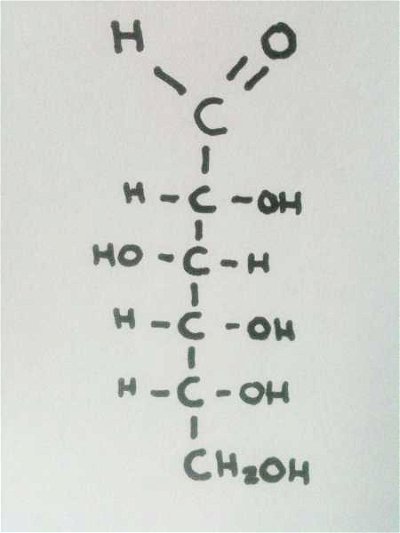
Ribose. Glucose and fructose are both 6-carbon sugars, while sucrose is glucose and fructose bonded together. Ribose is the sugar in RNA.
What is a long chain of sugar molecules? | Basic Biochemistry (Cher40) |
Polysaccharide. Polysaccharides are long chains of simple sugars bonded together including starch, glycogen and cellulose. Polypeptides and proteins are long chains of amino acids. Lipids are substances like fats.
What enzyme do cows have that allows them to digest cellulose? | Biochemistry (knight7se7en) |
beta-amylase. Humans only possess alpha amylase, which can't break down cellulose (because it has a beta 1-4 linkage). This is why when we ate grass as children (if you attempted to anyways) it passed straight through your system and out, eventually into the toilet.
Of what is a triglyceride composed? | Basic Biochemistry (Cher40) |
One glycerol with 3 fatty acids. A triglyceride is a 3-carbon glycerol or glyceride molecule that has three fatty acid chains attached to it, one chain to each of the glycerol's three carbons.
Of what elements are triglycerides composed? | Basic Biochemistry (Cher40) |
C, H & O. Carbohydrates and the lipids known as triglycerides are composed of carbon, hydrogen, and oxygen atoms. Proteins are composed primarily of carbon, hydrogen, oxygen, as well as nitrogen.
Of what elements are carbohydrates composed? | Basic Biochemistry (Cher40) |
C, H, & O. Carbohydrates are composed of carbon, hydrogen, and oxygen atoms. Proteins are composed primarily of carbon, hydrogen, oxygen, as well as nitrogen.
Frequently Asked Questions about Biochemistry
|