Quizzes at Fun Trivia Fun Trivia | quizzes Quizzes | games Games | community People | services Services | help Help | me Me
New Player - Log In
Currently 10533 players online.   Trivia games, quizzes, and contests - FREE !     Get Started! quiz register
Fun Trivia : Forensic Science Encyclopedia FunTrivia

Structure

fun facts,factoids,info

Interesting Questions, Facts and Information

  • There are a total of 70 general entries. We are selecting 30 for display.

Special Topics


Interesting Questions, Facts, and Information

    Forensic Science

    What does the term 'forensic' mean?Basic Forensic Science

      pertaining to the law. From the Latin 'forensis' meaning 'of the forum, or public' because the law is a matter of public interest. In Ancient Rome, the Forum was where the law courts were located. The modern meaning of the word "forensic" is "pertaining to the law or justice system".

    When two objects touch, there is a transfer of material from one to the other. This trace evidence is the basis of forensic science. What is the idea known as?Basic Forensic Science

      Locard's Principle. Dr Edmond Locard opened the world's first police crime laboratory in 1910 in Lyon, France. Locard was a student of Bertillon, also a pioneer of forensic science.

    When identifying victims of disasters, such as plane and train crashes, approximately 93 percent of identifications are made on the basis of which characteristic?Basic Forensic Science

      dental records. The top 3 characteristics are: dental records (about 93 percent), physical characteristics of the body (about 44 percent), personal jewellery (about 42 percent). Fourth place is shared by personal documents and fingerprints, about 30.5 percent each. You are probably thinking that this adds up to more than 100 percent. This is because identifications are never made on the basis of only one factor.

    Forensic entomology involves the study of insects. Insects are a very reliable indicator of post-mortem interval (the estimate of time since death). When and where was the first recorded application of forensic entomology?Basic Forensic Science

      13th century China. Believe it or not, the first application of forensic entomology dates back to 1235 in China in a book entitled 'The Washing Away of Wrongs'. Following a murder in a rural village by slashing with a sickle, the local death investigator assembled the farmers and laid their sickles out in the sun. Flies began settling on only one sickle, due to minute traces of blood and tissue still present, despite it having been washed. The owner of that sickle then confessed.

    Ted Bundy was an American serial killer who was convicted on the basis of which type of forensic evidence?Basic Forensic Science 2

      Bite marks. Although he denied being the killer, Bundy made the mistake of biting one of his victims on the buttocks. So although he lied through his teeth, his teeth marks didn’t lie!

    In October 1974 part of a male torso was found floating in the River Thames in England. Several parts, including the head and hands, were missing so police could not use the usual methods of fingerprints, facial features and dental records to identify the corpse. How was it eventually identified?Basic Forensic Science 2

      All the choices are correct. This case made legal history because it was the first time a body was identified without fingerprints or dental records. It belonged to a petty criminal called William Henry Moseley.

    The time of death can be calculated by various means. One is rigor mortis, Latin for 'the stiffness of death'. Another indication is livor mortis or lividity. What does this term refer to?Basic Forensic Science 2

      Gravitational pooling of blood. Livor is Latin for 'a black and blue spot' and refers to the discolouration of the skin in the lowest part of a cadaver resulting from the gravitational pooling of blood.

    Lord Louis Mountbatten, a cousin of Queen Elizabeth II, was blown to pieces in 1979 when an IRA bomb exploded on his yacht. How did police link the murderer, Thomas McMahon, to the crime scene?Basic Forensic Science 2

      All the choices are correct. The evidence against McMahon included a tiny speck of green paint on his boot which matched the paint on the yacht, the sand on his boots matched that found near the beach near where the boat was launched and traces of nitroglycerine were found on his clothes which were matched to the bomb.

    When attempting to identify a skeleton, craniofacial morphology (the structure and form of the skull and face) is the best indicator of race. One group of human beings has a unique, rounded jaw bone which is called a 'rocker jaw'. This is a characteristic of which ethnic group?Basic Forensic Science 2

      Hawaiians. The 'rocker jaw' is so called because it will rock back and forth like a rocking chair if gently pushed.

    In 1835, Henry Goddard was asked to investigate a burglary in Southampton, England. The butler said a shot had been fired as he struggled with the burglars. Goddard retrieved the bullet and disproved the butler’s version of events by using which technique?Basic Forensic Science 2

      Bullet comparison. The butler did it! Like most gun owners in those days, the butler made his own bullets by melting lead and pouring it into a mould. His mould had a fault, a small 'pimple'. The bullet had a corresponding flaw. Faced with the evidence, the burglar confessed to faking the burglary to curry favour with his employer. By the way, Henry Goddard was one of Scotland Yard’s original Bow Street Runners.

    In Knoxville, Tennessee, there is a research facility, popularly known as 'the Body Farm', where research is conducted into the nature of human decomposition and the factors which affect the rate at which it occurs. Who was responsible for the creation of this facility?Basic Forensic Science 2

      William Bass. The official name of the body farm is the Tennessee Anthropological Research Facility (TARF) but some of Bass’s colleagues call it the Bass Anthropological Research Facility or BARF. (For those who don't get the joke, barf is American slang for vomit).

    What is studied in forensic palynology?Basic Forensic Science 2

      Pollens and spores. One of the earliest cases involving the use of pollen analysis was in Austria in 1959. A man disappeared near Vienna but his body could not be found. Police had a suspect with a motive but no evidence to link him with the possible crime. The suspect’s muddy boots were examined. Dr Wilhelm Klaus found a rare fossilised pollen which enabled him to pinpoint where the defendant must have walked to get the mud on his boots. When confronted with the identity of the location, the defendant confessed the crime and showed the police where he killed the victim and buried the body, both of which occurred in the precise region Klaus had pinpointed.

    What is studied in forensic entomology?Basic Forensic Science 3

      insects. Insects are an extremely accurate indicator of post-mortem interval (the estimate of time since death). They can also help establish whether a body was killed in a different location from where it was found.

    In which year and country was the first case of a conviction based on fingerprint evidence?Basic Forensic Science 3

      1892 in Argentina. Many forensic science sources cite the 1902 case of Henry Jackson (Great Britain) as being the first case in which an individual was convicted of a crime based on fingerprint evidence. Jackson was a burglar who placed his hands in wet paint during a robbery, thus leaving behind his fingerprints. However, a decade previously, Juan Vucetich, a police researcher in Argentina, used fingerprints to prove that Francesca Rojas murdered her two children by taking her thumb print and matching it to a bloody thumbprint left behind on a door. When confronted with the evidence, the mother broke down and admitted killing her children because they stood in the way of her marriage to a young lover. She was subsequently convicted and sentenced to life imprisonment.

    In 1981, the greatest fraud in the history of publishing was perpetrated when the German publishing company Gruner and Jahr purchased the so-called "Hitler diaries". Three independent experts declared the diaries to be genuine but it was later revealed to be a hoax. What was the nature of the crucial evidence, discovered by German government scientists, which exposed the fraud?Basic Forensic Science 3

      analysis of the paper. The first three experts declared the diaries to be genuine using handwriting analysis. However, the German government scientists analysed the paper and found that it contained a chemical called "blankophor", a paper-whitening agent. Blankophor was not used in the manufacture of paper until 1954. Subsequent analysis of the ink established that the diaries were less than a year old. The book-bindings also contained man-made fibres and chemicals which were not available at the time the diaries were allegedly written.

    Dactyloscopy refers to the procedure of using which characteristic as a means of identification?Basic Forensic Science 3

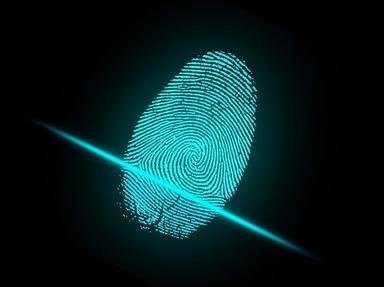
      fingerprints. Dactyloscopy comes from the Greek words "daktylos" meaning "finger" and "skopein" meaning "to examine". Fingerprints are impressions made by the ridges on the ends of the fingers and thumbs which is unique for every human being, even identical twins. These ridges do not change with growth or age. Superficial burns, cuts and scrapes do not affect fingerprints as the original pattern is maintained when the new skin grows. Only severe injury or surgery will alter fingerprints.

    One of Australia's most famous and bizarre murder cases is often referred to as the "Shark Arm Murder". In April 1935, a 14-foot tiger shark in a Sydney aquarium suddenly vomited up a human arm in front of a crowd of shocked tourists. The arm was eventually identified as belonging to a known criminal by the name of James Smith. How did the police make the identification?Basic Forensic Science 3

      tattoo. The identification was made on the basis of a tattoo (two boxers squaring up to each other). It was also noted that the arm was Caucasian, very muscular and remarkably well-preserved. Smith's wife identified the arm as that of her husband and police later confirmed it by obtaining fingerprints. Forensic examination revealed that the arm had been severed with a knife, not bitten off by a shark. The amputation had taken place a considerable time after death and there was a length of rope around the wrist. Another criminal, Patrick Brady, soon became the chief suspect. Despite the forensic evidence, Brady's lawyers obtained a Supreme Court injunction to stop the inquest on the grounds that one arm did not prove that James Smith was actually dead. When Brady came to trial, the jury decided there wasn't enough evidence to warrant a charge of murder.

    What are Bunter marks?Basic Forensic Science 3

      marks used to identify the manufacturer and calibre of a bullet. Bunter marks are the marks produced by a bunter, or head-stamping, tool when the bullet is manufactured. This tool imprints the manufacturer's name and bullet's calibre on the cartridge casing. It is possible to match bunter marks and determine which bunter made them.

    Patricia Cornwell's book "Portrait of a Killer" relates her attempt to apply modern forensic science techniques to solve the mystery of the identity of Jack the Ripper. Who was Jack the Ripper, according to Cornwell?Basic Forensic Science 3

      Walter Sickert (one of Britain's foremost Impressionist painters). In her quest for DNA evidence, Patricia Cornwell and her team swabbed the correspondence of Walter Sickert, Ellen Cobden Sickert (his first wife), James McNeill Whistler (Sickert's art teacher) and Montague John Druitt (another suspect). They found a sequence of DNA on several of the "Jack the Ripper" letters which matched sequences found on Walter Sickert's correspondence. While it may strongly suggest that Sickert wrote some of the letters, it does not prove he was Jack the Ripper. At most, it suggests he may have written hoax letters. According to Patricia Cornwell, this is the oldest DNA ever tested in a criminal investigation.

    What does the term "forensic" mean in Latin?The World of Forensic Science

      Belonging to the forum. Acoording to Dictionary. com- "Origin: 1650–60; L foréns(is) of, belonging to the forum, public (see forum, -ensis) + ic" History records indicate that the first known use of forensic science was in 44 B.C. A Roman physician named Antistius was summoned to examine the corpse of the would-be emperor, Gaius Julius Caesar. In the end, history tells us, the senators who murdered the Roman heir to the throne all paid with their lives. In fact, the term "forensic" is Latin for -before the forum- because this is where Antistius made his fateful decision.

    In forensics, criminologists use AFIS to search an online database for fingerprint matches. What does AFIS stand for?The World of Forensic Science

      Automated Fingerprint Identification System. Although AFIS has many fingerprints on file, it only has prints of people convicted of felonious crimes. People who have not committed crimes before will not be on AFIS.

    If there is a case of arson, the easiest way to find and identify an accelerant is to use what?The World of Forensic Science

      A Sniffer. An accelerant is used to get a fire going. E.g: gasoline, kerosene, and other flammable liquids. A sniffer takes examples of fumes and tests them to see what they are.

    There are two types of wounds people can get when they are shot. What are they? The World of Forensic Science

      Entry wound, Exit wound. The entry wound is where the bullet entered and the exit wound is where the bullet left. -Sometimes though, there is not an exit wound. The bullet would not penetrate through the body-.(Correction thanks to "singedeyebrows") The study of gunshots and bullets is called ballistics.

    What is involuntary manslaughter?The World of Forensic Science

      Killing someone without meaning to.. An example of manslaughter is if you get hit by a car by accident. The driver did not mean to kill the pedestrian, but either way, it happened (Thanks to Feminine_Mystique for the correction on the term "manslaughter").

    Which group of ancient people were the first to use fingerprints for personal identification?Forensic Science Part I: Fingerprints

      the Chinese. The Chinese mainly used a thumbprint in place of a signature in on legal conveyances and criminal confessions. The reason for this was simple. Many people were illiterate at that time and were incapable of signing their name. This recognition of the uniqueness of prints may have lead to the wide-spread use of them later on.

    Who was the first person to devise a system of classifying fingerprints?Forensic Science Part I: Fingerprints

      Johannes Purkinje. Purkinje published a thesis, in which he described different print patterns and gave them names. Purkinje never actually dreamed that they would be used for identifying people. That would come later.

    Before fingerprints, what did people do for identification?Forensic Science Part I: Fingerprints

      measured people's bodies. This system of measuring bodies was called bertillonage. It was named after its creator Alphonse Bertillon. The system took eleven measurements, height sitting and standing, the length of the left arm, etc. As fingerprints became popular Bertillon's system fell out of use.

    What system of fingerprint classification is most widely used today?Forensic Science Part I: Fingerprints

      the Henry system. The Henry system was completed by Edward Henry in 1899. It was first implemented in England and Wales. The FBI made modifications and it still is in wide use today, except for some countries in Central and South America.

    What is the main system used by the FBI and other organizations today to find a match to a latent fingerprint?Forensic Science Part I: Fingerprints

      AFIS. Automated Fingerprint Identification System, or AFIS, has been around since the 1970's when it became possible to use technology for fingerprint searching. Before this system, agents had to go through millions of cards to try to find a match. This could take days. AFIS can do it in less than a second.

    What was one of the problems during early blood tests? (Around 1875)Forensic Science Part II: Serology

      all of these (microscopic examination could not be applied to dried blood, human blood could not be distinguished from animal blood, blood types could not be identified). In 1875 the main blood test in use was the hematin test. It could not distinguish animal blood from human blood or identify the type of blood. The guaiacum test then came along. In the test the suspected blood was put in water. Then guaiacum (a type of tree resin) was added. Hydrogen peroxide was then put into the container. If blood was present, a blue color formed. This test, like the hematin test, could not identify what type of blood it was or tell whether it was human or animal, but it could be applied to small amounts of dried blood.

    Can a person with type A blood safely be transfused with type O blood?Forensic Science Part II: Serology

      Yes. At the beginning of the twentieth century, Karl Landsteiner discovered blood types. He found out that a person's blood cells had an antigen and an antibody. A person with type A antigen has type A blood and has the type B antibody. Therefore if a person with type A blood is transfused with type B blood their blood cells would clump, causing serious problems. If a person has both antigens their blood type is AB. If they have neither their blood type is O. This is why O can be transfused into anybody. No antibodies mean no clumping on A or B blood cells.

  • All content is (C)opyright 1995-2006 FunTrivia.com. Content may NOT be copied, reprinted, or distributed without our written consent. Feel free to link to any page you wish.

  • While we try to keep trivia as accurate as possible through a regular volunteer editing process, FunTrivia cannot guarantee the validity of the information found here. FunTrivia offers no professional advice, and you take all responsibility for your use of anything contained herein.
  • Feel free to send a note to a particular item's author for further details or source information; most of our authors love to hear feedback about their work.
  • See our conditions of use for details.