|
|
|
Structure
Interesting Questions, Facts and Information
- There are a total of 30 general entries.
Special Topics
|
Interesting Questions, Facts, and Information
General Astronomy
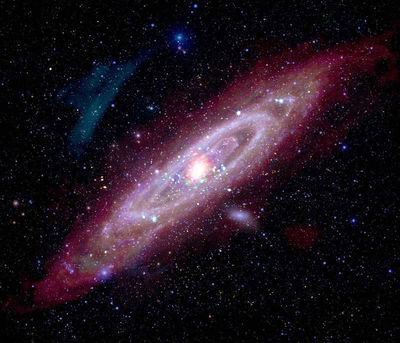
Andromeda Galaxy. Astronomers aren't entirely sure whether this will be a hit or miss affair, but the result would most likely be that the two galaxies would merge. Unless the solar system is near the centre of the mess, it's likely to emerge unharmed.
Magellanic Clouds. The Magellanic Clouds are named for the Ferdinand Magellan, who observed them during his voyage in 1519. They're easy to see with the naked eye from the southern hemisphere, but below the horizon for people in northern parts. They are irregular dwarf galaxies, orbiting the Milky Way.
globular clusters. Globular clusters are spherical clumps of older stars. They look a bit like somebody sprayed a blob of white paint on a black canvas. One of the best examples is Omega Centauri, which is visible to the naked eye, and can be resolved as a fuzzy blob with binoculars.
Orion Arm. Astronomers call the Orion Arm a minor arm, because it's basically a spur sticking out of the Sagittarius Arm. That said, it still manages to be some 3,500 light years across and around 10,000 light years long!
Sagittarius. The actual centre is the supermassive black hole astronomers call 'Sagittarius A*'. We can't actually see it, but it's responsible for a massive radio source, created as dust, gas and whole star systems falling into the black hole.
Space-travellers are unlikely to get lost in our galaxy due to which exotic stars, that act as natural lighthouses by emitting regular beams of radiation? | A Quizzer's Guide to the Galaxy
|
Pulsars. Pulsars are rapidly rotating neutron stars that shoot out beams of radiation as they spin. Each pulsar is distinctive in the pattern, frequency and timing of their pulses, so they're like natural lighthouses, each flashing their individual signature to the Universe!
a supermassive black hole. Astronomers believe that most galaxies have supermassive black holes at their centre. A supermassive black hole has a mass of at least ten thousand times the mass of the Sun. They think the one at the centre of the Milky Way has a mass of four million times the mass of our Sun!
a fried egg. Our galaxy is about 100,000 light years in diameter, and about 1000 light years thick on average, but in the middle it bulges out to a thickness of over 12,000 light years. Astronomers estimate the Milky Way contains at least 200 billion stars.
barred spiral galaxy. A barred spiral galaxy has a central bar-shaped bulge of stars. For some years astronomers using radio telescopes suggested our galaxy was barred, and in 2005, observations by the Spitzer Space Telescope proved it. If you want to see what our galaxy looks like, look for Hubble space telescope images of NGC 1300 or of the Sculptor Galaxy.
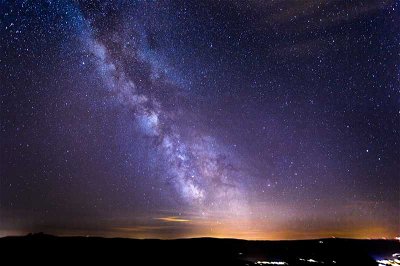
The Milky Way. The name "Milky Way" comes from the Latin "Via Lactea". Many cultures have legends about the origin of the bright band in the sky which is what we see as we look at our own galaxy from the inside, and many of them have to do with milk! The best known is the legend of how Zeus gave the infant Heracles to suckle at the breast of his wife, the goddess Hera, while she was sleeping. She woke, realised the boy wasn't hers and pushed him away. The spilled milk became the Milky Way.
If a star is of apparent magnitude 4.6 and its absolute magnitude is also 4.6, what do you know for certain about the star? | A Truly Universal Quiz!
|
Its distance from Earth. A star's apparent magnitude is its brightness as seen from Earth while a star's true luminosity is expressed as the brightness it would have if it would be exactly 10 parsecs (some 32.6 light years) away and this is called the absolute magnitude of a star. In other words, if a star's apparent and absolute magnitudes are the same, the star must be exactly 10 parsecs distant!
On what kind of diagram are stars plotted according to their surface temperature and luminosity? | A Truly Universal Quiz!
|
Hertzsprung-Russell Diagram. Ejnar Hertzsprung and Henry Russell independently devised a diagram on which stars can be plotted according to their surface temperature and luminosity. The distribution of stars into groups such as giant stars, main sequence stars and white dwarfs is readily evident on an HR Diagram.
Which planet of the Solar System is accompanied by two moons named for the Greek gods of fear and terror? | A Truly Universal Quiz!
|
Mars. Phobos and Deimos are the sons of the Greek god of war Ares and personify fear and terror. It is only fitting that the two moons of Mars (the Roman name for Ares) were named for these two deities. Both moons are likely asteroids captured by Mars' gravitational field and are only 27km (Phobos) and 15km (Deimos) in diameter.
What cosmologically profound discovery did Arno Penzias and Robert Woodrow Wilson make in 1965? | A Truly Universal Quiz!
|
Cosmic microwave background radiation. The cosmic microwave background radiation was discovered quite by accident by Penzias and Wilson. A constant "noise" of radiation that they couldn't account for was found to be emanating with equal intensity from all directions. The radiation is a product of the Big Bang and was predicted to exist as early as 1947.
Many variable stars brighten periodically and some brighten only once such as a supernova but there is one class of variable stars that spends most of the time more or less at a constant brightness only to dim considerably for weeks or months at a time. What class of variable stars exhibits this behavior? | A Truly Universal Quiz!
|
R Coronae Borealis stars. The prototype of this class of variable is R Coronae Borealis, a star that normally shines at the cusp of naked eye visibility (around magnitude 6). Periodically, the star sheds a cloud of carbon dust which dims the light of the star considerably by up to 9 magnitudes rendering the star invisible to all but the most powerful telescopes. As the carbon cloud dissipates into the interstellar medium the star slowly regains its normal brightness.
Its shape bears a striking resemblance to the North American continent. NGC 7000, the North America Nebula, in the constellation Cygnus indeed does bear a striking resemblance to the shape of the North American continent. Best seen in photographs or low-power wide-field telescopes its features include the east coast, the Gulf of Mexico and the Florida Peninsula as well as Mexico.
What celestial object is known as the morning star or the evening star depending on when it is seen in the sky? | A Truly Universal Quiz!
|
Venus. Venus is the brightest object in the sky after the sun and the moon and can best be seen at dawn before the sun rises or in the twilight after sunset in the evening. The planet is almost the Earth's twin in size but supports an inhospitable carbon dioxide rich atmosphere.
Ionized hydrogen. Ionized hydrogen is also referred to as H-II and these gas clouds are often found in the spiral arms of galaxies. Star formation is common in H-II regions with the Eagle Nebula in the constellation Serpens being a prime example.
Vega. American astronomer Henry Draper photographed Vega's spectrum in 1872. The images he took of Vega and other stars would lay the foundations for his "Henry Draper Catalogue of Stellar Spectra".
Pluto. The New Horizons spacecraft will be the first spacecraft to fly by and study Pluto and its moons at close range.
The Trapezium. Discovered by Galileo Galilei, the Trapezium is one of the most prominent features in the Orion Nebula.
What is the term that defines the maximum mass of a white dwarf star, approximately equal to 1.38 solar masses? | General Astronomy Facts
|
Chandrasekhar limit. The Chandrasekhar limit was named after Subrahmanyan Chandrasekhar, an astrophysicist who predicted it in 1930. Any white dwarf over this limit will form a different type of stellar remnant such as a neutron star or black hole. This is achievable by a white dwarf accreting hydrogen from its companion star, such as a red giant, thus forming a nova.
Declination and right ascension. Declination and right ascension are the astronomical equivalent to latitude and longitude respectively.
Heliopause. Voyager 1 is expected to pass the heliopause in 2014. Upon entering the heliopause, it is predicted to measure a massive drop in the temperature of charged particles.
In September 29, 2010, an unconfirmed extrasolar planet 20.5 light-years from Earth in the constellation of Libra was discovered. What was its name? | General Astronomy Facts
|
Gliese 581g. Detected by astronomers in the Lick-Carnegie Exoplanet Survey, Gliese 581g generated attention because from the amount of light it receives, it lie near the middle of the habitable zone, aka Goldilocks' position, of its parent star, Gliese 581. This means that it might be capable of sustaining life just like our Earth.
Ophiuchus. The constellation of Ophiuchus barely crosses the ecliptic plane compared to the 12 traditional signs of the zodiac. As a result, it is not traditionally seen as a part of the zodiac.
In the constellation of Serpens, this Messier object consists of noticeable features such as the Spire and the Pillars of Creation. What is it called? | General Astronomy Facts
|
Eagle Nebula. Discovered by Jean-Philippe de Cheseaux in 1745-1746, the Eagle Nebula is a young open cluster of stars resembling an eagle.
|