|
|
|
Structure
Interesting Questions, Facts and Information
- There are a total of 55 general entries. We are selecting 30 for display.
Special Topics
|
Interesting Questions, Facts, and Information
F1 Teams & Sponsors
In the Portuguese Grand Prix of 1986, the Marlboro McLaren of Keke Rosberg wasn't painted in the usual red/white livery but in yellow/white colours. Why? | Formula 1 Teams and Sponsors
|
In Portugal the Marlboro colours are yellow/white. The Marlboro colours in Portugal are yellow/white. The Marlboro design is the same as everywhere, but the red colours are replaced by yellow. For promotional reasons they changed the colours on Keke's car. It's the only time between 1950 and 2002, that a Marlboro McLaren didn't race in their traditional red/white livery.
Australian. The Spirit team was a very small team when they made their debut in 1983. There wasn't much money, but they had the Honda V6 turbo engines. In 1984 Honda had moved to Williams leaving Spirit with an old Hart 4 turbo and no money. There weren't any decent results in that year.
The situation didn't change for 1985. There was a new car, called the 101D. But the budget was very tight. The team entered the first three races of the year, with Italian Mauro Baldi at the wheel. But after the San Marino Grand Prix it was over. Benetton (who saved the Toleman team in the same year) bought what ever was left of the team.
Rebaque. Carta Blanca is Mexican beer. They sponsored the first Mexican F1 constructor in the history of the World Championship. Hector Rebaque was a wealthy Mexican who started his F1 career with Hesketh in 1977. He started his own Formula 1 team in 1978 and called it:"Team Rebaque" with Hector as a driver and constructor. He entered a 1 year old Lotus 78. He suprised everyone by scoring a point in Germany.
In 1979 he entered a Lotus 79, but was also working on a new car. This was the Rebaque HR100. It was an almost exact copy of a Lotus 79. The car only appeared in the last three races of the year. He didn't qualify two times. But in Canada he made it to the grid.
For 1980 Hector got the chance to drive for Brabham. Team Rebaque wasn't seen anymore.
Dutch wodka. Ursus is a Dutch wodka (vodka) producer.
In 1976 the main sponsor of the Penske team was "First National City Travelers Checks", but by the end the year Penske decided to quit F1. The sponsor stayed in Formula 1. Which team did they sponsor in 1977? | Formula 1 Teams and Sponsors
|
Tyrrell. The Tyrrell 008 of 1977 was painted in blue and white colours and was sponsored by First National City Travelers Checks.
Belgium. The main sponsor for the Onyx team in 1989 was Moneytron. This was a Belgian company led by Jean-Pierre van Rossum. A strange man with strange looks (he was fat, had a grey beard, long grey hair and wore sunglasses) He was very wealthy. He made his fortune with his Moneytron company. This Moneytron wasn't anything more than a clever system for predicting the ways of the stockmarkets. It was very popular in the late 80's. Van Rossum decided he liked the glamourworld of F1 and helped the British Onyx team into Formula 1. Van Rossum spent a lot of money throughout the year. Not all expenses were for the good of the team. For example he spend 20 million dollars on a company jet.
In the mean while Van Rossum spent (in his own words) 40 million dollars in the development of a new Porsche engine. When Porsche announced that the engine wasn't ready until 1991, Van Rossum decided to leave the team. He sold Onyx to Swiss Peter Monteverdi in 1990. The team disappeared after the Hungarian Grand Prix of that year.
5. *Mild Seven: Benetton and Tyrrell
*Rothmans: Williams
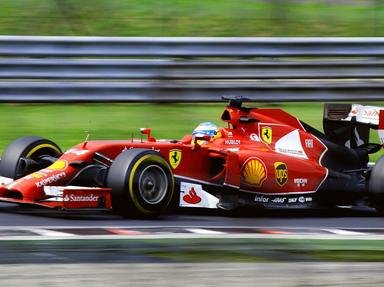
*Marlboro: McLaren and Ferrari
*Gitanes: Ligier and Larrousse
*Gaulioses: Also Larrousse (just for a few races)
5. Benetton, Lotus, AGS, Tyrrell, Lola Larrousse.
Suzuki. Suzuki sponsored the Trojan team in 1974. They were only sponsor and had no part in building car or engine. The car (Trojan T103) was designed by Ron Tauranac, the man who founded the Brabham team together with Jack Brabham in 1961. The car looked pretty, but was not competitive. Tim Schenken drove the car in 1974 and his best results were two tenth places in Belgium and Austria.
Tauranac left the team by the end of the year, to start another project: Ralt. They produced succesfull F3 chassis for many years.
Citizen. The Maki F101C was painted brightly blue in 1975, with main sponsoring from Citizen. But this wasn't a success. The cars were much too heavy and too slow. The team tried to qualify for a race but were never close.
In 1976 the team returned with the Maki F102A. It was too light. The car suffered from severe traction problems. It was seen only once in 1976, when Tony Trimmer tried to qualify the car for the Japanese Grand Prix. It was real no suprise that he failed.
In 1972 Eifelland entered a rebuilt March chassis and called it an Eifelland 21. But what kind of company was Eifelland? | Formula 1 Teams and Sponsors
|
They build caravans. Eifelland is a caravan manufacturer. In 1972 they bought a March 721 chassis. They hired an Italian designer Colani to redesign the car. The result was a strange looking car. The Eifelland 21 had only one rear-view mirror. It was placed in front of the driver (Rolf Stommelen) like a periscope. Stommelen raced the car in eight races in 1972. His best results: two tenth places in Monaco and Britain.
Shell. Elf sponsored Matra in 1969 and 1970. In 1971 and 1972 Shell was the new petrol sponsor.
5. Gold leaf in 1968 - 1971
John Player: 1972 - 1979
Martini: 1979
Essex: 1980 - 1981
John Player: 1981 - 1986
Camel: 1987 - 1990
From 1950 to 2002 there were two F1 constructors who started their Formula 1 career as a sponsor, without any racing background. Benetton is perhaps the most well known. What is the second? | Formula 1 Teams and Sponsors
|
LEC. LEC was (and is in 2002) a company who build refrigerators. They started their sponsoring in F1 in 1973 with a March 731, driven by David Purley. David's father was the manager of the LEC company. For 1977 Purley asked Mike Pilbeam to design him a Grand Prix car. It was built at the LEC factory and was called a LEC CRP1. The car looked good and David scored a sixth place finish in the Race of Champions that year. Things looked well for the small team, but tragedy struck them in Silverstone. Purley carshed heavily, and was very lucky to survive. He recovered but wasn't seen anymore in Grand Prix. He continued racing his LEC in domestic races.
Colombia. Cafe de Colombia was the main sponsor for the Ensign team in 1982. They're a Colombian Coffee producer.
German tobacco producer West sponsored the McLaren team in 2002. But which team did West sponsor in the eighties? | Formula 1 Teams and Sponsors
|
Zakspeed. West sponsored Erich Zakowski's Zakspeed team from Germany from 1985 to 1989. The cars were painted in a red/white livery. From 1985 to 1988 the cars were powered by a 4 cylinder turbo engine of their own making. The cars were never frontrunners. In those 4 turbo years they only scored 2 points, thanks to Martin Brundle in Imola in 1987. For the 1989 season Zakowski made a deal with Yamaha for a V8 engine. The new car (Zakspeed 891) powered by the new Yamaha OX88 V8 engine was a nightmare on wheels. Drivers Bernd Schneider and Aguri Suzuki struggled all year. Schneider made it to the grid only two times (in Brazil and Japan). Suzuki never got through the pre-qualifying. At the end of the season Zakowski decided to stop his Formula 1 adventure.
West stopped the sponsoring in Formula 1, but they returned in 1998 as the main sponsor for the Silver Arrows of McLaren-Mercedes.
Canada. Himont was (and remains in 2002) a Canadian forest products company. They were main sponsor of the Coloni team in 1988 and 1989.
Rotary Watches. Expensive watches from Switzerland. The sponsor wasn't happy at all with the performance of the BRM P207 of 1977. The car was a horrible piece of machinery. Too heavy and too slow. Rotary decided to stop their sponsoring. They even began proceeding against the team for failure to honour their commitments.
Belgian Teddy Pilette tried to qualify the now sponsorless car in Germany, Holland and Italy, but failed. It was the last year we saw the BRM team in the paddock in the twentieth century. There were plans for an entry in 1978, but that was cancelled because there was no money at all.
There were half naked women painted on the sides of the car. The Hesketh 308E of Rupert Keegan was sponsored by Penthouse magazine.
The car was often photographed because there were two half naked women painted on the sides of the car. The paintings didn't help Rupert or the team. Rupert's best finish in 1977 was a seventh place in the Austrian Grand Prix.
In 1978 Rupert had another controversial sponsor. He now drove for the Surtees team, and "Durex" was now his main sponsor.
HB Alarmsystemen. HB Alarmsystemen is a Dutch security systems company. This Boro car was originally an Ensign from 1975. Ensign was sponsored that year by "HB Bewaking". But team and sponsor started a row over money and past agreements. The sponsor took the cars and decided to enter them in 1976 as a "Boro 001". Ensign went on with the job and build a new Ensign N176. The Boro 001 was also seen in 1977, when Brian Henton drove the car in Zandvoort and Monza.
USF & G. In 1987, 1988 and 1989 the main sponsor of the Arrows team was
USF & G (United States Fidelity and Guaranty), an American financial services company. They were first seen on the Arrows A8 in 1986. But the main sponsor then was "Barclay". The last time the name was seen on the Arrows cars in the twentieth century, was in 1990 on the Arrows A11C. The main sponsor in that year was Footwork (a Japanese transport company).
Samson Shag. The Dutch tobacco company Samson sponsored Jan Lammers in his debut year in Formula 1 in 1979. The Shadow DN9 was beautifully painted with a giant lion head on the front of the car. The lion was (and remained in 2002) the logo of the firm.
Sadly for Jan, the DN9 wasn't a competitive car. He didn't score any points that year. His best finish was a nineth place at the Canadian Grand Prix in Montreal.
El Charro. El Charro is a Mexican shoes and clothing company. The AGS JH22 of 1987 was beautifully painted. A white car with lots of red horizontal lines on it. Sadly the performence of the car was not that good. Pascal Fabre struggled all year and was replaced by Roberto Moreno for the last two races. Moreno suprised everyone in Adelaide for the last race of the year by scoring a point.
barrichello . With rule changes in 2003, Ferrari may lose their advantage over the rest, but with drivers such as Michael Schumacher and Rubens Barrichello, they are still favourites to retain both championships.
Mark Webber. Another driver who impressed at Minardi in 2002, was Aussie Mark Webber. He was joined at Jaguar Racing by F1 debutant Pizzonia. They took over from Irvine and De La Rosa who left in 2002.
Ralph Firman. Jordan will be hoping to improve on last season's mediocre performance. They bring in Brit Ralph Firman to join Italian Fisichella.
Cristiano Da Matta. Cristiano Da Matta, a new Brazilian talent, joined Frenchman Panis at the Toyota team.
Kimi Raikkonen. Scot David Coulthard and Finn Kimi Raikkonen aim to end Ferrari's dominance in their McLaren Mercedes.
Fernando Alonso. Jarno Trulli retained his place at Renault, and was joined by 21 year old Fernando Alonso from Spain. Alonso impressed with Minardi last season, had taken Button's seat at Renault.
Justin Wilson. Dutchman Jos Verstappen returned to F1 after a break, and was joined by English rookie Wilson at Minardi.
Heinz Harald Frentzen. The Swiss Sauber team consisted of an all-German lineup with Frentzen and Heidfeld.
|