|
|
|
Structure
Interesting Questions, Facts and Information
- There are a total of 30 general entries.
|
Interesting Questions, Facts, and Information
Geoffrey Boycott
142 not out. This was a crucial second-innings knock for England in the Fourth Test at Sydney, which prevented Gleeson from bowling Australia back into the match and set up victory by 299 runs after Illingworth had been able to declare with plenty of time to bowl the home side out. (England's brilliant strike bowler John Snow speeded things up by taking 7-40 in exciting style.) England thus took the lead 1-0, and the psychological advantage that went with it. They finished the series winners by 2-0.
Australia 1970-71: a famous anecdote about Boycott dates from this tour. He was batting with Basil d'Oliveira, when the South African-born all-rounder approached him in excitement at the end of an over and announced that he had discovered an effective method of playing Australia's unorthodox leg-spinner John Gleeson, who had been tormenting England's other batsmen since the tour began. What is Boycott said to have replied? | The Test Career of Geoffrey Boycott [1]
|
I worked that out a fortnight ago.. The implication was that Boycott had not bothered to share important information with his teammates. This is sometimes cited to support the theory of a "selfish" Boycott, playing only for himself at all times. Quite a number of people - though not everybody, it must be said - feel that this aspect of the man has been exaggerated out of all proportion.
As a footnote to this story: this pair of dedicated professionals always tended to bat extremely well together. In fact, one of the most enjoyable partnerships I can ever remember watching was between Boycott (112) and d'Oliveira (74) for the fourth wicket against Pakistan at Headingley in the opening Test of the 1971 season. They batted like a pair of blood brothers, and the running between the wickets - on this occasion at least - was immaculate.
Boycott had a magnificent tour of Australia in 1970-71, during which Raymond Illingworth's side regained the Ashes after a very long time without them (England had lost the Ashes in 1958-59). His only on-field blemish was when he briefly lost his cool on the pitch at Adelaide Oval, after being controversially given out for 58. What kind of dismissal was it? | The Test Career of Geoffrey Boycott [1]
|
run out. It was a very tight decision indeed, and English supporters would naturally feel, in the days before referrals and third umpires, that Boycott might have been given the benefit of the doubt. On the other hand, Umpire Max O'Connell was regarded as a fair-minded man, popular with the England players, and he was presumably in the best position to judge. The Adelaide crowd quickly forgave Boycott when he scored a fluent century in the second innings. On that tour he was batting on water and averaged over 90 in the Tests.
Which swashbuckling, 17-stone Durham-born Northamptonshire player put on an exhilarating 132 with Boycott for the second wicket against Australia at Lord's, North London, in the summer of 1968? | The Test Career of Geoffrey Boycott [1]
|
Colin Milburn. This was the perfect start for England in this match, as they needed to restore some pride after having performed dismally in the previous Test at Old Trafford. Outscoring his partner 2 to 1, Milburn cut and pulled his way to 83 before being memorably caught by Doug Walters in front of the Members' Stand going for another big hit. England then bowled and fielded like demons when Australia batted, forcing the visitors to follow on but being denied victory when rain washed out the end of the game.
Milburn's cricketing career was sadly cut short by a car accident in the spring of 1969, just as he looked as if he might enjoy a long England stint as Boycott's perfect foil.
At Port of Spain, Trinidad, in March 1968, West Indies captain Garfield Sobers suddenly declared his second innings closed at 92-2 on the final day, sportingly (or perhaps rashly) setting England a target of 214 that looked gettable, on paper at least. What happened next? | The Test Career of Geoffrey Boycott [1]
|
Boycott and Cowdrey steered England to victory. This was perhaps the chief highspot in Boycott's wonderful first tour of the Caribbean (although his 113 at Sabina Park, Kingston, Jamaica in the drawn Fifth Test was another fine effort.) In a perfectly-timed response to Sobers's challenge, first with John Edrich (29) and then with the skipper Colin Cowdrey (71) England's anchor-man (80 not out) saw his side home by seven wickets with just a few minutes to spare - a result that later turned out to have secured victory in the series. I have the impression that Sobers's cricketing gambles usually paid off for his side - but this one certainly didn't.
In the First Test against India at Headingley, Leeds, in 1967 Boycott scored 246 not out - his highest Test score. What happened to him before the Second Test started at Lord's? | The Test Career of Geoffrey Boycott [1]
|
dropped from the side for slow scoring. Ironically, Boycott's run-rate during his Headingley innings (in a match which England eventually won by six wickets) was relatively brisk compared to some of his later Test batting marathons, for which he received no punishment. The selectors argued that the Indian bowling was gentle enough for a more aggressive innings to have been played. Boycott was reported to have been "gutted" by their decision.
Both in South Africa in 1964-65 and again in Australia in 1965-66 Boycott shared some first-rate Test opening stands with Warwickshire's free-scoring Bob Barber, most memorably at Sydney Cricket Ground in the Third Test. England won this Test by an innings - Barber stroked a glorious 185 while Boycott, allowing his partner free rein, himself made what score? | The Test Career of Geoffrey Boycott [1]
|
84. They put on 234 in even time, setting up a famous England victory by an innings and 93 runs, Australia in this game missing their captain Simpson who was injured. Boycott was no slouch during this big partnership: nor had he been in the previous Test, when - as wikipedia recounts - the same opening pair had "electrified" the Melbourne crowd with 88 in 77 minutes, Boycott scoring 51 of them!
Australia (with Simpson in charge again) came back hard at Adelaide in the Fourth Test to level the series, and so the Ashes stayed down under.
M.J.K. Smith. Boycott played some crucial Test innings on both tours, first in South Africa and then the following winter in Australia. I read somewhere that the young Yorkshire opener, who played in glasses in those early days, was inspired by the example of the bespectacled Smith captaining Warwickshire and England quite successfully without any apparent discomfort. England won a hard-fought series in South Africa 1-0, and drew 1-1 in Australia.
The Oxford-educated Smith, who played his cricket rather in the manner of an absent-minded professor, used Boycott creatively as a first-change bowler on both of these tours - a tactic which enabled both of England's quality off-spinners, Fred Titmus and David Allen, to be fitted into the Test team together. Although he has always been very modest about his seam-bowling skills, Boycott responded by taking several useful wickets in both rubbers.
Bobby Simpson's Australians. Showing good form on his first Test appearance, Boycott put together a solid 48 on the opening day before being paranormally caught at first slip by Simpson, who specialised in hanging on to highly unfeasible catches.
I've been watching some video footage of Boycott's debut series and I must say, he looked every inch an England batsman right from the word go. Australia won the rubber 1-0, but a new English star was born that summer. "This young man is very strong off the back foot," purred Denis Compton from the BBC commentary box at Leeds.
1 win, 1 loss, 2 draws. The Test in Karachi was a very slow-scoring, tedious draw, but things livened up in New Zealand with the English touring side's first-ever defeat there at Wellington, by 72 runs, after being skittled out for 64 in their second innings. Admitting that England hadn't deserved to win, Boycott added that his team "would like to be thought of as losing with grace, as New Zealand have done in the past". England gained quick revenge in the Second Test at Christchurch with a 174-run victory dominated by the youthful all-rounder Ian Botham, but anti-climax followed with a disappointing draw at Auckland.
Opinion is divided about the quality of Boycott's captaincy on this tour. He has been criticised for demanding too much from his players on the one hand, and on the other for monopolising the crease during match practice so that others did not get enough time at the wicket. He has always defended himself vigorously on this subject, pointing out for one thing that as his side's anchor-man he needed maximum practice time, and for another that he was working with Brearley's chosen players, not necessarily the ones he would have chosen himself, and some of them could not always quite live up to his exacting standards.
When Mike Brearley broke his arm in Pakistan during the England tour of 1977-78, vice-captain Boycott suddenly found himself taking on the top job, in what turned out to be pretty difficult circumstances. Predictably, perhaps, his first match as England captain was plunged into dramatic controversy before a ball had even been bowled. What was the reason? | The Test Career of Geoffrey Boycott [2]
|
the England players refused to accept the Pakistan team as selected. The origin of the dispute lay in World Series Cricket, the brainchild of Australian tycoon Kerry Packer, which had enticed many international cricketers into its orbit and deprived England of some of its key players. Unlike other countries' ruling bodies, however, the Pakistani Cricket Board had not suspended any of its Packer-contracted players, and some of them were duly selected for the Third Test at Karachi. The England team, egged on by their new captain, refused to take the field until the offending players had been replaced by non-Packer men - and the Englishmen got their way. So Boycott had organised a successful players' strike within days of becoming captain! (He may have been partly animated by thinking of all the money he had himself turned down when Packer tried to entice him into his fold.)
Then, from somewhere in the Southern Hemisphere, England's pirate captain, the deposed Packer rebel Tony Greig, suddenly unleashed a volley of insults aimed at "Boycott and his cronies" - something he may later have regretted doing, since it apparently made him very unpopular for a time with the authentic England team on duty in Karachi.
he scored his hundredth hundred. As the late Brian Johnston of the BBC remarked at the time, the odds against a Yorkshire player scoring his hundredth first-class hundred in an Ashes Test in front of his home crowd at Leeds must have been pretty astronomical, and yet most of the Yorkshiremen arriving at Headingley for the first day's play confidently expected Boycott to do it - and they were not disappointed.
Boycott batted long into the second day for his monumental 191, dominating the England innings and being last man out in an England total of 436 (Knott's 57 was the second-highest score). By the end of the match he had become only the fourth player in history to be on the field for the entire duration of a Test match.
It should not be forgotten, either, that the England victory by an innings and 85 runs - set up by Boycott and then completed expertly by England's seam bowlers and fielders - brought the Ashes back to England surprisingly soon after the team's mauling at the hands of Lillee, Thomson and Walker in Australia in 1974-75.
Having opted out of England's 1974-75 tour of Australia, Boycott then spent three years away from international cricket until in the summer of 1977 he was dramatically recalled for the Third Test against Australia at which English cricket ground? | The Test Career of Geoffrey Boycott [2]
|
Trent Bridge, Nottingham. The new England captain, Michael Brearley, had always been an admirer of Boycott's and it was no surprise when he quickly got his man back into the Test squad - and so the Yorkshire opener was recalled to Test duty on the very same ground where he had made his England debut thirteen years previously. Boycott has admitted that he felt tense at first, in spite of the reassuring presence at Trent Bridge of Harold Bird, on umpiring duty.
Boycott's comeback innings will not easily be forgotten by those who saw it. He started by running out the local hero, Derek Randall, with a terrible call, and then spent more than two hours laboriously acquiring 20 runs, at which point he offered a regulation slip catch to Rick McCosker, who put it down. With his team having subsided to 74-5, however, Boycott was still there, and in a sixth-wicket partnership of 215 with the mercurial England wicket-keeper Alan Knott - who chose this moment to register his highest Test score of 135 - the game was turned on its head, and Boycott followed his first-innings 107 with an undefeated 80 which steered England to a seven-wicket victory.
Boycott was "rested" by the England selectors after one Test of the 1974 home season, during which he had twice been dismissed cheaply by the innocuous-looking Indian seam attack. Who replaced him as Amiss's opening partner against India and Pakistan for the rest of the summer? | The Test Career of Geoffrey Boycott [2]
|
David Lloyd. The left-handed Lloyd scored 214 not out in the second innings of his maiden Test against India at Lord's, but in his subsequent appearances at international level was never quite able to reproduce this sort of form. Lancastrian to his bootstraps, Lloyd is an excellent source of good-natured anecdotes about his old Yorkshire foe (they never actually played in the same Test side together). You can catch him in droll form on the subject of Boycott by going to youtube.
99 & 112. On a wicket which seemed to inhibit free-scoring strokeplay, Boycott's two dour and determined innings held England's batting together like glue and, backed up by some inspired off-break bowling from the versatile Tony Greig (who took 13 for 156 in the match against the opposition's star-studded batting line-up), kept England in the game. In the end England won the match by just 26 runs and in doing so levelled the series 1-1, much to the consternation of the Trinidad crowd who had certainly not been expecting anything like that to happen.
In a ghosted book of cricketing memoirs, Dennis Amiss recounts how he once had the temerity to call out "Good luck, Geoffrey!" as he and Boycott walked out to start another England innings together. What, according to Amiss, did his partner reply? (You will already know the answer to this one if you read my quiz introduction.) | The Test Career of Geoffrey Boycott [2]
|
It's nowt to do wi' luck, it's ability that counts.. In fact Boycott and Amiss developed into a successful double-act as England openers after their initial kerfuffle at Trent Bridge, with partnerships of 112 against New Zealand at Lord's and 105 against the West Indies at Edgbaston that same summer, and then 209 together (Boycott making 93 and Amiss going on to 174) in the second innings at Port of Spain, Trinidad in the opening Test of the subsequent Caribbean tour. England lost this Test by seven wickets after their middle-order and later-order batsmen, throwing away the opportunity so valiantly created by the openers, were routed by the veteran off-spinner Lance Gibbs (who finished with 6-108).
"Boycott is good to bat with," said Amiss in a newspaper interview, "because he is always looking to push his partner's score along as well as his own."
Some time later, the Yorkshireman wrote a very warm tribute about his opening partner's cricketing talents for Amiss's publishers to use on the cover of one of his books. The story goes that the publishers were so astonished by the lavishness of the praise that they called Boycott's agent to check whether the glowing testimonial had really been written by Boycott, or not rather by some mischievous hoaxer.
At Headingley in 1973 Boycott's first-ever century against New Zealand - a well-made 115 - was watched approvingly from close quarters by an old Yorkshire friend of his, Harold "Dickie" Bird, who was making his debut as a Test umpire. What, according to Bird, was always his greatest fear when officiating at one of Boycott's batting marathons? | The Test Career of Geoffrey Boycott [2]
|
falling asleep. One of the best-loved and most humorous characters in the cricket world, Barnsley-born Harold Bird was also one of the great Test umpires, whose judgement on the field was outstanding - except perhaps, some would say, for an exaggerated tendency to stop play because of bad light. Mr Bird gave an interview to Sky News a few years ago, during which he recalled his habit of talking to himself while umpiring during a long Boycott innings: "Concentrate, Dickie, concentrate, lad, don't let him send you to sleep, don't let him send you to sleep...". As he was much in demand as a Test umpire during Boycott's later England career, Mr Bird must have spent an awful lot of time doing this out in the middle.
June, 1973: Trent Bridge, Nottingham. The start of another Test series. Early in England's second innings against New Zealand, Warwickshire's Dennis Amiss took a leisurely single for a shot which his partner, Boycott, had decided was worth two. What happened next? | The Test Career of Geoffrey Boycott [2]
|
Boycott was run out by the length of the pitch. This was the first match in which these two slightly unpredictable runners between the wickets had opened the England innings together, and the ensuing run-out episode seemed rather comical to some of those not closely involved. The incident ended with both batsmen stranded at the same end and with Amiss, as he grounded his bat, being seen to turn his back pointedly on his furious teammate. To add insult to injury, the Warwickshire batsman then cruised to 138 not out, during the course of which innings discontented growls of "them's my runs" were allegedly reported coming from the dressing room.
This match was also remarkable for an astonishing fightback by the Kiwis when, set a massive 473 to win, they fell only 37 runs short thanks to an epic display of classy batsmanship by their captain, Bevan Congdon, who scored 176 and took them to the brink of what would have been a historic victory.
47.73. The other three Test batting averages given were - in descending order - those of Gower, Gooch and Fletcher respectively. Boycott averaged 84.42 against Pakistan, 57.05 against India, 47.50 against Australia (with seven centuries) and 45.93 against the West Indies (with five centuries).
108. Quite a lot of people - and not only in Yorkshire - think he should have played in more. There was one last chance to bring him back, in the Caribbean on David Gower's tour of 1985-86 when Mike Gatting's nose got in the way of a Malcolm Marshall bouncer and he was forced to withdraw from the series. The 45-year-old Boycott, who had been compiling mountains of runs for Yorkshire in the summer and was covering the winter tour as a journalist, courageously volunteered to step into the sudden vacancy and square up again to the fearsome pace of the world's most dangerous bowlers. His offer was politely declined and a younger player was drafted in from England - although personally I think Boycott would have physically glued himself to the wicket rather than let any England team of which he was a member lose 5-0 in a rubber (which they managed to do without him).
Keith Fletcher. Fletcher, "the Essex Gnome", captained England in India in 1981-82, but did not particularly endear himself to the crowds there either by his introverted manner or by his negative tactics on the field, especially after England had lost the First Test at Bombay by 138 runs. It was a low-scoring game, which they should have won after the painstaking efforts of Boycott and his snail-paced understudy from Kent, the slow-scoring Chris Tavaré - "a worse version of me", as the Yorkshireman remarked grimly. This dedicated pair had, in making the two top scores of the match (60 and 56 respectively), put together a solid second-wicket stand of 92 in England's first innings, only to see their teammates fritter away the edge thus gained (aided, admittedly, by one or two grotesque umpiring misjudgments in India's favour).
The sight of two such slow batters occupying the crease for hours together was too much for the late great Denis Compton, covering the series as a journalist, as he prepared his evening copy for a British tabloid newspaper. "Never again!" he spluttered over his vindaloo, "never again must Boycott and Tavaré be allowed to play together in the same England side!"
by scoring a century. The honour of scoring the first Test century at St John's went to Northamptonshire's Peter Willey on the first day: he played brilliantly, but since he was batting down at No.7 he predictably ran out of partners soon after reaching three figures. Boycott's 104 not out came in the second innings as he and Gooch (83) ensured a comfortable draw. Except for his double failure in Barbados, Boycott - who had just turned 40 when the tour began - scored good runs in all the Tests and won praise for his cricket from all quarters, including some of his former critics.
Which great West Indian fast bowler, known affectionately to his peers as "Whispering Death", dismissed Boycott for 0 and 1 at Bridgetown, Barbados in the Second Test of the 1980-81 series? | The Test Career of Geoffrey Boycott [3]
|
Michael Holding. The single devastating over which the lean and hungry-looking Holding unleashed at Boycott in the first innings, the sixth ball of which clean-bowled him, has gone down in Caribbean folklore, and there must have been some joyful calypsos written about it afterwards. It is reported that the perfectionist Yorkshireman studied innumerable video clips from different angles of the delivery which had dismissed him, before finally concluding that there was no way either he or anybody else could have kept that ball from hitting the stumps.
England lost this match by 298 runs, but some pride was salvaged by Boycott's opening partner, Graham Gooch, who hit a defiant 116 as his teammates fell around him in the second innings.
by scoring a century. There was some excellent cricket played in this historic game by both sides, in particular by the young Australian vice-captain Kim Hughes (who batted beautifully for 117 and 84), but the captains were not prepared to take risks and persistent rain over two days - and then a waterlogged outfield - curtailed play and, together with Boycott's dogged resistance, ensured a draw. Boycott top-scored in both England innings, playing the fast men Lillee and Pascoe more confidently than anybody else in the England camp.
Sadly, this match is more likely to be remembered for an unsavoury incident in which Umpire David Constant was physically assaulted by a man in the members' enclosure protesting about delays to the restart of play. After Constant had been rescued by the two captains, Greg Chappell - revealing a hitherto unsuspected sensitive side to his character - complained about having been "embarrassed" by some of the strong language used by angry MCC members during this incident.
They're a rum bunch, these Lord's members: it is said that some of them used to get down on their knees before the start of every Test match in which Geoffrey Boycott was due to play, and pray to the God of Cricket for his early dismissal. Well, at least they never did him any physical harm.
"Naturally I am interested," remarked Boycott when Brearley stepped down from the England captaincy in the spring of 1980. The Test selectors, however, chose a much younger player to skipper the side against the West Indies that summer. Who was it? | The Test Career of Geoffrey Boycott [3]
|
Ian Botham. Boycott had wanted the England captaincy badly since at least 1973 and was considered by many (including, of course, himself) to be the person best qualified for the job, but it seems that the board of selectors (and in particular their long-serving chairman, the unflappable Alec Bedser) had decided a long time before this that the Yorkshireman was a hopeless loner whose behaviour under extreme pressure was dangerously unpredictable. (The selectors were not always unanimous in these matters, however: Boycott's old Test buddy John Murray had resigned from the panel in protest in the autumn of 1978 after his one-time teammate was deprived of the England vice-captaincy.)
All this led to Botham's being thrown in at the deep end as skipper against Clive Lloyd's all-conqueroring West Indians, and the extra pressures of captaining the side against such ultra-powerful opposition certainly seemed to affect the brilliant young player's batting form, which returned in 1981 immediately after he relinquished his extra burden.
Boycott was a key player in Botham's team, and he played his heart out as always. England lost the summer series only 1-0, and nobody will ever know if the extra expertise that Boycott would have brought to the top job might not even have tipped the end result in England's favour. Boycott would also have had his say in selection meetings, without any doubt: he is on record as commenting, for instance, that he thought the selectors had made a pretty good blunder in dropping the classy Kent batsman Bob Woolmer from the squad after only two Tests of the summer, and then not even bringing him back for the Caribbean tour which followed, when several players of lesser ability were chosen.
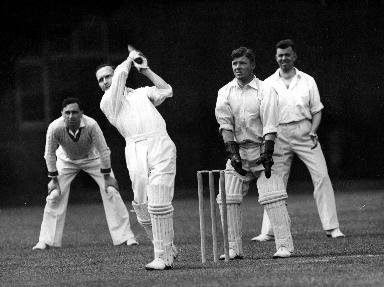
The scene is the WACA stadium at Perth, during the 1979-80 England tour of Australia. What unusual feat did Boycott achieve on this ground in the First Test of the three-match series? | The Test Career of Geoffrey Boycott [3]
|
carried his bat through an England innings. Here was a match which England could have won after skipper Mike Brearley's bold decision to put Australia in on the first morning - the home side were struggling at 127-5 in mid-afternoon - but in the end the tourists lost by 138 runs, in spite of Boycott's heroic second-innings effort, which lasted more than six hours.
Boycott finished with 99 not out - the first time this exact score had ever been registered in a Test match, although a few other players have recorded it since. Bob Willis, England's No. 11, could not stay with his senior partner long enough to see him through to three figures - but the real blame lay with the specialist batsmen, some of whom let Boycott down by getting out to loose strokes at critical moments. "Geoff did his job superbly," commented Brearley after the game,"but we didn't do ours." Or in the words of Wisden, "only Boycott showed the technique and determination needed to survive."
England also lost the other two Tests of this three-match rubber (which, for various reasons, was not accorded Ashes status) but they were at the receiving end of some controversial umpiring decicions - more than once involving Greg Chappell, Australia's captain and star batsman, who seemed to lesd a charmed life at the crease.
|