|
Structure
Interesting Questions, Facts and Information
- There are a total of 35 general entries. We are selecting 30 for display.
Special Topics
|
Interesting Questions, Facts, and Information
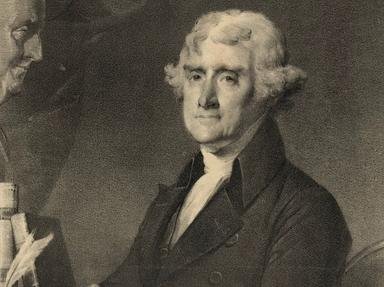
Jefferson, Thomas
April 13, 1743. He was born on April 13, 1743 to Peter and Jane.
Shadwell, Virginia. Shadwell is just east of Charlottesville and was the former home of Peter Jefferson. His house burned to the ground in 1770.
University of Virginia . It opened in March in 1825 to it's first 123 students. Edgar Allan Poe attended the university in 1826- 27.
Randolph. Jane was born in 1720 and died in 1776.
Martha. Martha is also the first name of Washington's wife.
Wayles Skelton. At 56, Thomas Jefferson married Martha Wayles Skelton and were married for ten years before Martha's death. They had six children, but only to of whom lived to adulthood.
William and Mary. William and Mary was founded when Johnstown was still capital of the Virginia colony.
Law. Jefferson studied law and served in a local government as a magistrate, county lieutenant, and a member of the House of Burgesses in his early professional life.
1776. As a member of the Continental Congress Jefferson was chosen to draft the Declaration of Independence in 1776.
Yes. He was elected as a governor from 1779 to 1781.
In what year did Jefferson assume the office of Secretary of State? | Thomas Jefferson
|
1790. He was chosen as secretary of state in 1789 by his friend George Washington, but wasn't able to take office till the following year, as he was abroad at the time.
1800. When he defeated Adams and became president it was the first peaceful transfer of one authority from one party to another in the history of the young nation.
July 4, 1826. Just hours before Jefferson's death he told friend John Adams that he didn't wanted put on his tombstone what he did for the people, not what they did for him. So this is what it says on his epitaph, "HERE WAS BURIED THOMAS JEFFERSON AUTHOR OF THE DECLARATION OF AMERICAN INDEPENDENCE OF THE STATUE OF VIRGINIA FOR RELIGIOUS FREEDOM AND FATHER OF THE UNIVERSITY OF VIRGINIA BORN APRIL 2, 1743, O.S. DIED JULY 4, 1826."
Adams. Jefferson was the vice-president to Adams. Adams and Jefferson had so many political differences that Jefferson would change the way the vice presidents were elected in 1800. Jefferson would defeat Adam's in this election.
Charlottesville. Charlottesville would become the center for the university because of its proximity to Monticello. Jefferson was the founder of this university. Monticello was the home that Thomas Jefferson would establish after his marriage.
Who was the co-author of the Virginia Resolutions, along with Jefferson? | Thomas Jefferson
|
James Madison. The Virginia Resolutions would be the prelude to the 10th amendment which offered relief from Adams Alien and Sedition Laws.
Jefferson’s estate of Monticello was not the only property he owned in the Charlottesville, Virginia countryside.
Which is the name of his other 483-acre property adjoining Monticello in Charlottesville?
| President Thomas Jefferson and His Times
|
Montalto. Jefferson purchased Montalto on October 17, 1777. Although the land was never developed, Jefferson had plans for a possible aqueduct from the Montalto spring and an observation tower. The Thomas Jefferson Foundation has announced plans to acquire Montalto for historic preservation.
Nearby Highland (now known as Ash Lawn) near Charlottesville was the estate of the 5th US President James Monroe – for which it is said Jefferson was a consulting architect.
Jefferson was adamant that his epitaph memorialize three - and only three - of his lifetime endeavors.
Which accomplishment did he consider less worthy of inclusion? | President Thomas Jefferson and His Times
|
President of the United States. Referring to the Presidency, Jefferson said:
"The second office [Vice President] of the government is honorable and easy, the first [President] is but a splendid misery." ...from a letter to Elbridge Gerry (May 13, 1797).
All of these ("First Lady" during his administration, The only one of Jefferson’s six children to survive him, First woman to give birth in the White House). Martha Washington Jefferson Randolph was Jefferson’s eldest daughter. She lived at the White House in the winters of 1803-1804 and 1805-1806 and served as the White House hostess.
She gave birth to the first child born at the White House (James Madison Randolph) on January 17, 1806.
Interestingly, the second child born at 1600 Pennsylvania Avenue was black, born in 1806 to Fanny and Eddy, two of President Jefferson's slaves.
Jefferson's 5 other children were: Jane Randolph (1774-1775), a stillborn or unnamed son (1777), Mary "Polly" Wayles (1778-1804), Lucy Elizabeth (1780-1781), and Lucy Elizabeth (1782-1785).
Only one state was added to the Union during Jefferson's 8-year administration.
Although its physical borders were established by an Act of Congress in 1803, its admission to the United States was not ratified at that time.
Which state had its formal admission to the United States delayed until August 7, 1953?
| President Thomas Jefferson and His Times
|
Ohio. Prior to the admission of the State of Louisiana by Act of Congress in 1812, there was no designated legal provision for the admission of a state to the Union.
On August 7, 1953, President Eisenhower signed an Act of Congress ratifying Ohio's admission to the United States, retroactive to March 1, 1803.
In which Frenchman did Jefferson place his confidence to pave the way with Napoleon for the negotiations to purchase the Port of New Orleans in 1803?
His guidance and influence resulted in the Louisiana Purchase. | President Thomas Jefferson and His Times
|
Éleuthère Irénée du Pont de Nemours. From his years as an envoy to Paris from the Continental Congress, Jefferson considered É. I. du Pont both a friend and confidant. At Jefferson’s request, du Pont entered into back-channel communications with Napoleon's government during a personal visit to Paris in 1802.
With his advance knowledge of the state of French politics, du Pont provided invaluable information to James Monroe and Robert Livingston in their negotiations with the French. He was instrumental in encouraging the French to relinquish not only the Port of New Orleans but the entire Louisiana Territory as well.
du Pont emigrated to the United States after the French Revolution and in 1799 founded the I. E. du Pont company as a gunpowder mill. Today it is one of the largest international corporations.
René Robert de La Salle (1643-1687); Jacques-Yves Cousteau (1910-1997); Alexis de Tocqueville (1805-1859).
Aaron Burr. After Burr mortally wounded Alexander Hamilton in a duel in 1804, he left the Vice-Presidency.
Burr then traveled to the areas of the Louisiana Purchase where he had leased property in the Bastrop Land Grants (Texas). There he was alleged to have conspired to become King or Emperor of Louisiana.
Burr stood trial for treason against the United States in 1807 but was not convicted.
As of 2008, the only Supreme Court justice to be impeached in the history of the United States was exonerated by trial in the Senate of the United States in 1805.
Who was this “victim” of alleged partisan political impeachment during Jefferson's administration?
| President Thomas Jefferson and His Times
|
Samuel Chase. The senatorial majority of Democratic-Republicans sought to undo many of the appointments of Federalist President John Adams to the bench. The irascible Chase made a perfect target for them.
Chase was acquitted of the 8 charges of impeachment by the Senate on March 1 1805.
The charges alleged inappropriate application of judicial procedures and poor performance, The acquittal set a precedent that, in general, no sitting judge may be impeached and found guilty solely on the basis of judicial performance.
On March 16, 1802 Jefferson signed “The Military Peace Establishment Act” authorizing the first United States military academy.
Which branch of the military staffed this first academy and where was it located?
| President Thomas Jefferson and His Times
|
US Army – West Point NY. Jefferson had a passion for scientific education, culminating in his drive to establish The University of Virginia.
Since the administration of Washington, the Federalists had called for the establishment of some sort of military academy.
The establishment of West Point marked one of the highlights of cooperation between the Democratic-Republicans and the Federalists during Jefferson's administration.
Based on his 6th Annual Message to Congress, Jefferson signed into law which Act against "violations of human rights" on March 17, 1807, to become effective January 1, 1808?
| President Thomas Jefferson and His Times
|
Prohibition of the Slave Trade. The United States Constitution (1787) prohibited enactment of any law affecting the slave trade before January 1, 1808.
By signaling his intentions at the annual message of 1806, Jefferson gave clear indication that he would abolish the slave trade in the United States at the earliest opportunity.
Congress passed “An Act to Prohibit the Importation of Slaves into any Port or Place Within the Jurisdiction of the United States….” on March 2, 1807.”
Jefferson’s impressive tombstone at Monticello is not the original grave marker; it is a replica of the original.
Where is the original tombstone of Jefferson’s grave?
| President Thomas Jefferson and His Times
|
The University of Missouri. The original tombstone had fallen into disrepair by the time the land was purchased by Uriah Phillips Levy in 1836. The tombstone was eventually removed and held in storage at the estate of Thomas Jefferson Randolph.
In 1885, the descendants of Jefferson approved the donation of the original grave marker to The University of Missouri. It is now found at the Jefferson Garden of the Francis Quadrangle at the University of Missouri.
|