Quizzes at Fun Trivia Fun Trivia | quizzes Quizzes | games Games | community People | services Services | help Help | me Me
New Player - Log In
Currently 8488 players online.   Trivia games, quizzes, and contests - FREE !     Get Started! quiz register
Fun Trivia : Madison, James Encyclopedia FunTrivia

Structure

fun facts,factoids,info

Interesting Questions, Facts and Information

  • There are a total of 30 general entries.


Interesting Questions, Facts, and Information

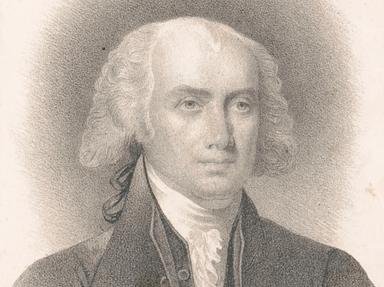
    Madison, James

    Known as the “Father of the Constitution,” how many children did Madison actually have?James Madison: Little Big Man

      0. James and Dolley never had any children of their own, although Dolley did have a son by her first husband, John Todd, a lawyer who died of yellow fever in 1793. Ironically, another famous American “father,” George Washington, also had no biological children.

    One of America’s first professional politicians, Madison never held a job that was out of the public eye before his retirement from the presidency. He did, however, consider a career in the private sector. What was it?James Madison: Little Big Man

      Lawyer. Madison, after graduating from Princeton University in 1772, briefly considered a career as a member of the bar but soon abandoned that course. He was elected to the Orange County (VA) Committee of Safety in 1774, which was chaired by his father. After leaving the White House in 1817, Madison served on the board of regents for the University 0f Virginia, succeeding his life-long friend Thomas Jefferson as rector in 1826.

    As Jefferson’s secretary of state, Madison whole-heartedly supported the president’s Embargo Act of 1807. What was the goal of the embargo?James Madison: Little Big Man

      The protection of U.S. neutral rights at sea.. Both sides of the Napoleonic Wars treated the U.S. as a pawn. France was seizing America ships and their cargo bound for England, while the British, desperate for men, regularly boarded ships flying the American flag and impressed, or seized, sailors from those ships and pirated them to serve on theirs. In retaliation, and to assert America’s right as a neutral to deal with all belligerents of the war, President Jefferson, with the full backing of Secretary of State Madison, enacted the embargo. The hope was that the economies of France and England would be so severely damaged that they would be more than happy to respect America’s neutrality. It turned out that the economy that suffered the most was America’s, as $16 million in customs revenues was lost from the inception of the embargo until its partial repeal in 1809, just before Jefferson left office.

    What was unique about Madison’s vice-presidents?James Madison: Little Big Man

      Both died in office.. George Clinton, Madison’s first V.P., and Elbridge Gerry, his second V.P., died in office. Clinton, former governor of New York and nemesis of Alexander Hamilton, had also been Jefferson’s vice-president. He died shortly before the end of his term in 1812. Gerry was one of the American representatives during the XYZ Affair that occurred during John Adams’ presidency, and had served as governor of Massachusetts before being elected to the vice presidency. He died midway through his term, in 1814.

    How many times did Madison serve as a member of the Virginia House of Delegates?James Madison: Little Big Man

      3. As a delegate to the Virginia Convention of 1776, Madison was automatically a member of the first House of delegates, as this was one of the provisions of the state constitution of Virginia adopted at the convention. He was returned to the House in 1784, where he led the fight against the reestablishment of the Episcopalian church as the state-sanctioned church of Virginia. After serving in the U.S. House of Representatives from 1789-1797, he once again was elected to the Virginia House, were he campaigned for Thomas Jefferson’s presidential bid in 1800. As a reward, and as they were close friends, Jefferson rewarded Madison with what was then the “stepping stone” to the White House, secretary of state.

    After leaving the public eye in 1817, Madison stayed active in the local political scene. Much of his time was spent fighting the extension of slavery. What organization did Madison help organize that was devoted to the ending slavery in America?James Madison: Little Big Man

      The American Colonization Society. Madison had believed for many years that slavery was a cancer upon America that would eventually lead to its dissolution, if allowed to spread unabated. He favored the idea of resettling freed blacks back in Africa. The American Colonization Society, founded in 1819, was the organization that founded the country of Liberia in Africa, whose capitol was named for then-President James Monroe.

    When Madison died on June 28, 1836, who delivered his eulogy?James Madison: Little Big Man

      John Quincy Adams. Adams, in reviewing Madison’s career, studied, among other items, the correspondence between Madison and his old friend Thomas Jefferson. John Q. wasn’t quite as forgiving of Jefferson as his father had been, feeling that Jefferson, at the least, was a user of people. Madison, Adams believed, did much to blunt some of Jefferson’s sharp edges. In studying their relationship, Adams wrote, “Madison moderated some of his (Jefferson’s) excess....He was in truth a greater and far more estimable man.”

    Although childless himself, James Madison is often called the “Father” of the United States Constitution, and the “Father” of which other bulwark of United States legislation?President James Madison and His Times

      The Bill of Rights. The death of James Madison in 1836 marked the passing of the last of the "Founding Fathers" of the nation. He was "Founding Father" of the United States Constitution and The Bill of Rights. From his advocacy at the Constitutional Convention of 1787; through his 8 years as a US Representative and leader of the Federalist Party (1789-1797) - including his shepherding of the Bill of Rights through Congress; to his service as Jefferson's Secretary of State (1801-1809); and, finally, to his own two terms as President (1809-1817), James Madison not only witnessed but strongly influenced the political development of a new nation. The James Madison Papers at the Library of Congress represent the most authoritative documentation of the earliest years of the American experiment in self-governance. Recognizing the importance of his legacy, on March 3 1837 Congress approved the purchase of Madison's notes from the Constitutional Convention of 1787-1788 for $30,000. Again on May 31 1848, Congress agreed to purchase the remainder of Madison's papers for an additional $25,000.

    The Bill of Rights: in 1789 James Madison presented Congress with 12 articles to amend the Constitution. Congress approved all 12 articles and sent them to the state legislatures for ratification. From 1789-1791, the states ratified 10 amendments to the Constitution (the articles numbered 3-12) as The Bill of Rights. After more than 200 years, the states also ratified article #2. It became the 27th Amendment to the Constitution in 1992. Which is the subject of the 27th Amendment?President James Madison and His Times

      Congressional Salaries. Text of Article 2 as presented to Congress in 1789: “No law, varying the compensation for the services of the Senators and Representatives, shall take effect, until an election of Representatives shall have intervened.” In 1982 a Texas State legislative assistant, Gregory Watson, began a one-man crusade for the ratification of Article 2. On May 5 1992, Alabama became the 38th state of ratify James Madison’s original article 2, making it the 27th Amendment of the US Constitution. Article 1 is still pending ...

    During 1787-1788 James Madison, Alexander Hamilton and John Jay authored a series of 85 essays advocating ratification of the proposed United States Constitution. Written under the pseudonym “Publius”, these essays are known as which?President James Madison and His Times

      The Federalist Papers. The Supreme Court has cited "The Federalist Papers" more than 300 times in its decisions. They collectively articulate an understanding of the original intentions of the Founding Fathers of the United States in forming "a more perfect union." Though not without contrasting opinions, they are an invaluable source for insight into the philosophy and motives that served as the basis for the United States Constitution. The “Salmagundi Papers” or “Salmagundi” are a series of 20 satirical essays written by Washington Irving in 1807-1808. The 17th essay contains the first mention of “Gotham” as a reference to New York City. The “Pentagon Papers”, so-called, are a series of documents published in the “New York Times” 1971 and taken from a top secret government report of the planning and conduct of the Viet Nam War. "The Passport Papers" are what The Department of Homeland Security asks for when a person arrives at a port of entry to the United States.

    Before the War of 1812, the crème de la crème of social invitations was a "request of your presence" from President and Mrs. James Madison at a “levee” at the White House. Which term most closely describes a “levee” hosted by Dolley Madison?President James Madison and His Times

      brunch. a levee is a morning reception with light refreshment; a soirée is an evening reception with entertainment; a séance is a gathering to call forward spirits of the deceased; a shindig is a loud and boisterous party with dancing.

    President James Madison's unilateral proclamation of October 27 1810 annexed which lone-star republic to the United States as part of the Louisiana Territory?President James Madison and His Times

      The Republic of West Florida. Alas, Texas was not the only lone star republic! The “Bonnie Blue Flag” (single white star centered on a field of blue) flew over the capitol of the Republic of West Florida at St. Francisville, Louisiana from June-October 1810. The President of the Republic, Fulwar Skipwith, at first refused to recognize the annexation but he and the legislature eventually acquiesced and accepted Madison’s proclamation. The 7 parishes of the old Republic that now reside in Louisiana (East Baton Rouge, Livingston, St. Helena, St. Tammany, Tangipahoa, Washington and West Feliciana) are sometimes referred to as the “Florida” parishes.

    James Madison's unfortunate and unnecessary war (The War of 1812) nonetheless produced "The Star-Spangled Banner" - the national anthem of the United States, written by Francis Scott Key in 1814. Given the history of the US flag, which elements of design were unique to the flag that was "gallantly streaming" o'er the ramparts of Ft. McHenry?President James Madison and His Times

      The flag had 15 alternating white and red stripes and 15 stars.. The Fort McHenry flag - with 15 stripes and 15 stars - is now housed at The National Museum of American History in Washington, DC. It was patterned after the Flag Act of 1794 which approved the addition of 2 stars and 2 stripes to the original flag of 13 stars and stripes. This modification acknowledged the admission to the United States of Vermont (1791) and Kentucky (1792). James Monroe signed a bill from Congress on April 4 1818 directing all future designs of the flag to contain the original 13 stripes (in honor of the original 13 colonies) and the addition of 1 star for each future state admitted to the Union.

    As soon as the War of 1812 began, which international leader offered to negotiate a peace treaty between the United States and Great Britain? His intervention lead to the Treaty of Ghent that ended the war in 1815.President James Madison and His Times

      Czar Alexander I of Russia. Beginning in 1812, Napoleon invaded Russia while continuing to wage war in the European theater against Britain. Czar Alexander I needed Britain’s full attention and commitment to the European theater of war against Napoleon – not draining resources in an overseas adventure with the United States. It was with Russia’s defense in mind that he offered to mediate a peace between Britain and he United States.

    A brief 1865 memoir by Paul Jennings, former slave of President James Madison, provides evidence that Dolley Madison did not, in fact, rescue the Gilbert Stuart portrait of George Washington from the burning White House in 1814. Parenthetically, who freed Paul Jennings from slavery on March 19, 1847?President James Madison and His Times

      Daniel Webster. Dolley Madison, living in poverty and poor health in her Lafayette Square home in Washington, was forced by circumstances to sell the slave Paul Jennings to slave agent Pollard Webb in early March 1847. Senator Daniel Webster, a Lafayette Square neighbor, heard of the sale and promptly purchased Jennings from Webb on March 19 1847 for $120. By signed contract, Webster manumitted Jennings at a rate of $8 a month until the $120 was paid. "I have paid $120 for the freedom of Paul Jennings; he agrees to work out the same at $8 per month, to be furnished with board, clothes, washing," &c...." Concerning Dolley's rescue of the Washington portrait, Jennings relates that: "All she carried off was the silver in her reticule, as the British were...expected every moment. John Suse'(a Frenchman, then door-keeper, and still living) and Magraw, the President's gardener, took it down and sent it off on a wagon, with some large silver urns and such other valuables as could be hastily got hold of"...“A Colored Man’s Reminiscences of James Madison”, Paul Jennings, 1865.

    After British troops burned the unfinished US capitol building in 1814, at which site did Congress meet from 1814-1819? Further, which modern building now occupies this site?President James Madison and His Times

      The Brick Capitol - now the Supreme Court Building. After the capitol burned, Congress assembled at Blodgett's Boarding House on September 8 1814 to discuss its future options. Many members were of the opinion that Congress should move temporarily to Philadelphia until the capitol was restored. A group of local citizens responded by beginning immediate construction of a large red brick building which they offered to the government to house Congress and keep them in Washington. Congress accepted and continued to meet in session at the "Red Brick Capitol" until 1819. Subsequently, the red brick building was used to house prisoners during the Civil War and became known as The Old Prison. Because of its prominent location immediately across the street from the original capitol building, the "Red Brick Capitol" site was chosen as the location for the Supreme Court building in 1932.

    President James Madison was a prolific public speaker - soft-spoken and self-conscious of his high, thin voice. Curiously, which were his last spoken words before death in 1836?President James Madison and His Times

      I speak better lying down.. After graduating from The College of New Jersey (now Princeton University) in 1771, Madison returned for an additional year to study theology under the tutelage of John Witherspoon (then President of the College).It is possible that because of his vocal limitations, Madison decided against a career in the Presbyterian or Episcopalian ministry and entered the practice of law instead.

    Who did James Madison marry?The Life of James Madison

      Dolley Payne Todd. James Madison married Dolley Payne Todd on September 14, 1794, and had no children the rest of their lives. (With the exception of an adopted son.) Betsy Ross obviously did not marry James Madison, and Elizabeth Kortright married James Monroe, not James Madison.

    What political party did James Madison belong to?The Life of James Madison

      Democratic - Republican. James Madison helped found the Democratic-Republican party along with Thomas Jefferson, around 1792. The party opposed most of the Federalist ideas, and supported strict interpretation of the constitution. So, they opposed the idea of a national bank, proposed by Alexander Hamilton (a federalist). The Whig party was not created until about 1833, making it impossible for James Madison to be apart of it.

    Which title is James Madison most remembered by?The Life of James Madison

      Father of the Constitution. James Madison is known as the Father of the Constitution, because he was the principle author of the document. (He also hated the nickname.) He is also known as the Father of the Bill of Rights. John Adams is known as the Father of the Declaration of Independence. (Even though Thomas Jefferson wrote it, John Adams was the driving force behind it.)

    How many terms did James Madison serve as president?The Life of James Madison

      two. He served as the fourth president of the United States from 1809-1817.

    Did James Madison died on July 4, like Thomas Jefferson and John Adams? If yes, how did he do it?The Life of James Madison

      He didn't die on July 4. James Madison died of natural causes on June 28, 1836. It is said that some townspeople encouraged James Madison to try to survive until July 4 (by use of special drugs), when former presidents John Adams and Thomas Jefferson died. But, James Madison payed no attention to them and died peacefully on June 28, 1836.

    There was something special about James Madison's height and/or weight. What was it?The Life of James Madison

      He was our shortest Founding Father. He was the shortest and skinniest Founding Father, at 5ft. 4in and a mere 100 pounds. He was also a distant relative of George Washington (1st cousin twice removed). Hope you liked my quiz!

  • All content is (C)opyright 1995-2006 FunTrivia.com. Content may NOT be copied, reprinted, or distributed without our written consent. Feel free to link to any page you wish.

  • While we try to keep trivia as accurate as possible through a regular volunteer editing process, FunTrivia cannot guarantee the validity of the information found here. FunTrivia offers no professional advice, and you take all responsibility for your use of anything contained herein.
  • Feel free to send a note to a particular item's author for further details or source information; most of our authors love to hear feedback about their work.
  • See our conditions of use for details.