FREE! Click here to
Join FunTrivia. Thousands of games, quizzes, and lots more!

Seven Ancient Wonders Trivia Questions and Answers
Fun Facts & Interesting Information
Fun Trivia Question Usage
You are welcome to use the questions in this section for non-commerical purposes: quizzing friends/coworkers, classrooms, newsletters, trivia nights, events, etc. Questions may
not be used for websites or in apps, and may not be resold. You use the questions at your own risk, and FunTrivia is not responsible for errors, etc in the content.
Please
link to or
credit FunTrivia textually (http://www.funtrivia.com) if you use any of these questions. Thanks!
Visit our
Trivia Question Store to buy question packs for commercial or for-profit ventures.
1. In what modern-day country was the Mausoleum of Halicarnassus built?
Answer: Turkey
Interesting Information:The Mausoleum was built in what is now known as Bodrum, Turkey. Artemisia, queen and naval commander of the Persian Empire, had the Mausoleum built in honor of her dead husband, Satrap Mausolus. The Mausoleum was built to be 131 feet tall. The outer walls of the Mausoleum depicted battle scenes and Greek gods and goddesses.
Difficulty: Hard.
From Quiz: Ancient Wonders
Some incorrect choices:
Iran, Iraq, Afghanistan
2. The Great Pyramid of Cheops: Built around 2560 B.C., the pyramid was designed for the fourth dynasty Pharaoh Cheops. What artefact, useful in getting Cheops to the afterlife, was discovered within the pyramid in 1954?
Answer: Solar Boat
Interesting Information:The Great Pyramid is located at Giza in Egypt. Of all the ancient wonders it is by far the oldest and the only one still standing. The ancient historian, Herodotus, estimated the number of workers required to construct the pyramid at one hundred thousand. Modern scholars suggest a much more modest figure of eight thousand, comprised of labourers and craftsmen. The solar boat, discovered in 1954, was constructed from 1274 pieces of wood and measured more than thirty metres in length. It is believed that the boat was used to transport the dead Pharaoh down the Nile to his final resting place.
Difficulty: Hard.
From Quiz: Seven Wonders, Ancient and New
Some incorrect choices:
Mummified cats, Wine filled urns, Visa and passport
3. How many of the Ancient Wonders were located in Egypt?
Answer: 2
Interesting Information:The Pharos of Alexandria and the Pyramids were the only two wonders located in Egypt. However, the list of wonders was very Mediterranean based and didn't therefore encompass the possible treasures lurking in Asia or the Americas.
Difficulty: Hard.
From Quiz: Ancient Wonders of the World
Some incorrect choices:
1, 3, 7
4. Where were the Great Pyramids located?
Answer: Giza
Interesting Information:The Pyramids are currently the only wonders that haven't been destroyed. The Pyramids were supposedly built for Pharoah Khufu and his family.
Difficulty: Very Easy.
From Quiz: The Seven Wonders Of The Ancient World
Some incorrect choices:
Napata, Thebes, Abydos
5. The Statue of Zeus at Olympia: who was the sculptor?
Answer: Phidias
Interesting Information:Phidias or Pheidias also did the statue of Athena in the Parthenon at Athens. This statue was made for a new temple (completed 456 BC) that was built due to the popularity of the Olympic Games.
Difficulty: Hard.
From Quiz: The Seven Wonders of the World
Some incorrect choices:
Theomanos, Karosas, Nicodemos
6. Which ancient wonder did Sostrates of Knidos design?
Answer: The Lighthouse of Alexandria
Interesting Information:In 332 B.C., Alexander The Great founded the city of Alexandria in Egypt. Although Alexander The Great started approximately seventeen other cities named Alexandria, the one in Egypt was the most prominent, and thrived even after the other cities with same name had disappeared. When Alexander The Great died in 323 B.C., Ptolemy Soter became the new ruler of Egypt. Ptolemy made the city of Alexandria rich and prosperous, but he realized that it needed a symbol, something great, to guide the many trade ships in the busy harbor. In 290 B.C., Ptolemy authorized the building of the Pharos, which is better known as The Lighthouse of Alexandria. In 270 B.C, the lighthouse was completed. The design was unlike the slim single column of most modern lighthouses, but more like the structure of an early twentieth century skyscraper. There were three stages, each built on top of the lower.
The building was constructed of marble blocks with lead mortar. The lowest level was probably more that 200 feet in height and 100 feet square, shaped like a massive box. Inside this section was a large spiral ramp that allowed materials to be pulled to the top in horse-drawn carts. The last recorded time that the lighthouse was seen was around 1115 A.D., and in the report it was stated that the lighthouse was intact and operational. After standing tall for 1,500 years, the great lighthouse collapsed in 1326 after being damaged by earthquakes in 365 and 1303 A.D. For many years, no one knew what happened to this magnificent structure, until it was rediscovered in 1994 at the bottom of the sea. In 1994, scuba divers came across large underwater blocks of stone that, after some testing, revealed that it was indeed The Lighthouse of Alexandria.
Difficulty: Hard.
From Quiz: The Seven Wonders Of The Ancient World
Some incorrect choices:
The Statue of Zeus at Olympia, The Temple of Artemis at Ephesus, The Great Pyramid of Egypt
7. Who is listed as the author of "On the Seven Wonders of the World", the oldest surviving literary account about the great sites?
Answer: Philon of Byzantium
Interesting Information:Philon of Byzantium was a second-century BCE engineer who published many works on mathematics. Many modern historic scholars do not believe he is the actual author of the work, but rather his name was used as a pseudonym. It has been suggested that the actual author wrote the account several hundred years later. Regardless, the work is the oldest surviving text on the original list of the seven accepted ancient wonders. There were other lists that predate Philon's work, but none of them have survived. Some like to give Herodotus credit for the list, but it must be noted that a few of the wonders were not built until long after Herodotus was dead.
Difficulty: Easy.
From Quiz: The Amazing Wonders of the Ancient World
Some incorrect choices:
Aristotle, Sophocles, Pliny the Elder
8. In 1936, excavators uncovered an earthenware vase in Iraq from the ruins of a 2,000 year old village. The bottom of the tube was sealed with a copper disk, and an iron rod with an asphalt plug at the top. What is this believed to have been?
Answer: an electric battery
Interesting Information:A modern replica has been made and it does indeed produce an electric current.
Difficulty: Hard.
From Quiz: Ancient Wonders 2
Some incorrect choices:
a treatment for arthritis, a way to keep food from spoiling, a religious altar
9. What institution, thought to be built near the end of the 4th century b.c., held almost all the knowledge of that time?
Answer: The Alexandria Library
Interesting Information:At it's height, it held 300,000-500,000 volumes of work.
Difficulty: Average.
From Quiz: Wonders Of The Ancient World
Some incorrect choices:
The Council of Greek Studies, The Egyptian Scrolls, The Library of Ptolemy
10. What is the oldest wonder of the ancient world?
Answer: Great Pyramid of Giza
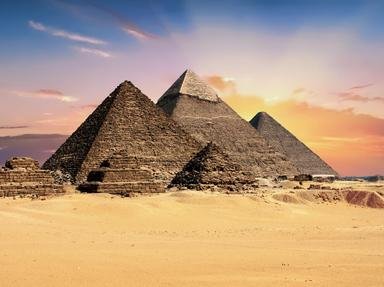
Interesting Information:The Egyptian Pyramids were built over 4000 years ago and served as tombs for the Egyptian pharaohs. Believed to have been completed in 2560 BC, the Great Pyramid of Giza (also known as the Pyramid of Khufu and the Pyramid of Cheops) is the only surviving of the seven ancient wonders. It stood as the world's tallest man-made structure for more than 3,800 years.
Difficulty: Hard.
From Quiz: Seven Ancient Wonders
Some incorrect choices:
Colossus of Rhodes, Hanging Gardens of Babylon, Mausoleum at Halicarnassus
11. Known as one of the Seven Wonders of the Ancient World, Phidias built a statue of what Greek god in 435 B.C.?
Answer: Zeus
Interesting Information:Phidias was a Greek artist who built the statue of Zeus in Olympia, Greece, where the ancient Olympic games were once held. The throne of Zeus was said to be made from ivory, gold, and precious stones. The statue of Zeus no longer stands in Olympia.
Difficulty: Easy.
From Quiz: Ancient Wonders
Some incorrect choices:
Hera, Aphrodite, Artemis
12. What is the only Wonder of the ancient world still in existence?
Answer: Great Pyramid of Giza
Interesting Information:The Great Pyramid of Giza dates back to between 2584-2561 BC. It was built by Egyptians and still remains standing at Giza Necropolis, Egypt. The construction of this marvel has been the topic of controversy for centuries and remains a mystery to this day. The true marvel may not be how it was constructed, but that it was constructed so well that it remains the only wonder of the world still in existence.
Difficulty: Easy.
From Quiz: Guide Book of Ancient Treasures
Some incorrect choices:
The Colosseum, Great Wall of China, Taj Mahal
13. The Hanging Gardens of Babylon: Thought to have been built for his wife/concubine Amytis to remind her of her homeland, the Hanging Gardens are said to be the work of which ancient King?
Answer: Nebuchadnezzar
Interesting Information:Because there has been no discoveries of first hand or eyewitness accounts of their existence, the Hanging Gardens might very well just be the stuff of myth and legend. Common ancient descriptions of the gardens, written hundreds of years after the reign of Nebuchadnezzar, paint vivid images of tiered layers of stone pillars with marble steps leading to each level. Trees of immense height and girth, flowers and shrubs would hang down where people could walk under the canopy while workers toiled above.
Difficulty: Easy.
From Quiz: Seven Wonders, Ancient and New
Some incorrect choices:
Herod, Arthur, Charlemagne
14. Only one of the Seven Wonders of the Ancient World still exists. Which one is it?
Answer: Great Pyramid of Giza
Interesting Information:The Great Pyramid of Giza was constructed somewhere between 2584-2561 BC and is the only wonder still standing. It was built as a tomb for the Pharaoh Khufu. The pyramid was also the tallest of all man-made structures for over 3,800 years until the Lincoln Cathedral was completed in 1300 AD.
Difficulty: Very Easy.
From Quiz: Seven Wonders of the Ancient World
Some incorrect choices:
Gardens of Babylon, Lighthouse of Alexandria, Statue of Zeus at Olympia
15. In which Egyptian city did the Pharos reside?
Answer: Alexandria
Interesting Information:The Pharos, or lighthouse at Alexandria was one of the first of its kind in the ancient world. The fire in the lighthouse was always kept burning by slaves at night, so as to guide ships into the port. Alexandria was named after Alexander the Great who conquered the area and made this city an important part of his empire.
Difficulty: Hard.
From Quiz: Ancient Wonders of the World
Some incorrect choices:
Cairo, Giza, Cheops
16. For which pharaoh was the Great Pyramid of Giza constructed?
Answer: Khufu
Interesting Information:Also known by the Greek name of "Cheops," Khufu is widely credited with directing the construction of the Great Pyramid (without the assistance of space aliens!). The Great Pyramid remained the tallest building in the world until the Lincoln Cathedral surpassed it in 1311, for a period of about 4,000 years! Snefru was Khufu's father and predecessor as pharaoh.
Difficulty: Hard.
From Quiz: The Seven Wonders of the Ancient World
Some incorrect choices:
Rameses II, Tutankhamun, Snefru
17. How were the Hanging Gardens of Babylon thought to be watered?
Answer: A machine carried water to the top and it irrigated the plants
Interesting Information:Although there may have been different ways to how it was watered, experts believe this is the most likely idea as it was the most efficient.
Difficulty: Hard.
From Quiz: The Seven Wonders Of The Ancient World
Some incorrect choices:
Each plant was watered separately, They waited for it to rain, A different group of slaves watered each terrace
18. For which of the seven ancient wonders is there no evidence of its existence?
Answer: Hanging Gardens of Babylon
Interesting Information:Though it is said that Nebuchadnezzar built the structure for his homesick wife, Amytis, no evidence has been found to substantiate its existence. It isn't even mentioned by Herodotus.
Difficulty: Hard.
From Quiz: The Seven Wonders of the Ancient World
Some incorrect choices:
Colossus of Rhodes, Mausoleum of Halicarnassus, Pharos of Alexandria
19. The Statue of Zeus at Olympia: The statue is gold and ivory on a wooden core. What is the term for this type of statue?
Answer: chryselephantine
Interesting Information:Chrys is the root for gold. Elephantine is the root for ivory (for obvious reasons). In his right hand was the goddess Nike (Victory). His left hand held a scepter as king of the gods.
Difficulty: Hard.
From Quiz: The Seven Wonders of the World
20. The Chief Librarian at the Alexandria Mouseion wrote 'A Collection of Wonders around the World'. Who was he?
Answer: Callimachus of Cyrene
Interesting Information:Callimachus of Cyrene lived from 305BC-240BC. All we know about this collection is its title because it was destroyed with the Alexandria Library.
Difficulty: Hard.
From Quiz: The 7 Ancient World Wonders
Some incorrect choices:
Maerten van Heemskerck, Herodotus, Johann Fischer von Erlach's
21. This ancient wonder was located off the southwestern tip of Asia Minor where the Aegean Sea meets the Mediterranean. It was created in 311 B.C., and was designed by Chares of Lindos. What is the name of this wonder?
Answer: The Colossus of Rhodes
Interesting Information:In 332 B.C., Alexander the Great captured the city of Rhodes. When Alexander died, his kingdom was divided, and taken over by Ptolemy, Seleucus, and Antigous. The Rhodians wanted Ptolemy as their ruler, but this angered Antigous, who sent his son Demetrius, along with 40,000 men to destroy the city of Rhodes. A strong, tall wall that forced the invaders to climb over it protected Rhodes. In the end, the Rhodians won this battle. When Demetrius tried to attack the city a year later, he was surprised to find an army of Egyptian ships protecting the city.
Demetrius immediately withdrew. About 311 B.C., the Colossus of Rhodes was designed, although some historians claim that it was designed in 304. Chares of Lindos was a Rhodian sculptor, who started out making smaller versions of the Colossus of Rhodes. Chares used these smaller versions to create the skin of the masterpiece that was his great donation to the ancient world. This great statue, which resembled the Statue of Liberty, was created for the same purpose, freedom.
Difficulty: Hard.
From Quiz: The Seven Wonders Of The Ancient World
Some incorrect choices:
The Lighthouse of Alexandria, The Temple of Artemis at Ephesus, The Statue of Zeus at Olympia
22. What was the Pharos of Alexandria made of?
Answer: marble
Interesting Information:It was made of solid white marble and survived until 1375 A.D.
Difficulty: Hard.
From Quiz: The Seven Ancient Wonders
Some incorrect choices:
limestone, sand, unknown material
23. Where was Damascus steel made?
Answer: India
Interesting Information:Made of a high carbon metal that cannot be duplicated even today. The swords made of this material were said to be able to bisect a feather floating in mid air, or fell a Crusader with equal ease.
Difficulty: Hard.
From Quiz: Ancient Wonders 2
Some incorrect choices:
Greece, Rome, Iraq
24. Where did they have schools, similar to our High Schools 5,000 years ago?
Answer: Sumer
Interesting Information:Originally founded for teaching script to wealthy children to prepare them for careers as scribes.
Difficulty: Hard.
From Quiz: Wonders Of The Ancient World
Some incorrect choices:
Greece, Rome, Egypt
25. Which wonder was rebuilt in the 4th century BC but destroyed by the Goths in the 3rd century AD?
Answer: Temple of Artemis at Ephesus
Interesting Information:The Temple of Artemis at Ephesus in Asia Minor was built in the 6th century BC. It was a marble temple in honor of the goddess Artemis and of the moon.
Difficulty: Hard.
From Quiz: Seven Ancient Wonders
Some incorrect choices:
Statue of Zeus at Olympia, Pharos of Alexandria, Colossus of Rhodes
26. On what special day did the Temple of Artemis burn?
Answer: Alexander the Great's birthday
Interesting Information:Alexander the Great was born on July 21, 356 BC. After the first temple was burned, a new temple was built six years later.
Difficulty: Hard.
From Quiz: Ancient Wonders
Some incorrect choices:
Alexander the Great's wedding day, Alexander the Great's funeral, Alexander the Great's coronation
27. The Colossus of Rhodes was the last of the original 7 wonders to be completed. This wonder was a giant statue of what Greek Titan?
Answer: Helios
Interesting Information:The Colossus of Rhodes was constructed by Charres of Lindos around 280 BC. It was 107 Ft (30 meters) tall and was erected to celebrate the victory over the Cyprus ruler, Antigonus I Monophthalmus. It was made of iron and bronze believed to have been from the weapons that were left behind by the army after the unsuccessful seige of Rhodes. The Colossus was destroyed by an earthquake in 226 BC.
Difficulty: Hard.
From Quiz: Guide Book of Ancient Treasures
Some incorrect choices:
Atlas, Potamoi, Cronus
28. The Statue Of Zeus at Olympia: housed inside the Temple of Zeus, the statue of the seated deity was criticised by the Greek geographer Strabo for being out of proportion. What was his reasoning behind this criticism?
Answer: If Zeus were to stand up, his head would unroof the temple
Interesting Information:The Statue of Zeus was completed about 430 B.C. by the Athenian sculptor Phidias. Described as being chryselephantine, meaning gold and ivory, it rose to a height of around forty feet and portrayed a bare chested Zeus seated on a cedarwood throne. The Greek traveller, Pausanias, recorded details of a figure of Victory in his right hand, a sceptre with a perching eagle in his left hand, and a wreath of olive branches adorning his head. After being located in Olympia for over eight centuries, the statue was relocated to Constantinople where, in 462 A.D., it was destroyed by fire.
Difficulty: Hard.
From Quiz: Seven Wonders, Ancient and New
Some incorrect choices:
The toes were longer than the fingers, The head was too big for the body, The genitalia was grossly exaggerated
29. The Hanging Gardens of Babylon were said to have been destroyed after the 2nd century BC by a repeated natural disaster. What was the cause of the destruction of the Hanging Gardens of Babylon?
Answer: Earthquakes
Interesting Information:The gardens were said to have been built by Nebuchadnezzar II between 605-562 BC and destroyed in the 2nd Century BC by earthquakes. He built the garden to please his wife, Amytis of Media who was homesick.
Difficulty: Easy.
From Quiz: Seven Wonders of the Ancient World
Some incorrect choices:
Hurricanes, Volcanoes, Tidal Waves
30. Which creature famously guards the pyramids?
Answer: Sphinx
Interesting Information:The sphinx is undoubtedly a formidable creature, with the body of a lion and the head of a woman; not many Egyptians were going to stand in its way. A chimaera was a mixture of lion, goat and serpent and was seen more often in Greek mythology guarding underground treasures. The manticore is also a Greek beast and may be seen as the Greek equivalent of the sphinx as it has the body of a red lion and a human head. The Cyclops is perhaps the most famous of these beasts, distinguished by its one eye and brutal nature.
Difficulty: Very Easy.
From Quiz: Ancient Wonders of the World
Some incorrect choices:
Chimaera, Manticore, Cyclops
31. What was the location of the Colossus in Rhodes?
Answer: a hill in the city behind the harbor
Interesting Information:Nobody is 100% certain of the actual location today, but the once widely-accepted theory of an enormous statue straddling the entrance to the harbor, under whose legs ships would pass to enter the harbor, has been largely discredited. And ancient texts tell of houses being destroyed by the toppled statue, which would rule out a location in or near the harbor.
The most likely site is atop a hill in the city, the present-day location of the Turkish School at the head of the Street of Knights, which overlooks the ancient harbor. The Colossus was toppled by an earthquake in 226 B.C., and lay in ruins at the site for about 900 years before being carted away by plundering Arabs around 654 A.D.
Difficulty: Hard.
From Quiz: The Seven Wonders of the Ancient World
Some incorrect choices:
astride the entrance to the harbor, to the side of the entrance to the harbor, the middle of town
32. Who was the ruler of Babylon while the Gardens were built?
Answer: Nebuchadnezzar
Interesting Information:It is said that Nebuchadnezzar II built these gardens for his wife because she missed her homeland up in the mountains. He never had a son named Herodotus; he was a Greek historian.
Difficulty: Average.
From Quiz: The Seven Wonders Of The Ancient World
Some incorrect choices:
Herodotus, Darius, Hamurabi
33. The Mausoleum at Halicarnassus: Some of the remains of this building still exist. Where?
Answer: British Museum
Interesting Information:This tomb was built after King Mausolus died in 353BC. In honor of this wonder, English now has the word "mausoleum".
Difficulty: Hard.
From Quiz: The Seven Wonders of the World
Some incorrect choices:
Smithsonian Institution, National Museum in Ankara, A private collection in Paris
34. Scopas of Pharos designed this magnificent ancient wonder. According to the ancient texts, this wonder took 120 years to build. What is the name of this ancient wonder?
Answer: The Temple of Artemis at Ephesus
Interesting Information:In 355 B.C. Scopas of Pharos designed the Temple of Artemis at Ephesus. This creation was to be his best creation ever built. The building is thought to be the first completely constructed of marble, and one of its most unusual features were 36 columns, whose lower portions were carved with figures. The temple was also home to many works of art including, four bronze statues of Amazon women. The temple stood 425 feet and was 225 feet wide. It had 127 columns, that were 60 feet in height, supported the roof. Many believe that since the great temple was built on a muddy-marsh, that it started to sink slowly into oblivion. There is a single column that has been constructed to remind visitors that once The Temple of Artemis at Ephesus stood in the very same place.
Difficulty: Hard.
From Quiz: The Seven Wonders Of The Ancient World
Some incorrect choices:
The Lighthouse of Alexandria, The Statue of Zeus at Olympia, The Mausoleum at Halicarnassus
35. Which Egyptian pharaoh had the Great Pyramid built?
Answer: Khufu
Interesting Information:Khufu was the second pharaoh of the Fourth Dynasty and was considered to be the commissioner of the Great Pyramid. Khufu's father was Sneferu who had built three true pyramids of his own which helped develop the building technology. It makes sense that Khufu would want to build a pyramid even grander than his father; however, the number of resources needed to build the great pyramid would lead it never to be surpassed. The Great Pyramid was the first ancient wonder of the world constructed and had been in existence for almost 2,000 years before the construction of the second ancient wonder. On top of that, the Great Pyramid is the only ancient wonder still standing today.
Difficulty: Hard.
From Quiz: The Amazing Wonders of the Ancient World
Some incorrect choices:
Ramses the Great, Sneferu, Khafre
36. How long did it take to complete the Colossus of Rhodes?
Answer: 12 years
Interesting Information:The statue was created by sculptor Chares of Lindus to commemorate a hard won victory over the Macedonians.
Difficulty: Hard.
From Quiz: The Seven Ancient Wonders
Some incorrect choices:
18 months, 34 years, 3 years
37. What is the ancient practice of cutting out a a rectangular hole in the skull as a medical treatment called?
Answer: trepanning
Interesting Information:Believed to be a treatment for relieving swelling on the brain, as in a head injury.
Difficulty: Hard.
From Quiz: Ancient Wonders 2
Some incorrect choices:
boring, transplaning, silly
38. Who were the first people to develop playing cards?
Answer: Chinese
From Quiz: Wonders Of The Ancient World
Some incorrect choices:
Greek, Romans, Sumerians
39. Who was the architect of the Hanging Gardens of Babylon?
Answer: Nebuchadnezzar II
Interesting Information:Constructed in the 6th century BC, it was a series of terraces of trees and flowers along the banks of the Euphrates.
Difficulty: Average.
From Quiz: Seven Ancient Wonders
Some incorrect choices:
Solomon, Xerxes, Darius
40. The Temple of Artemis was built in Ephesus to honor the Greek goddess. Of what was Artemis a goddess?
Answer: Hunting
Interesting Information:The Temple of Artemis was built in Ephesus in 550 BC on the coast of modern day Turkey. The temple was built three times before being destroyed permanently by the Goths in 268 CE. The third time the Temple of Artemis was rebuilt, 127 columns surrounded the temple.
Difficulty: Average.
From Quiz: Ancient Wonders
Some incorrect choices:
Love, War, Family
Please remember to credit FunTrivia.com, add links on your website or newsletters, or otherwise spread the word about our website. Thank you very much, and we hope these questions have been useful!
|