

|
Structure
Interesting Questions, Facts and Information
- There are a total of 20 general entries.
Special Topics
|
Interesting Questions, Facts, and Information
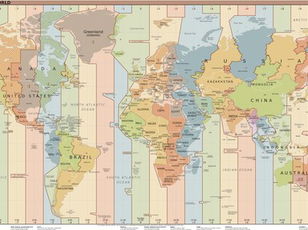
Time Zones
When were time zones officially adopted worldwide? | Time Zones
|
November 1, 1884. At the International Meridian Conference held in Washington, DC.
How many time zones does the United States use (states only, no territories)? | Time Zones
|
6. Aleutian Islands and Hawaii: UT-10 hours; Alaska mainland: UT-9 hours; Pacific: UT-8 hours; Mountain: UT-7 hours;} Central: UT-6 hours; Eastern: UT-5 hours.
How many time zones does mainland China use? | Time Zones
|
1. It spans the longitudes of five standard zones, but it has been decreed that the nation as a whole use just one: UT+8 hours.
What place on Earth has the greatest offset from Universal Time (UT), at UT+13.75 hours during its Summer Time (Daylight Savings)? | Time Zones
|
Chatham Islands. A 'region' of New Zealand (a political division), they are located 850 km east of mainland NZ. They are actually in the Western Hemisphere, and their time is offset from NZ by +45 minutes. They are the first local time to 'experience' any new date. Also, since New Year's Day is just after their Summer Solstice, their sunrise on January 1 is the first dawn of any new year.
Of the 48 contiguous US States, name the one that does not observe Daylight Saving Time (Summer Time)? | Time Zones
|
Arizona . Arizona observes Mountain Standard Time. It does not change its clocks, so its time is the same as Pacific Daylight Time during the summer. Parts of Indiana used not to use Daylight Savings Time.
Most people know that Benjamin Franklin was the first to conceive the idea of daylight saving time while he was a delegate in Paris in 1784, but who was the first person to design and propose a practical way to implement it? | Daylight Saving Time Facts
|
William Willett. William Willett was a London builder who published a pamphlet "Waste of Daylight" in 1907. He lobbied for years to have DST put into action but was still unsuccessful when he died in 1915.
Even though they were not on daylight saving yet, which country was the first to adopt one standard time throughout a region? | Daylight Saving Time Facts
|
Great Britain. Pushed by the railroads, Britain began to change the many different times to a standard one in 1847 and was largely converted by 1855.
1883. 18 November 1883, the United States as well as Canada implemented standard time in their time zones. This was also driven by the railroads and prior to this, each locality was able to determine time in whatever fashion suited them. William Lambert was the first to promote the adoption of time zones in 1809, though he was unsuccessful in this endeavor.
What is the primary reasons that 02:00 in the morning was set as that changeover time in the United States? | Daylight Saving Time Facts
|
Less disruption and most would be changed over by daybreak. Lawmakers believed that it was very desirable for the entire continental U.S. to have made the change by the start of the normal working day. Many computer and electronic systems now are able to make the adjustment without human intervention.
Do countries close to the equator gain as much increase in daylight during DST as those farther from it? | Daylight Saving Time Facts
|
No. Countries close to the equator have more hours of daylight than those farther away so they get less benefit from extending daylight hours. Most equatorial and tropical countries do not observe DST.
Australia. When the Federal Parliament in Australia enacted this bill, they also defined a national system of time zones.
Germany. Germany adopted DST in April 1916, with Great Britain following May 1916. Currently about 70 countries around the world observe daylight saving time in some form.
The Uniform Time Act, 1966. Prior to this time, localities set the start and end of DST at will. This Act standardized the starting and ending dates as well as the time the change occurred. It did not require that all areas observe DST.
Double Summer Time. Double Summer Time was deemed a benefit to the war effort. Other countries in the world have altered their standard time when war was waged.
Japan went to the use of daylight saving when they were occupied by the U.S. after World War II. Why did they stop using DST in 1952? | Daylight Saving Time Facts
|
Complaints from the farmers. The farmers found it very disruptive, this complaint being a common one throughout the world. Many farmers find that it is inconvenient to have to work in an extra hour of darkness in the early mornings.
1996. The European Union uniformly adopted daylight saving in the same year.
They set the clocks 2 hours ahead of standard in summer. The higher latitude localities in Russia see a lot of benefit from the two hour difference in summer.
Indiana. Prior to 2005, only around 16% of Indiana counties observed DST and the others did not. Driving through the state, you might encounter a strange change in time as you pass through the various counties.
|