|
Structure
Interesting Questions, Facts and Information
- There are a total of 25 general entries.
|
Interesting Questions, Facts, and Information
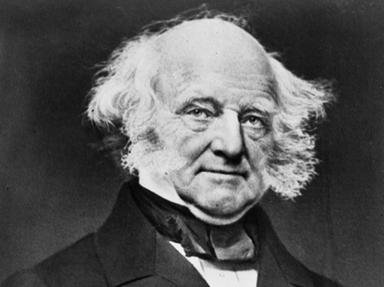
Van Buren, Martin
Netherlands. Van Buren's great great grandfather, Cornelius Maesen, hailed from Buurmalsen in the Netherlands.
Martin Van Buren is a third cousin, twice removed, of what future US president? | Martin Van Buren
|
Theodore Roosevelt. Truman is a distant relative of John Tyler. Nixon is a distant relative of both William Howard Taft and Herbert Hoover. Cleveland was a 6th cousin, once removed of Ulysses S. Grant.
four boys. The names of Van Buren's children were: Abraham, John, Martin Jr., and Smith.
William Crawford. Crawford was considered the likely winner of the 1824 election until he suffered a stroke. Even after suffering the stroke, Van Buren still supported him for the office.
3 months. Van Buren only ran for Governor of New York to improve Andrew Jackson's chances of winning the state in the election of 1828. Van Buren was sworn in as governor in January 1829 and resigned the office in March to become Jackson's secretary of state.
An undeclared candidate received electorial votes for president in 1836, the year Van Buren was elected president. Who was he? | Martin Van Buren
|
Willie Magnum. Willie Magnum was the US senator from North Carolina. Hugh White had originally won the electorial votes of South Carolina but the electors refused to support him because of his stand during the nullification crisis.
What was Van Buren's marital status when he entered the White House in 1836? | Martin Van Buren
|
widower. Van Buren's wife, Hannah, died February 5, 1819 from tuberculosis. He never remarried.
A border dispute between Canada and the US that took place during Van Buren's presidency in 1839 is better known as what? | Martin Van Buren
|
Aroostook War. In dispute was 12,000 square miles of land on the Aroostook River between Maine and New Brunswick. The dispute was settled as part of the Webster-Ashburton Treaty of 1842.
The Amistad incident, which took place during the Van Buren administration, was made into a movie in the 1990's. In the movie, who played Van Buren? | Martin Van Buren
|
Nigel Hawthorne. Hopkins played former president John Quincy Adams in the movie. George C. Scott played fictional president Samuel Tresch in the 80's Fox series "Mr. President" and Kline played the president in "Dave".
Hawthorne received an Oscar nomination for playing another world leader, England's King George III, in "The Madness of King George" in the mid 90's.
In 1848, which political party nominated Van Buren for president? | Martin Van Buren
|
Free Soil. Van Buren was the front-runner for the Democratic nomination in 1844 but his opposition to the annexation of Texas eventually cost him the nomination. In 1848, the Free-Soil Party, meeting in Buffalo, nominated him and Charles Francis Adams, the son of John Qunicy Adams, for vice-president. They won no electorial votes but drew enough votes away from Democratic nominee Lewis Cass to give the election to the Whig candidate Zachary Taylor.
Abraham Lincoln. Van Buren died July 24, 1862, during Lincoln's first term. Until the election of Bill Clinton in 1992, Lincoln's election in 1861 was the only time in US History that five ex-presidents were still alive. Alive at the time of Lincoln's first election were Van Buren, Tyler, Fillmore, Pierce and Buchanan. Alive at the time of Clinton's first election were Nixon, Ford, Carter, Reagan and Bush.
President Martin Van Buren did not speak English as his first language growing up as a child in Kinderhook, New York. Which was his native language? | President Martin Van Buren's Life
|
Dutch. Martin Van Buren was born December 5, 1782, and spoke Dutch as a child in the small primarily Dutch community of Kinderhook, 20 miles south of Albany. He shared Dutch ancestral heritage with Presidents Theodore and Franklin D. Roosevelt. Van Buren was the first U.S. President who was not of British paternal descent. Others over time included the two Roosevelts (Dutch), Herbert Hoover (German), Dwight D. Eisenhower (German), and Barak Obama (Kenyan).
In Martin Van Buren’s election day as President in 1836, the electors from Virginia refused to vote for his Vice Presidential running mate, Richard Mentor Johnson. Why did they refuse to vote for Johnson? | President Martin Van Buren's Life
|
His deceased common-law wife, Julia Chinn was a slave. Virginia withheld its electoral votes from Johnson because of amorous relationships that Johnson publicly acknowledged and pursued with his own female slaves. He acknowledged Julia Chinn, a slave he had inherited from his father, to be his common-law wife. When Chinn died in 1833 during a cholera epidemic, Johnson forged a second common-law relationship with another of his slaves. When she in turn left him for another man, Johnson had her captured and sold at auction. He subsequently began a third relationship with the second slave’s sister.
Because the electors from Virginia withheld their votes from Johnson, the election resulted in an insufficient number of votes for Johnson (147) to gain a majority and the election (148 required for election). For the first time in the history of the United States, the election of the Vice President was thrown into the Senate, where Richard Mentor Johnson won handily on a party-line vote of 33 for Johnson, and 16 for Francis Granger.
President Andrew Jackson nominated Martin Van Buren to serve as U.S. ambassador to Great Britain in 1831. Who blocked Van Buren’s confirmation as ambassador in the Senate?
| President Martin Van Buren's Life
|
Vice President John Calhoun. On January 25, 1832, the United States Senate considered the question of "consent" to Jackson’s nomination of Martin Van Buren as ambassador to Great Britain. The vote for approval tied at 23-23. As the presiding officer of the Senate, Vice President John C. Calhoun cast the tie-breaking negative vote, depriving Jackson and Van Buren of the nomination.
Calhoun was already at odds with President Andrew Jackson over the refusal of Mrs. Floride Bonneau Calhoun, to associate with Peggy Eaton during the "Petticoat Affair". Additionally, Calhoun stead-fastly championed South Carolina’s Nullification Law in opposition to Jackson’s support of federal tariffs (also supported by Van Buren).
The strain between Jackson and Calhoun was such that in the election of November 1832. Jackson was re-elected with Martin Van Buren as his Vice President replacing Calhoun.
Calhoun and Jackson finally broke with one another irrevocably, when Calhoun resigned as Vice President on December 28, 1832, to serve as the newly elected Senator from the State of South Carolina. Although Calhoun only had three more months to serve as Vice President when he resigned, he was nonetheless the first Vice President of the United States to voluntarily resign his office while serving in the office.
A widower, President Martin Van Buren designated his daughter-in-law, Sarah Angelica Singleton Van Buren, to serve as First Lady of the White House. Who arranged the introduction of Van Buren's son Abraham to Miss Singleton, at a White House reception in March 1837? | President Martin Van Buren's Life
|
Former First Lady Dolley Madison. Former First Lady Dolley Madison introduced her distantly related cousin to Abraham Van Buren during a White House reception in March 1837. Dolley's motives were not entirely selfless. President James Madison died in 1836, leaving former First Lady Dolley Madison heavily in debt at their Montpelier, Virginia estate. Early in 1837, Dolley returned to Washington, taking up residence at Lafayette Square across from the White House. Beginning with President Jackson, she petitioned Congress and the successive Presidents to purchase her husband's remaining historical manuscripts as financial security into her old age. Although Congress passed legislation to provide the funding, the Panic of 1837 prevented payment. Congress finally passed, and President Polk signed the authorization of payment on May 31, 1848, however, at a lesser amount. Dolley died the following year on July 12, 1849, having lived her last years primarily on the charity of the people of Washington D.C., while waiting for Congress to pay for her husband's manuscripts.
The official portrait of Angelica Singleton Van Buren is one of the most impressive in the White House collections. Recently, it was hung above the mantel in the Red Room.
The Little Magician. Because of his many differences with John C. Calhoun, many were amazed that he still overcame all those differences, and was elected Vice President in 1832, then President in 1836. Van Buren was only 5'6" as documented by White House official documents.
Joseph Smith, founder of the Mormon Church, met with President Martin Van Buren privately in 1839 while seeking the President's assistance to combat an "Extermination Order" against the Mormons issued by Governor Lilburn Boggs of which state? | President Martin Van Buren's Life
|
Missouri. In 1838, Governor Lilburn Boggs of Missouri authorized the use of military troops to forcibly remove 20,000 Mormons from the state of Missouri.
Which White House state room, where the official White House Christmas tree stood each year, had traditionally retained the same color decor that was chosen for it by President Martin Van Buren in 1837? | President Martin Van Buren's Life
|
The Blue Room. The oval or elliptical Blue Room is the centermost of the state rooms on the first floor of the White House. It is the traditional place for Presidents to formally receive a guest to the White House. Prior to Van Buren’s administration, various color schemes and furnishings had been used by previous Presidents to decorate the room. The designation of the color blue by Van Buren in 1837 for the furnishings of the room, had remained an ongoing tradition enduring through each of the successive Presidencies. President Grover Cleveland married Frances Folsom in the Blue Room on June 2, 1886.
During his four-year term, President Martin Van Buren issued only one veto of Congressional legislation. Why did he issue this "pocket veto"? | President Martin Van Buren's Life
|
The legislation was not presented with the required congressional signatures. March 5, 1839, Official Communication of the Office of President to the Joint Houses of Congress:
"The annexed joint resolution was presented to me by Messrs. Foster and Metrick, of the Senate, on the 4th of March at half past 3 o'clock a.m. at the President's house, after a joint committee had informed me at the Capitol that the two Houses had completed their business and were ready to adjourn, and had communicated my answer that I had no further communication to make to them. The committee of the Senate, on presenting the joint resolution for my signature, stated in explanation of the circumstance that they were not attended by the Committee on Enrolled Bills of the House of Representatives (as is required by the joint rules of the two Houses); that that body had adjourned about two hours before. The joint resolution is not certified by the clerk of the House in which it originated, as is likewise required by the joint rules. Under these circumstances and without reference to its provisions, I withheld my approval from the joint resolution."
President Martin Van Buren rented which District of Columbia estate that also served as a summer residence for future Presidents John Tyler, James Buchanan, and Grover Cleveland?
| President Martin Van Buren's Life
|
Woodley. Woodley was built in 1803 on a 250-acre tract of land owned by Philip Barton Key, uncle of Francis Scott Key. Situated on a plateau above the District of Columbia, Woodley benefitted from cool breezes from the Potomac River and offers respite from the stagnant heat of downtown Washington. Later, the edifice is home to the Maret School.
During his summers as President, Van Buren closed the residential living quarters at the White House and rented the Woodley estate. Each morning he would ride on horseback to the White House office, and return to Woodley in the evening.
Rentals of Woodley by Presidents Tyler and Buchanan are less certifiable than those of Van Buren and Cleveland. During Cleveland’s first administration (1885-1889), he purchased a 27-acre working farm with a house known as "Red Top". The property was sold at a considerable profit when he left office in 1889. During the second administration, he leased the Woodley property from 1893 until leaving office in 1897.
Who did the Democratic Party choose at Baltimore in May 1840, to be President Martin Van Buren's running mate as Vice President for re-election? | President Martin Van Buren's Life
|
No one. He stood for re-election alone. The Democratic Party Convention was held in Baltimore during May 1840. It refused to re-nominate Richard Mentor Johnson as Van Buren’s Vice Presidential running mate (although Van Buren continued to support him). Instead, the individual states’ Democratic members were left to vote for whom ever they desired for the office of Vice President, effectively leaving Van Buren to run alone without a running mate.
In the Electoral College voting for Vice President, John Tyler (Virginia) received 234 votes; Richard Mentor Johnson (Kentucky) received 48 votes; Littleton W. Tazewell (Virginia) received 11 votes, and James Knox Polk (Tennessee) received 1 vote.
Van Buren lost the Electoral College vote for the Presidency. Martin Van Buren (New York) received 60 votes, and William Henry Harrison (Ohio) received 234 votes.
|