Quizzes at Fun Trivia Fun Trivia | quizzes Quizzes | games Games | community People | services Services | help Help | me Me
New Player - Log In
Currently 6342 players online.   Trivia games, quizzes, and contests - FREE !     Get Started! quiz register
Fun Trivia: M : Man in Space

Special Sub-Topic: Apollo Bric a Brac - 2


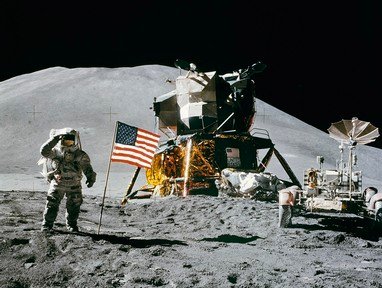
The Lunar Roving Vehicle (LRV) was powered by four small electric motors in each wheel. The motors each produced:

    1/4 hp. Yes thats right, just 1/4 hp per wheel for a total of 1 hp was sufficient to power the fully loaded LRV over the lunar surface. With two fully kitted out astronauts it weighed up to half a ton.

How many Apollo missions carried the LRV?
    3. The last three missions, Apollo's 15,16,and 17, were extended three day expeditions and carried the LRV. They were called "J" missions and fully extended the Apollo/Saturn capabilities enabling the astronauts to conduct extensive explorations and sample collections from their respective landing sites.

Small motors called "ullage rockets" were placed around the rim of the 2nd and 3rd stages of the Saturn V to apply a small force against the direction of motion in order to achieve a clean stage separation.
    f. Ullage rockets fired in the direction of motion at stage separation in order to settle the fuel and oxidiser at the bottom of their tanks so that a clean flow of fuel was supplied to the engines. "Ullage" is an old brewers term to describe that part of the barrel not occupied by beverage. Small retro-rockets firing against the direction of motion ensured clean stage separation.

The Apollo Command Module had a heat shield to protect it from burning up during re-entry. The approximate thickness of this shield was:
    3". Just 3 inches protected the astronauts from the 3000 degree F temperatures generated during re-entry!

The heatshield of the Command Module protected it during re-entry by a process known as:
    Ablation. The process of ablation removes heat from a spacecraft during high speed atmospheric re-entry by vaporising, melting, and charring, preventing the heat from penetrating the structure below. The heatshield of Apollo was a phenolic epoxy resin a type of reinforced plastic which turned white hot, charred and melted thus removing the heat during re-entry.

How many periods of Extra Vehicular Activity (EVA) were conducted during the Apollo 16 mission?
    4. An EVA occurs whenever an astronaut(s) leaves the spacecraft for any reason. During Apollo 16 astronauts Young and Duke conducted three EVA's or moonwalks on the lunar surface for a total of 20 hours 14 minutes and astronaut Mattingly conducted a 1 hour EVA or spacewalk to retrieve the film cassettes from the Service Module during the cruise back to earth.

If G is the weight of a stationary object on the earth's surface, during what phase of the Apollo mission were the maximum number of G's imposed on the astronauts body?
    Re-entry. During re-entry the astronauts were slammed back into their couches by an oppressive 6 G's and the craft hit the ocean with a jarring 12 to 40 G's depending on the ocean state. However up to 90% of these latter forces were absorbed by the structure of the craft. During launch the forces were about 3 to 4 G's (The Saturn Apollo combination was stressed to about 5 G's). TLI and Lunar liftoff only subjected the astronauts to a fraction of a G. Indeed, restraint harnesses were sufficient to secure the astronauts at lunar lift off as there were no seats in the LM!

There were 33 positions on the 11 manned Apollo flights. How many astronauts went to the moon more than once?
    3. Although four astronauts flew on Apollo more than once, David Scott's Apollo 9 mission was conducted in earth orbit. He later commanded Apollo 15. Jim Lovell went to the moon on Apollo 8 and was unlucky enough to command Apollo 13 so he never did get to walk on the moon. John Young was Command Module Pilot on Apollo 10 and then went on to Command Apollo 16. Eugene Cernan was Lunar Module Pilot on Apollo 10 and then went on to command the very last mission Apollo 17.

Which company was awarded the contract to build the S1C first stage of the Saturn V rocket?
    Boeing. NASA decide to award the contracts to different companies to build the main components of the Apollo Saturn system because of the vast scale of the project. This spread the workload among several companies so that they could concentrate on their component thus ensuring that President Kennedy's 1970 deadline was met. Boeing assembled the first two SIC's at Marshall Space Flight Centre, Alabama, and the rest were assembled at NASA's new Michoud facility in Lousiana.

When Apollo 11 landed on the moon the team on duty at mission control was led by:
    Eugene Kranz. Eugene Kranz, wearing his trademark white waistcoat, was on duty leading the White team during the tense Apollo 11 landing at the Sea of Tranquility. The other teams at mission control during different phases of the Apollo 11 mission were the Gold team led by Glynn Lunney, the Black team led by Cliff Charlesworth, and the Maroon team led by Gerald Griffin.


Did you find these entries particularly interesting, or do you have comments / corrections to make? Let the author know!

  • Send the author a thank you or compliment
  • Submit a correction