Quizzes at Fun Trivia Fun Trivia | quizzes Quizzes | games Games | community People | services Services | help Help | me Me
New Player - Log In
Currently 7891 players online.   Trivia games, quizzes, and contests - FREE !     Get Started! quiz register
Fun Trivia: A : Ancient Egypt

Special Sub-Topic: Egypt and the Pharaohs


How many dynasties were there in pharaonic Egypt, from the unification of Egypt ca. 3200 B.C. to the beginning of the Graeco-Roman period in 332 B.C.?

    31 Dynasties. The division of Egyptian chronology into 30 dynasties was first established by Manetho (a priest from lower Egypt who lived in the 3rd century B.C.). The 31st dynasty (Persian dynasty) was added later.

What was the key to the decipherment of the Egyptian system of writing (the hieroglyphs)?
    The Rosetta Stone. Hieroglphs were still understood at the beginning of the 4th Century A.D. The Rosetta Stone was discovered by the French in the 1800s. It had text written on it in three different scripts: hieroglyphic, demotic and Greek. This allowed scholars to decipher the meaning of the hieroglyphs.

In ancient Egyptian religion the sun was worshipped by many names. What was the common name of the sun-god?
    Re or Ra. Re is the heavenly body itself. The others are the sun in certain states. Examples: Khephri-sun at dawn, Atum-mature sun, Aten-the sun disc and Harakhte-the morning sun.

The first king of pharaonic Egypt, the one who unified Egypt is known as?
    Menes. A legend has it that it was an Upper Egyptian king named Menes who united the country. Some identify Menes with Narmer, others with his probable son, Aha.

The first pyramid was built during the 3rd dynasty for king Djoser. It is known as the step pyramid. The man who built the pyramid was the vizier of Djoser. He was also a doctor, writer, magician and an architect. What was his name?
    Imhotep. After their deaths Imhotep became more well known than king Djoser. He was later deified by the Egyptians as well as the Greeks who called him Asklepios (god of medicine).

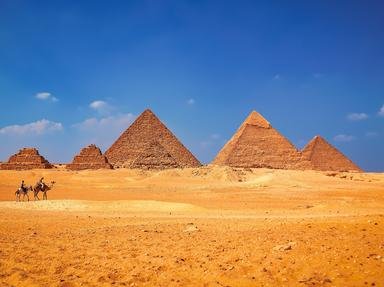
The 4th dynasty was responsible for the great pyramids of Giza. Who was the largest pyramid built for?
    Cheops (Khufu). The largest pyramid in Egypt is that of Cheops (also known as Khufu) in Giza. It is believed that the pyramid took 20 years to build and employed 100,000 workers and slaves. It is the last remaining one of the Seven Wonders of the World.

Who was the pharaoh with the longest rule in the history of Egypt-it lasted 94 years during the 6th dynasty?
    Pepy II. Pepy II had the longest rule in the history of Egypt. He is partially responsible for the decline in power of the pharaohs before the 7th dynasty.

The tomb of this pharaoh was found largely unscathed by archaeologists. The king in this tomb has become very famous, he died when he was between 18-20 years old. Who was he?
    Tutankhamen. Tutankhamen (king Tut) became king for a very short reign after his brother had died. When they found his tomb it was filled with many artifacts that have helped anthropologists unravel the Egyptian history.

This ruler in the 20th dynasty is considered by many one of the greatest Egyptian pharaohs. He stopped the 'sea people' (Indo-European tribes) before they destroyed Egypt. Who is he?
    Ramses III. Ramses III was victorious in many battles with peoples trying to overtake Egypt. The 'sea people' were his greatest victory because they had just destroyed the Hittite kingdom and were moving on to Egypt. Ramses III massacred them, they never entered Egypt. He is also considered to be the pharaoh living during the time of Moses. Most people confuse Ramesses II with Ramesses III as being the greatest pharaoh but that is because they have heard more about Ramses II's accomplishments, however it was Ramses III who is considered by historians and anthropologists to be the greatest. He was the one to stop the Indo-European tribes.

This woman was the most famous female pharaoh of Egypt. She often presented herself in art as a man with a false beard. After her death her step son, the new king of Egypt, had her statues destroyed and her inscriptions replaced with his own name. Who was she?
    Hatshepsut. Hatshepsut was the daughter of the pharaoh Thutmosis I and the first queen. Thutmosis I had a son with a concubime and named him Thutmosis II. Thutmosis II married his half sister Hatshepsut to become king. During his short reign they had a daughter. Thutmosis II also had a son with a concubine and named him Thutmosis III. When Hatshepsut died Thutmosis III married his half sister, Hatshepsuts daughter, to become king. There was a lot of incest going on at that time.


Did you find these entries particularly interesting, or do you have comments / corrections to make? Let the author know!

  • Send the author a thank you or compliment
  • Submit a correction