Register New Player - Log In
Welcome to our world of fun trivia quizzes and quiz games:     New Player quiz register Play Now! trivia game
Fun Trivia: E : Electronics and Circuits

Special Sub-Topic: Soldering Basics


What is solder made of?

    Tin and lead or tin and copper. Solder for electronics is a mixture of tin and lead with more of the former. However, it has been found that even a small amount of lead can be detrimental to health so now copper is used with a higher proportion of tin. Some companies still use lead solder but are gradually changing over to copper/tin because of country lead import restrictions and the known health risks of working with lead.

How hot should a soldering iron be in order to solder leaded solder?
    650-800 degrees Fahrenheit. Although solder will melt at 450 degrees, it will not create a clean strong joint as such a low temperature. Therefore soldering components on circuit boards is usually advisable at 700 degrees for surface mount parts, and 750 for parts that go through the board when working with leaded solder. When working with unleaded solder it is recommended to solder at 750 for surface mount parts and 800 degrees for through-hole parts for the most effective solder.

It is good to use a lot of solder when placing components on boards?
    no. Very little solder is required to make a good solder joint. If too much solder is used it can make it difficult for the technician to determine whether a proper connection has been made, or whether the solder is just balled up around the joint. If the solder joint is shiny and makes a clean slope from the part to the board, then it is considered a good solder joint.

What tools are needed to solder circuit boards?
    Soldering iron, solder, flux. Often tweezers are also used when working with very small parts. Some resistors are smaller than ants and require the use of a microscope to place them on circuit boards.

What can be used to clean circuit boards when you are finished soldering?
    Defluxer spray, compressed air, or water. A technician should only use chemicals specifically designed for use on circuit boards such as defluxer spray or acetone. Other chemicals can leave residue that can damage the board. Abrasive pads should be completely avoided to prevent damage to the board. Cotton balls tend to leave "strings" in the boards and alcohol will not take off the flux adequately.

What is a "cold" solder joint?
    Solder that was not heated adequately to make a strong bond with the board.. The cold solder joint is a long time enemy of technicians. When solder is "cold" it will be dull and bumpy in appearance. The strength of the solder is much weaker and very likely to break if the board is put under even minimal stress.

Should solder be reheated on a circuit board?
    Yes, once or twice using flux but only with prototype boards.. Generally it is unwise to reheat solder, but in the case of repairing the circuit board to experiment with various components it may be necessary to reheat the part a second time. Professional circuit boards are "wave" soldered with a machine to insure the parts are soldered at the appropriate temperature the first time.

Is it safe to eat or drink while soldering?
    no. Since solder often contains lead it is unwise to solder while eating. A technician should wash his hands with soap before eating or drinking anything. And food that gets on your hands may also contaminate the board and cause food particles to stick to parts.

When soldering, a technician needs to take care not to damage the board by wearing a wrist strap to protect the board from ESD. What is ESD?
    Electrostatic discharge. ESD can be seen when we have a spark come from our finger tips. If you actually see or hear the spark it is at least 10,000 volts of electricity being sent to a specific spot on the board. Even unheard ESD sparks can damage integrated circuits on boards and render them useless. Manufacturers ship boards and components in ESD safe bags so that technicians can safely carry them or ship them by mail in non static safe environments.

What are common names for some primary discrete components used on circuit boards?
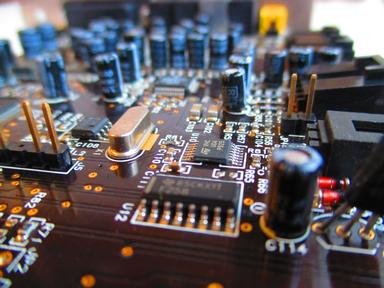
    Resistors, capacitors, diodes. Of course, there are many more parts on circuit boards like transistors, transformers, fuses, inductors and integrated circuits. These three components are the most frequently used parts. A via is the name for the holes on circuit boards and header's and receptacles allow engineers to program boards or stack more than one board on top of another. Conformal coating is put on some circuit boards to waterproof it for automotive use. Just imagine if salt water from the road was able to get all over your car's circuit boards, it would be a tragedy and destroy the boards. Capacitors are often made from ceramic and integrated circuits are made from silicon.


Did you find these entries particularly interesting, or do you have comments / corrections to make? Let the author know!

  • Send the author a thank you or compliment
  • Submit a correction