Quizzes at Fun Trivia Fun Trivia | quizzes Quizzes | games Games | community People | services Services | help Help | me Me
New Player - Log In
Currently 8281 players online.   Trivia games, quizzes, and contests - FREE !     Get Started! quiz register
Fun Trivia: W : WW2 Armor

Special Sub-Topic: Tanks in the European Theatre


This tank was the most common tank used by the Germans during the invasions of France and the Low Countries during the early part of the war.

    Panzer II. Though essentially obsolete, 1,000 Panzer IIs participated in the invasions of France and the Low Countries. The superior tactics of the Germans with sub par tanks proved better than the superior tanks of the French.

This man once said, in reference to a tank named after him, "This tank even has more flaws than me myself!"
    Winston Churchill. The first Churchill tank was plagued with many problems, the most notable being the undersized engine. However, later Churchill tank designs proved to be more effective.

Which tank was initially designated Panzer VI?
    Tiger. The Tiger was a heavy tank that sacrificed speed for firepower and armor. The Tiger, like most tanks, also faced many mechanical failures in the early stages.

This tank was easily the most formidable tank during the first few years of the war and was also the most produced tank of World War II.
    T-34. The T-34 surprised the Germans during Operation Barbarossa. The revolutionary design features of the T-34, including sloped armor, made it virtually invulnerable to any German tank of the time. The T-34 was one of the main reasons why Germany was unable to conquer the Soviet Union.

This was the biggest tank produced during the war but was introduced too late to have much of an impact.
    Tiger II. The Tiger II (King Tiger) weighed about 70 tons. (The Tiger I tank was only about 57 tons). It also has an immense 88 millimeter gun. When a Tiger II entered the battlefield, opposing tanks would find an excuse to leave. The best way to destroy a Tiger II was to call for bombers to take it out. The fuel shortage in Germany as well as some mechanical prolems limited the effectiveness of the Tiger II.

This tank was introduced at the Battle of Kursk and was a direct response to the T-34 and has many similar features and is generally regarded as the best overall tank of World War II.
    Panther. The Panthers had various mechanical problems during the Battle of Kursk, which contributed to the German defeat there and more Panthers at Kursk were disabled by mechanical problems than by enemy fire. After the initial problems were fixed, the Panther was a very formidable tank being an excellent combination of size and speed. The Panther tank was so effective that the French used them in their army after World War II!

Which tank was often referred to as a "Ronson" (cigarette lighter)?
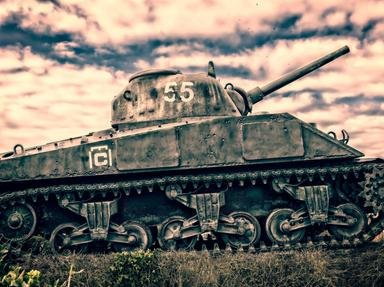
    M4 Sherman. The British called it this because it "lights up the first time, every time" when hit. Other nicknames included "the burning grave" and "Tommycooker" (Germans referred to British soldiers as "Tommys"). The United States mass produced the cheaper Shermans rather than more expensive tanks.

Which of the following tanks that was used during World War II was not even equipped with a cannon?
    Panzer I. The Panzer I was intended as a training tank being very small and lightly armed and armored. Due to the lack of tanks during the invasions of Poland and France, however, the tanks were still used even though they were completely obselete.

This tank was the fastest tank in service during World War II with a notional top speed of about 40 miles per hour.
    Cromwell Tank. The Cromwell’s suspension could not handle 40 miles per hour over time even though the tank was cabable of going 40 mph. Therefore the tanks were not to go over 32 mph.

This tank never passed the development stage because of the end of the war. Two prototypes of this humungus 188 ton tank were produced. One broke down and another was captured by opposing forces. What tank am I speaking of?
    Maus. The Maus (Panzer VIII) had an unprecidented 128 millimeter gun (destroyers and some cruisers do not even carry guns this big), however it was only capable of 8 miles per hour. With its armor being as thick as 240 mm (10 inch) in some places, its only foes would have been bombers - and mud. I am not sure how effective it would have been with its very limited mobility; it would have been excellent for defense I suppose. The Panther II was also a project that was never completed. The T-54 was an excellent Soviet tank that was not completed until after the war.


Did you find these entries particularly interesting, or do you have comments / corrections to make? Let the author know!

  • Send the author a thank you or compliment
  • Submit a correction