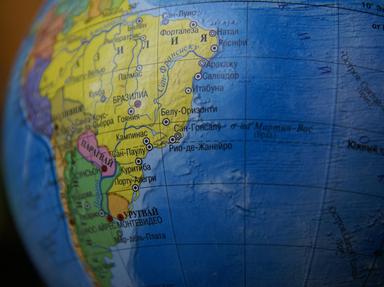
When traveling west, at what point do you begin traveling east? (Such as, if you walked due north you would come to the north pole and then you would be traveling south until you reached the south pole and you would again be traveling north.)
Question #68170. Asked by
jst4fn.
Last updated Sep 11 2018.
If you were walking west, you would always walk west, to go east you'd have to turn around. There are no definitive markers like the North and South Poles that put a finite limit on a direction.
However far you walk (or swim!), going west you will have north on your right. All the way round to where you started. There ain't no east or west side, except politically. As Sam says, no west or east poles.
Jul 13 2006, 4:00 PM
What-A-Mess
Answer has 1 vote
What-A-Mess
Answer has 1 vote.
West is West and East is East. The direction does not ever change. The only reason that the direction changes when traveling North or South is because of the fixed poles. Once you have crossed the Pole and are traveling away from, with your back toward, you change the direction of travel.
There exists no East or West "fixed point" so there is no directional threshold in the travels.
You may say one is traveling toward the "East" (Asia etc) while traveling West but one is not traveling in the compass direction of East. And of course vice-versa referring to the USofA and Europe(the West) while traveling East. When traveling East your compass will ALWAYS say East and the same for West. Not so when traveling North or South When one crosses the South Pole the compass does an immediate 180 degree shift (actually it spins multidirectionally for a bit until you are far enough away to be traveling in a true declination) facing Magnetic North once again (the closest Magnetic North).
Just as sam has said.
Response last updated by gtho4 on Sep 11 2018.
Jul 14 2006, 8:32 PM
Return to FunTrivia
"Ask FunTrivia" strives to offer the best answers possible to trivia questions. We ask our submitters to thoroughly research questions and provide sources where possible. Feel free to post corrections or additions. This is server B184.