FREE! Click here to
Join FunTrivia. Thousands of games, quizzes, and lots more!

Cetaceans and Sirenians Trivia Questions and Answers
Fun Facts & Interesting Information
Fun Trivia Question Usage
You are welcome to use the questions in this section for non-commerical purposes: quizzing friends/coworkers, classrooms, newsletters, trivia nights, events, etc. Questions may
not be used for websites or in apps, and may not be resold. You use the questions at your own risk, and FunTrivia is not responsible for errors, etc in the content.
Please
link to or
credit FunTrivia textually (http://www.funtrivia.com) if you use any of these questions. Thanks!
Visit our
Trivia Question Store to buy question packs for commercial or for-profit ventures.
1. What is the most distinguishable feature of narwhals?
Answer: Tusk
Interesting Information:The long tusk is most commonly found on males; some have two (this is not common) and some don't have one at all. The tusk is actually a canine tooth. It can grow up to ten feet (three meters) long and has millions of nerve endings inside. There are lots of theories about what it is actually used for. Some of these theories include as a weapon, as a tool to break through ice, as an acoustic organ and as a sexual trait (a way to distinguish who among other males is higher up in the hierarchy based on the size of the tusk). The general consensus is that the tusk doesn't serve a critical purpose for survival since only about fifteen percent of females have one.
Difficulty: Very Easy.
From Quiz: The Unique Narwhal
Some incorrect choices:
Mane, Stripes, Fin
2. An Atlantic blue whale is about to give birth to her calf. Where is she?
Answer: In warmer waters near the Equator
Interesting Information:Female blue whales carry their young for twelve months. During that time they eat roughly four percent of their body weight daily, amounting to some sixty percent of their overall body weight throughout the summer foraging period. As to the calving process itself, marine biologists know next to nothing beyond that it takes place in the warmer waters at the southern extreme of the whales' migratory cycle, where they both mate and look after their young.
Difficulty: Hard.
From Quiz: A Tale of a Whale
Some incorrect choices:
In colder waters near one of the poles, There is no specific place for calving, Researchers don't know
3. Cachalots are not the very largest whales but what do they have that is larger than that of any other animal on earth today and possibly ever?
Answer: brain
Interesting Information:Cachalots (pronounced cash-uh-lots) could take an entire page in the "Guinness World Records" book if a whale enthusiast ever got on the editorial staff there. Their brains (about five times the size of a human's) are not just huge because they are big animals. Their brains are also proportionately larger than anything alive. The portions of the brain controlling smell and taste are reduced but hearing is keenly developed which is not surprising as it is believed they use their calls both to communicate and as echolocation for hunting.
There are a few larger whales but all are baleen filter feeders making the cachalot the world's largest toothed predator. Giant squid actually have the largest eyes on earth. The mighty blue whale outdoes the cachalot slightly on size for tail and blowhole. Though it is a tough comparison on the latter because their blowhole is one of several features which makes a cachalot very easy to identify at a distance. It is S-shaped and pointed at a 45-degree angle to vertical which gives a very distinct spray pattern.
Difficulty: Hard.
From Quiz: Call me Cachalot, or Sperm Whale if You Must
Some incorrect choices:
blowhole, tail flukes, eyes
4. At birth, what is the length of a blue whale calf?
Answer: seven metres
Interesting Information:At birth, blue whale calves measure seven metres long and weigh three tonnes. They will eventually grow to a length of thirty metres and weigh more than two hundred tonnes.
Difficulty: Hard.
From Quiz: Born in the Wild: Whale
Some incorrect choices:
four metres, ten metres, one metre
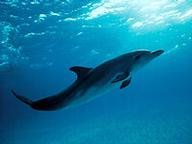
5. What do we call a baby dolphin?
Answer: calf
Interesting Information:Baby dolphins are called calves.
An ephyna is a baby jellyfish, a cria is a baby alpaca and a kit is the name given to a baby ferret.
Difficulty: Easy.
From Quiz: Born in the Wild: Dolphin
Some incorrect choices:
cria, kit, ephyna
6. In what ocean are narwhals most commonly found?
Answer: Arctic Ocean
Interesting Information:Although they are found predominantly in the Arctic Ocean, sometimes a stray narwhal can be found swimming much further south in areas such as the Hudson Bay.
Difficulty: Easy.
From Quiz: Nifty Narwhals
Some incorrect choices:
Pacific Ocean, Atlantic Ocean, Indian Ocean
7. Manatees belong to the order Sirenia. Where did that name come from?
Answer: The sirens of Greek mythology
Interesting Information:The order Sirenia includes only manatees and dugongs. There was a third species--Steller's sea cow, but they were wiped out in the mid to late 1700s. Due to their long tail sections, manatees and dugongs had the general appearance of the mythological Greek sirens who lured sailors to their death in shallow, rocky water.
Difficulty: Hard.
From Quiz: Oh, the Huge Manatees!
Some incorrect choices:
They are so peaceful and serene, The man who first studied them was named Silas Syren, They make a high-pitched sound like a siren
8. 'Cetacean' is the name given to the order of animals such as whales, dolphins and porpoises. The ancient Greeks named these animals 'ketos'. What does/did it mean?
Answer: Sea Monster
Interesting Information:The Latin for whales & dolphins is 'cetus', simply meaning 'large sea creature'. There are around 86 species of cetacean found worldwide.
Difficulty: Hard.
From Quiz: Cetaceans: Whales, dolphins and porpoises.
Some incorrect choices:
Serpent, Fish, Dragon
9. The Maui's dolphin is endemic to only one country, where it is the country's only endemic cetacean. Which country is this?
Answer: New Zealand
Interesting Information:Maui's dolphin can only be found in the North Island of New Zealand, on the west coast, though their range once reached all around the North Island in the 19th century. It is the only dolphin which can be found exclusively in New Zealand (as well as the dolphin they are a subspecies of). They can be found in small pods (groups of dolphins) of about 1-5 dolphins close to the shore (about 9 kilometres or 5 nautical miles from the shore) where the water isn't too deep. During summer they may venture closer to shore.
Difficulty: Hard.
From Quiz: Endangered: The Maui's Dolphin
Some incorrect choices:
Australia, Indonesia, Japan
10. How would you classify a dolphin?
Answer: Mammal
Interesting Information:A dolphin is a mammal. Though it may live in the water, it needs air to breathe.
Difficulty: Very Easy.
From Quiz: All About Dolphins
Some incorrect choices:
Fish, Bird, Amphibian
11. What is one unique characteristic of the narwhal that makes it easily distinguishable from other sea creatures?
Answer: its tusk
Interesting Information:The narwhal has an elongated, helical tusk growing from its upper left jaw. Helical means that it is in the shape of a helix, so that it is in a counter-clockwise spiral (from the point of view of the narwhal).
Difficulty: Very Easy.
From Quiz: Narwhal Knowledge
Some incorrect choices:
its unusual pink colour, its square head, the fringe of "hair"
12. The blue whale is larger than any other animal that has ever lived on earth, including all known dinosaurs. What makes the blue whale ideally suited for having such a gigantic size?
Answer: It lives in the ocean.
Interesting Information:Because the blue whale spends its entire life in water it does not need to carry its weight like land animals do. Although it is a highly evolved mammal that does need to have great diving capabilities these are not the specific reasons for its impressive size.
Difficulty: Average.
From Quiz: Blue Whales
Some incorrect choices:
It is a mammal., It is very evolved., It needs great size to make rapid dives.
13. There is a functionally extinct dolphin species named after a river. What is the dolphin species called?
Answer: Yangtze river dolphin
Interesting Information:This species is declared to be 'functionally extinct' because in 2006, a group of marine biologists went on an expedition along the Yangtze River to try and find one. They couldn't find any, and four years earlier, the last one in captivity had died. It isn't likely that there are any left wild.
Difficulty: Easy.
From Quiz: Endangered Cetaceans
Some incorrect choices:
Thames river dolphin, Rhine river dolphin, Mississippi river dolphin
14. What is the binomial name that has been given to the narwhal?
Answer: Monodon monoceros
Interesting Information:The binomial name of the narwhal has been derived from its genus (Monodon) and species (M. monoceros). The binomial name means 'one tooth, one horn', an accurate representation of the narwhal due to the fact that it has one tooth (or horn) that is shaped like that of a unicorn tusk.
Difficulty: Hard.
From Quiz: Narwhals: The Northern Wonder
Some incorrect choices:
Monodon cetecea, Monodontidae monoceros, Monoceros cetecea
15. What is the only enemy of an orca whale?
Answer: man
Interesting Information:Humans are the only enemy and predator of an orca. The orcas have been hunted down and killed by fisherman who claimed that the whales depleted their fish stock. Also many things such as commercial shipping, whale watching and live capture for marine parks can harm the orca's population.
Difficulty: Easy.
From Quiz: Orca, The Killer Whale
Some incorrect choices:
shark, other orcas, other species of whale
16. About what percent of a beluga's body weight is blubber?
Answer: 40
Interesting Information:The blubber is usually around 10-15 cm thick. Imagine taking the mattress off of your bed, wrapping it around your body, then going swimming, that's what it would be like to be a beluga whale.
Difficulty: Hard.
From Quiz: Beluga Whales
Some incorrect choices:
60, 10, 90
17. Whales are a kind of:
Answer: mammal
Interesting Information:They were recognized as mammals in 1758 by the Swedish biologist Linnaeus. Mammals give birth to live young, have hair, are warm-blooded, all traits that whales share, even down to stubble-like hair that many species have on their snouts.
Difficulty: Very Easy.
From Quiz: Whales and Dolphins
Some incorrect choices:
fish, amphibian, shark
18. Which whale is the largest animal on earth?
Answer: Blue
Interesting Information:The largest blue whale recovered was 110 feet long, longer than a 737 jetliner!
Difficulty: Easy.
From Quiz: Whales and Whaling
Some incorrect choices:
Sperm, Humpback, Bowhead
19. Orca are also known as 'Killer Whales'. What sort of animal are they really?
Answer: Dolphin
Interesting Information:Orca belong to the same family as dolphins and whales. They are mammals: warm blooded, air breathing, and bear their young alive.
Difficulty: Easy.
From Quiz: Killer Whales
Some incorrect choices:
Shark, Fish, Badger
20. What was the name of the first killer whale EVER held in captivity?
Answer: Moby Doll
Interesting Information:Moby Doll was actually a young male. But this wasn't known until after his death and an autopy was performed.
Difficulty: Hard.
From Quiz: Whales and Dolphins
Some incorrect choices:
Shamu, Corky, Namu
21. What is the habitat of narwhals?
Answer: Arctic waters
Interesting Information:Narwhals live in the Arctic waters of Canada, Russia, Greenland and Norway. They do migrate with the seasons. In the winter time they can be found in deep offshore waters under thick ice. In the summer they move closer to coasts. In winter they spend time in areas with very little open water. They have an amazing ability to deep dive. They have excellent oxygen storage capacity and can dive for up to twenty four minutes and as deep as sixteen hundred meters (over five thousand feet!).
Difficulty: Easy.
From Quiz: The Unique Narwhal
Some incorrect choices:
Great Barrier Reef, Mediterranean waters, Indian Ocean
22. How did cachalots come to be known by the unflattering name of sperm whale?
Answer: early whalers believed the whale's head contained sperm
Interesting Information:Cachalots have a large cavity in their head filled with an oily, yellowish-white liquid. Early whalers believed this was a massive sperm reservoir so the substance was dubbed spermaceti, and the name sperm whale naturally followed.
Incidentally, the German word for head is "kopf" and sperm is "sperma". Not much chance for such a low-grade international incident there.
Difficulty: Hard.
From Quiz: Call me Cachalot, or Sperm Whale if You Must
Some incorrect choices:
because boy cachalots will be boys, a mistranslation of the German word for head, some sailor thought the whale looked like a giant sperm
23. Where is the most likely place a female dolphin will go to give birth?
Answer: shallow water
Interesting Information:When the time comes to give birth, female dolphins will move into shallow water. They are usually accompanied by other females who offer comfort, protect the mother from predators and help the newborn calf reach the surface to breathe.
Difficulty: Average.
From Quiz: Born in the Wild: Dolphin
Some incorrect choices:
deep water, coral reefs, underwater caves
24. Which animal is responsible for nearly all hunting of narwhals?
Answer: humans
Interesting Information:Humans, in particular Inuit peoples, hunt narwhals for blubber and food. Polar bears and walruses also hunt narwhals, but they are not main predators and will only go after narwhals by accident or if there is nothing else to eat.
Difficulty: Average.
From Quiz: Nifty Narwhals
Some incorrect choices:
polar bears, walruses, sharks
25. Which animals are affected by dolphin morbillivirus?
Answer: Dolphins, porpoises, and whales
Interesting Information:A morbillivirus affects only members of one mammalian order under natural conditions. In the case of dolphin morbillivirus, the order affected is Cetacea, which includes dolphins, porpoises, and whales. Major epidemics can occur if those creatures infected with the disease are exposed to populations that are not immune from the virus.
Difficulty: Easy.
From Quiz: Dolphin Morbillivirus
Some incorrect choices:
Dolphins, otters, and sharks, Manatees, porpoises, and sea bears, Sharks, whales, and dolphins
26. Cetaceans are divided into two categories. What are they, in their Latin form?
Answer: Odontocetes and Mysticetes
Interesting Information:Mysticete means 'moustached whale' due to the hairy baleen plates used to sift plankton and krill etc. Odontocete refers to all toothed whales such as the sperm whale and killer whale.
Difficulty: Hard.
From Quiz: Cetaceans: Whales, dolphins and porpoises.
Some incorrect choices:
Odontocetes and Megaptera, Balaenoptera and Mysticetes, Musculus and Phocena
27. The Maui's dolphin is a subspecies of another type of dolphin. Which one?
Answer: Hector's dolphin
Interesting Information:The Maui's dolphin was originally thought to be the Hector's dolphin itself. In 2002, Dr Alan Baker found differences in skeleton structure, colouration and genetics between the two, so Maui's dolphin was named a subspecies of the Hector's dolphin. The differences between the two are quite amazing considering how close their distribution range is to each other geographically. Sadly, the Hector's dolphin is listed as "Endangered" by the IUCN.
The other options are dolphin species, but the Maui's dolphin is not a subspecies any of them.
Difficulty: Hard.
From Quiz: Endangered: The Maui's Dolphin
Some incorrect choices:
Bottlenose dolphin, Common dolphin, Killer whale
28. What is the name of the hole on the top of the dolphin's head?
Answer: blowhole
Interesting Information:The hole on the top of the head is called the blowhole. When a dolphin goes underwater the hole closes and when it comes up for air it opens.
Difficulty: Very Easy.
From Quiz: All About Dolphins
Some incorrect choices:
breathe hole, air hole, water hole
29. Besides humans, what is the only known natural enemy of the blue whale?
Answer: Orca.
Interesting Information:About one quarter of all blue whales observed have scars from being aggressively hit by orcas (killer whales). It is unknown how many blue whales die due to these orca attacks.
Difficulty: Hard.
From Quiz: Blue Whales
Some incorrect choices:
Giant squid., Great white shark., Sting ray.
30. The name of the rarest porpoise means 'little cow' in Spanish. Which is it?
Answer: Vaquita
Interesting Information:The vaquita has been called the 'most endangered cetacean', and will most likely be the next to become extinct. There are supposed to be 100 to 300 left.
Difficulty: Easy.
From Quiz: Endangered Cetaceans
Some incorrect choices:
Harbour porpoise, Beluga, Finless porpoise
31. What fin do belugas not have?
Answer: Dorsal
Interesting Information:They have a dorsal ridge on their back instead of a fin. Since they're from the arctic, they use the ridge to break through ice to find a place to breathe. And a dorsal fin would bang on the ice everytime that they swam.
Difficulty: Hard.
From Quiz: Beluga Whales
Some incorrect choices:
Pectoral, Fluke, They have all of these
32. The very largest whales eat:
Answer: krill and plankton
Interesting Information:All of the largest whale families are baleen whales who strain the water for krill and various plankton. Ironic, isn't it, that the very largest animals on Earth eat some of the smallest animals they can find.
Difficulty: Easy.
From Quiz: Whales and Dolphins
Some incorrect choices:
fish, other whales, coral
33. How did the sperm whale get its name?
Answer: From the substance in its head
Interesting Information:The substance in the head, from which came the oil and wax, looked like human sperm, thus the name.
Difficulty: Average.
From Quiz: Whales and Whaling
Some incorrect choices:
From its promiscuity, From its massive amount of sperm, From the dominance of males
34. There is only one species of orca. However, three types have been identified. These are:
Answer: Transients, Residents and Offshores
Interesting Information:Each population differs in behaviour, social organization and appearance of dorsal fins.
Difficulty: Hard.
From Quiz: Killer Whales
Some incorrect choices:
Residents, Migrates and Rogues, Shallow, Offshore and Ocean, Ocean, Shoreline and Rogues
35. What sense do humans have that killer whales do NOT have?
Answer: smell
Interesting Information:Killer whales and dolphins have the benefit of echolocation to make up for the lack of a sense of smell.
Difficulty: Hard.
From Quiz: Whales and Dolphins
Some incorrect choices:
sight, taste, hearing
36. Unlike other marine animals, the narwhal lacks what feature that aids in stabilization?
Answer: Dorsal fin
Interesting Information:Another unique characteristic of the narwhal's appearance is the fact that it does not have a dorsal fin. Not having a dorsal fin actually benefits the narwhal given where they live. It cuts down on body surface area and allows them to travel closely under ice sheets. The body shape is stout and shaped like a torpedo and the color changes depending on the age of the narwhal. Newborns are blue-gray, young narwhals are blue-black and adults are mottled gray. They become more mottled as they age.
Difficulty: Average.
From Quiz: The Unique Narwhal
Some incorrect choices:
Tail flukes, Pectoral fin, Flippers
37. What does a blue whale eat once it is weaned?
Answer: Krill
Interesting Information:Krill, the predominant food source for blue whales, are tiny shrimp-like crustaceans that swarm in great clouds in the oceans.
The blue whale's feeding method is simple; it swims forward at speed with mouth wide open (up to eighty-eight degrees), scooping up as much as two hundred twenty tons of seawater at a time and whatever is in it. Then the animal's remarkable anatomy comes into play. Members of a group of species called rorqual whales, they have pleated, expandable throats with sixty to eighty-eight grooves which allows the skin to expand during feeding. Moreover, they are baleen whales, their upper jaw lined with seventy to three hundred ninety-five black baleen plates.
During feeding, the whale squeezes the seawater out through the curtain-like baleen with pressure from the throat pouch and tongue. It then swallows the krill, releasing the water back into the sea. This style of feeding emphasizes quantity over selectivity. So, sometimes the whale inadvertently eats fish, octopus and other sea life. It is also surprisingly energy efficient. By targeting a particularly dense swarm, the whale can swallow up to five hundred kilos of krill, eating four hundred fifty-seven thousand calories in a single bite, that provides almost two hundred times the amount it burned in the lunge.
Furthermore, the whale maximizes calorie intake by increasing the number of lunges while selecting the thickest krill patches. This provides enough energy for everyday activities while allowing the whale to store additional energy for migration and reproduction. It is now known that a blue whale consumes sixteen tons of krill daily.
It is believed that, along with other baleen whale species, blue whales engage in behavior that minimizes direct competition with other baleen whales. Different species select different feeding spaces and times as well as different prey species.
Difficulty: Easy.
From Quiz: A Tale of a Whale
Some incorrect choices:
Sharks, Plants such as seaweed, A mix of plant and animal food sources
38. Cachalot males are how much larger than females?
Answer: about 30% longer and three times heavier
Interesting Information:Males and females are born the same size, about three meters (11 feet) long, but the boys rapidly begin to outgrow the girls and develop the elongated, bulkier head for ramming enemies (would-be predators, or for the last few centuries, whaling ships). Adult males end up 16-21 meters (50-70 feet) and tip the scales at over 40,000 kilograms (45 short tons) while females reach 11-12 meters (35-40 feet).
Of course, sea stories being what they are, tales of huge whales exist. The cachalot which retaliated against and sank the whaler Essex, for instance, was estimated to be 85 feet long by sailors on board, but the likelihood that, under duress, they may have been prone to exaggeration seems high.
Difficulty: Hard.
From Quiz: Call me Cachalot, or Sperm Whale if You Must
Some incorrect choices:
roughly the same length and weight, roughly the same length but twice as heavy, twice as long but roughly the same weight
39. Concerning sperm whales, which sex generally tends to live alone?
Answer: males
Interesting Information:Much like elephants, female sperm whales and their calves live in small family groups while mature males live alone.
Difficulty: Easy.
From Quiz: Born in the Wild: Whale
40. Baby dolphins are always born tail-first. Why?
Answer: they would drown if born head-first
Interesting Information:Since dolphins are air-breathers, in the time it takes to be born, the calf would drown if it came out head-first.
Difficulty: Hard.
From Quiz: Born in the Wild: Dolphin
Some incorrect choices:
it's more comfortable, it helps with swimming, it makes the birth more easy
Please remember to credit FunTrivia.com, add links on your website or newsletters, or otherwise spread the word about our website. Thank you very much, and we hope these questions have been useful!
|