FREE! Click here to
Join FunTrivia. Thousands of games, quizzes, and lots more!

Horse Breeds Trivia Questions and Answers
Fun Facts & Interesting Information
Fun Trivia Question Usage
You are welcome to use the questions in this section for non-commerical purposes: quizzing friends/coworkers, classrooms, newsletters, trivia nights, events, etc. Questions may
not be used for websites or in apps, and may not be resold. You use the questions at your own risk, and FunTrivia is not responsible for errors, etc in the content.
Please
link to or
credit FunTrivia textually (http://www.funtrivia.com) if you use any of these questions. Thanks!
Visit our
Trivia Question Store to buy question packs for commercial or for-profit ventures.
1. The first native breed of horse or pony is this highly strung, eye catching driving breed, a wonderful sight flying round the main ring at the larger county shows. Which harness horse/pony am I referring to here?
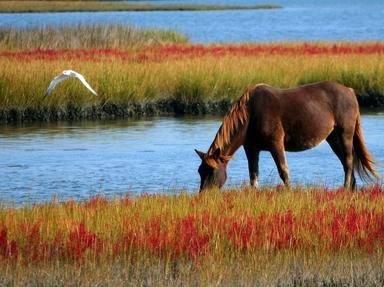
Answer: Hackney
Interesting Information:The Hackney pony and horse are registered as separate breeds, the pony standing between 12 and 14 hands high (hh), and the horse from 14.2 to 16.2hh. Both have a distinctive high knee action in trot and a Hackney in full flow is a memorable sight. Surprisingly few have been registered with their breed societies in recent years but hopefully they will be with us for many years to come.
Difficulty: Hard.
From Quiz: British Native Horses in Short Supply
Some incorrect choices:
Norfolk Trotter, Andalusian, Lippizaner
2. What is the country of origin for Friesians?
Answer: Netherlands
Interesting Information:According to the Friesian Horse Society, all purebred examples of the breed today can trace their ancestry back to a single stallion, Nemo 51. He was born in 1885, but the breed as a whole is much older.
Difficulty: Hard.
From Quiz: A Dark Horse
Some incorrect choices:
Denmark, Germany, Italy
3. Which rather small horse, known for its white coat and bull herding skills, is native to the marshlands of southern France?
Answer: Camargue
Interesting Information:A prehistoric breed, the Camargue is technically a pony due to its size (about the size of a New Forest or Connemara Pony). It is still a crucial horse to the "cowboys" of the Camargue delta. In the age of Romans the horses were believed to be direct descendants of the goddess Venus, and their white coats to be from the seawater she was risen from.
The Ariegeois is also a French breed, but always has a black coat and is used mainly as a pack horse in mountainous regions. The skogsruss, or Gotland pony, is an ancient Swedish breed believed to be a direct descendant of the Tarpan. The Hucul is a Polish pony, mostly used for farm work.
Difficulty: Easy.
From Quiz: Horse Breeds from Around the World
Some incorrect choices:
Ariegeois, Skogsruss, Hucul
4. This breed from India is known for its distinct ears that curve together and often touch.
Answer: Marwari
Interesting Information:Marwaris come in all colours, including piebald and skewbald, and range from 14.2 to 16hands. Horses with curved ears have been seen in cave paintings since 2000 BC!
Difficulty: Hard.
From Quiz: Uncommon Horse Breeds
Some incorrect choices:
Lusitano, Quarter Horse, Kiso
5. What is the original and smallest of the Welsh pony breeds?
Answer: Welsh Mountain Pony
Interesting Information:The Welsh Mountain Pony is descended from Celtic horses. They are twelve hands high and every color but piebald (patches of white and black) and skewbald (patches of white on brown). The stud book classifies the Welsh ponies into four sections: the Welsh Mountain pony, the Welsh Merlin, the Welsh pony, and the Welsh Cob.
Difficulty: Easy.
From Quiz: It's Not Just About Mr. Ed
Some incorrect choices:
Karabakh, Arab, Lippizaner
6. The New Forest pony comes from an area of the same name, but where is this?
Answer: Southern England
Interesting Information:The New Forest is in the county of Hampshire on the South Coast of England. The forest is a National Park and the area includes heathland, ancient woodland and sand dune areas.
Difficulty: Hard.
From Quiz: Do you know the New Forest pony?
Some incorrect choices:
Northern England, Wales, Scotland
7. Where did the Friesian breed originally come from?
Answer: Friesland
Interesting Information:Most people have heard of Friesian cattle, but not so many have heard of Friesian horses. They both come from 'Friesland' in the Netherlands. Friesian horses are mostly known for their black coat colouring, but are also distinguishable by their wavy manes and long feathers.
Difficulty: Hard.
From Quiz: Horse Breeds of the World
Some incorrect choices:
Friesianland, Felland, Finland
8. Where is it believed that the first Norwegian fjord horses were bred?
Answer: Norway
Interesting Information:Archaeological excavations show that Norwegian fjord horses were first bred in Norway over 4000 years ago.
Difficulty: Average.
From Quiz: The Norwegian Fjord Horse
Some incorrect choices:
France, Greenland, Canada
9. This breed originated in North Dakota, and is closely related to Sitting Bull's horses.
Answer: Nokota
Interesting Information:They come in a variety of sizes, ranging from 14-17 hands, and are of Spanish ancestry. They were almost wiped out by ranchers, and some federal agencies. The only reason this breed survived was because a small band was fenced in on the Theodore Roosevelt National Park. While the National Park Service still tried to wipe out this herd of horses, laws protecting wild and free-roaming horses and burros stopped the slaughter.
The Nokota is a highly athletic horse, good for jumping, endurance riding, and pleasure riding. They come primarily in blue roan (white and black hairs evenly mixed together) and gray. They can also be any other color.
Difficulty: Hard.
From Quiz: North American Horse Breeds
10. This breed of pony is one of the rarest of all equine breeds. It originated in Majorca and usually stands around 14 hands high. Its main uses are riding and agricultural work.
Answer: Balearic
Interesting Information:The Balearic pony is usually bay or brown in colour. As it is so rare, not much is known about this breed.
Difficulty: Hard.
From Quiz: All About Horse Breeds
Some incorrect choices:
Brumby, Barb, Bhutia
11. This French horse is one of several breeds used by Louis XIV in his armies, and Napoleon for his campaign of Russia. Which breed is it?
Answer: Comtois
Interesting Information:The Comtois is a light draft horse. It's one of the older breeds, thought to originate from horses brought into France by the Burgundians around the 4th century. In the 16th century, the Comtois was used to improve the horses of Burgundy, and was used as a cavalry and artillery horse.
The Comtois is a short draft horse, averaging around 14.3 hands. Its color is any variation of the chestnut, with a flaxen mane and tail.
Difficulty: Hard.
From Quiz: Rare Horse Breeds
Some incorrect choices:
Percheron, Selle Francais, Friesian
12. What country did the Thoroughbred originate in?
Answer: England
Interesting Information:The Thoroughbred originated in 17th century England. The Thoroughbred is a product of English racing mares and Arabian stallions. Most people are familiar with the three founding stallions, the Godolphin Arabian, the Byerly Turk and the Darly Arabian.
Difficulty: Hard.
From Quiz: The Magnificent Thoroughbred
Some incorrect choices:
United States of America, France, Arabia
13. What breed am I?
I am usually black.
I have feathers.
I'm not allowed to have a marking bigger than a five cent piece.
Answer: Friesian
Interesting Information:Friesians are mostly black and are not allowed to be used for breeding if they have a marking bigger than a five cent piece.
Difficulty: Easy.
From Quiz: Breeds of Horses
Some incorrect choices:
Clydesdale, Draught horse, Palomino
14. This horse has a gait called the running walk, which is similar to the walk of other horse breeds. The running walk, though, can get up to speeds of 10 miles an hour. Which breed is this?
Answer: Tennessee Walking Horse
Interesting Information:The TWH is a gaited breed known for its "rocking chair" canter, which is a collected gallop. While doing the running walk, the TWH can quickly outdistance many other horses without spending much energy.
The TWH can come in many colors, both solid and paint. It can also range from 14.2 to 17 hands.
Difficulty: Average.
From Quiz: Gaited Horse Breeds
Some incorrect choices:
Peruvian Paso, American Saddlebred, Morgan
15. The Welsh pony and the Arabian horse have been crossed to produce this versatile pony. What is it called?
Answer: Welara pony
Interesting Information:This breed registry has been in existence since 1981, thanks to a group of Southern California ranchers. The cross itself has been crossed for years before this, due to its versatility as a pony. It's been known to hunt, to jump, and to do harness work (such as competitively pulling a carriage), English pleasure and endurance riding.
The Welara can come in any color but appaloosa.
Difficulty: Hard.
From Quiz: Equine Cross Breeds
Some incorrect choices:
Arash pony, Arab-Welsh pony, Welbian pony
16. Which horse was originally bred in Northern England as a pack horse but is now more usually seen as a carriage horse?
Answer: Cleveland Bay
Interesting Information:The Cleveland Bay comes from North East England and was originally bred as a pack horse and known as the Chapman horse - a name derived from the packmen and pedlars (or chapmen) who used them. These Chapman horses were bred to Arabian Barbs to produce a more powerful horse, known as the Yorkshire coach horse. The breed today still has two types, with the Chapman being a finer and smaller animal. They are always bay in colour though.
The advent of the car and the tractor saw a decline in the numbers of the Cleveland Bay but they are making a come-back (though still on the Rare Breeds critical list) and are popular again as carriage horses. They are also being being bred with other types such as thoroughbreds to produce competition horses for pursuits such as dressage, show jumping and eventing.
For more information visit www.clevelandbay.com
Difficulty: Hard.
From Quiz: British Native Horses and Ponies
Some incorrect choices:
Hackney, Shire, Clydesdale
17. Where is the Spanish Riding School located?
Answer: Vienna
Interesting Information:The Spanish Riding School is considered to be the "Harvard" of the equestrian world.
Difficulty: Easy.
From Quiz: Movements of the Lipizzaner Stallions
Some incorrect choices:
Australia, Italy, Mexico
18. Which breed of horse/pony is often thought to be the descendant of shipwrecked horses who swam ashore to islands during the late 16th century?
Answer: Chincoteague/Assateague
Interesting Information:This pony breed is found on the islands of Assateague and Chincoteague. Shetland and Welsh pony blood has been introduced and has greatly improved this little-known breed. Today, they are mainly feral ponies. On a disposition scale of 1-4, 4 being calmest, this pony breed would rate about a two. They may play-up at times and are usually placid.
Difficulty: Average.
From Quiz: Which Breed of Horse or Pony....
Some incorrect choices:
Thoroughbred, Boulonnais, Chinese Guoxia
19. Today, the Irish Draft/Draught is _____ than its ancestors.
Answer: lighter
Interesting Information:Today, these horses are normally used as riding horses.
Difficulty: Hard.
From Quiz: Irish Draft/Draught
Some incorrect choices:
heavier, smarter, more skittish
20. The Clydesdale was developed in which country?
Answer: Scotland
Interesting Information:The Clydesdale originated in Scotland. They were developed in Lanarkshire, which was known historically as Clydesdale, when imported Flemish stallions were mated in native mares to increase their size.
Difficulty: Hard.
From Quiz: Do You Know Clydesdales?
Some incorrect choices:
USA, Ireland, New Zealand
21. From which state did the Rocky Mountain horse (otherwise referred to as RMH) originate?
Answer: Kentucky
Interesting Information:The RMH originated in Kentucky around the early 20th century. A man named Sam Tuttle, who was an avid horseman, owned a stallion which is now in the bloodlines of many RMH's today. The breed is named the "Rocky Mountain Horse" because the breed was created using a local mare and a stallion that originally came from the Rockies.
Difficulty: Hard.
From Quiz: The Rocky Mountain Horse
Some incorrect choices:
Florida, Michigan, Virginia
22. Which country does the Icelandic horse originate from?
Answer: Iceland
Interesting Information:The Icelandic horse's name is true to its country of origin. Developed in 865 A.D., the Icelandic horse is around 12 to 14.2 hands high.
Difficulty: Average.
From Quiz: The Icelandic Horse
Some incorrect choices:
Wales, England, Greenland
23. The stallions name comes from Lipizza, or Lipica, which is located in which present day country?
Answer: Slovenia
Interesting Information:Although located in the Austrian-Hungarian empire when the horses resided there, after the dissolution of the empire in 1917 the town reverted to Italy, and the horses were divided between the Italian, Czechoslovakian, and Austrian governments. The town is in Slovenia, near the Italian border, and is known as Lipica in Slovenian or Lipizza in Italian.
Difficulty: Hard.
From Quiz: The Lipizzaner Stallions
Some incorrect choices:
Spain, Hungary, Portugal
24. During what event is the American Saddlebred World's Grand Championship Horse Show held?
Answer: Kentucky State Fair
Interesting Information:The World's Championships have been held at the KY State Fair since 1917.
Difficulty: Hard.
From Quiz: All About American Saddlebreds
Some incorrect choices:
Missouri State Fair, The Olympics, American Royal
25. What desert-dwellers were best known for raising Arabian horses?
Answer: Bedouin
Interesting Information:Many other groups were known to raise Arabians, but the Bedouin is the best known.
Difficulty: Hard.
From Quiz: Arabian Horses
Some incorrect choices:
Dedanite, Lihyanite, Quraysh
26. It's a popular breed down under, largely descended from the Waler with inputs from thoroughbred, Timor pony and Welsh pony stock among others. What is its name?
Answer: Australian stock horse
Interesting Information:The Australian stock horse is a strong, compact animal that can thrive on poor grazing, much like its feral Waler ancestry. Though being replaced by motor vehicles they are still used for rounding up ('mustering' if you're an Aussie) stock in mountainous terrain.
Difficulty: Hard.
From Quiz: Horses for Courses
Some incorrect choices:
Brumby, Coffin Bay pony, Bernborough Horse
27. What is a group of female mustangs called?
Answer: Harem
Interesting Information:A group of females is called a harem. A stallion will not head the herd until he is about 6 years old. (Wild! America and National Geographic Explorer)
Difficulty: Hard.
From Quiz: Mustangs
Some incorrect choices:
Pride, Herd of females, The girls club
28. This second native horse breed is principally used as a carriage horse. Examples of the breed are to be found in the Royal Mews.
Answer: Cleveland Bay
Interesting Information:The Cleveland Bay breed can trace its roots back to the 17th century when it was a general purpose ride and drive animal on many farms. It stands up to 16.2hh and is always bay in colour with only a small white star permissible.
Difficulty: Hard.
From Quiz: British Native Horses in Short Supply
Some incorrect choices:
Thoroughbred, Hanoverian, Quarterhorse
29. If the French King Louis XIV had been heard to shout, "Mon royaume pour un cheval!", what horse, native to his country, might he have expected to be brought to him?
Answer: Camargue
Interesting Information:The Camargue is usually white and is one of the oldest horse breeds in the world. It can be found living wild in the swamps of southern France, and was traditionally ridden by the French version of cowboys, herding bulls for French bullfights.
Difficulty: Easy.
From Quiz: "My Kingdom for a Horse!"
Some incorrect choices:
Kiso, Sandan, Mecklenburger
30. This British draft breed only comes in "chesnut" (note the missing 't').
Answer: Suffolk Punch
Interesting Information:Every Suffolk horse has ancestry to one stallion, the "Horse of Ufford", owned by Thomas Crisp. Crisp described his horse as being "chesnut", and that is why all Suffolk Punches, while being chestnut, are called "chesnut".
Difficulty: Hard.
From Quiz: Uncommon Horse Breeds
Some incorrect choices:
Shire, Jutland, Breton
31. Where did the Appaloosa breed get its name?
Answer: From the name of a river
Interesting Information:The Nez Perce Indians lived near the Palouise river. The Indians named the horse breed A Paloulse and the name evolved into Appaloosa. When the Nez Perce indians were captured in 1877, the army confiscated the horses and bred them. Appaloosa is now one of six most popular horse breeds in North America. The Appaloosa breed of horse can come in six color patterns: leopard, frost, snowflake, marble, spotted blanket, and white blanket. The horses are fourteen to sixteen hands high and descendants of the Andalusian breed.
Difficulty: Hard.
From Quiz: It's Not Just About Mr. Ed
Some incorrect choices:
The name came from the owner's last name, The town where the horse was born, The horse loved apples
32. Tom wants a flashy show horse. He really likes color and wants a horse that isn't just "plain old brown". What breed *shouldn't* he get?
Answer: Suffolk Punch
Interesting Information:The Pony of America and Knabstrup are all Appaloosa colored with small spots all over or just on the rump. The Paint has bigger spots that are arranged in all different patterns. The Suffolk Punch isn't a colored horse and it wouldn't be the best choice as a show horse.
Difficulty: Hard.
From Quiz: Which Breed Would You Choose?
Some incorrect choices:
Paint, Pony of the Americas, Knabstrup
33. The American Curly Horse is known by what defining characteristic?
Answer: Curly coat (includes mane and tail)
Interesting Information:The American Curly Horse is known for its curly mane, tail and coat, and for curls inside its ears. It's also known for the smooth lateral gait (which is also called a shuffling gait.) Curlies, as they are called, range from 14.3-15.2 hands, and the color can range from solid colors, to spots, to paint and pinto colorings.
Difficulty: Hard.
From Quiz: North American Horse Breeds
Some incorrect choices:
Spotted coat, Curly mane and tail (does not include coat), Curls inside of the ears
34. This breed originates in France. There are three different types of horses within this breed, the Postier, Draft and Small Draft. This breed is considered a coldblood.
Answer: Breton
Interesting Information:The Postier Breton are quite elegant and they have a little feathering on their lower legs. The Breton Draft horses are bigger than the Postier. As their name suggests, the Small Brenton Draft are a smaller version of the Brenton Draft.
Difficulty: Hard.
From Quiz: All About Horse Breeds
Some incorrect choices:
Boulonnais, Bosnian, Burma
35. Sampson, born in England in 1846, is often cited as being the heaviest horse ever. What breed was he?
Answer: Shire
Interesting Information:Sampson was renamed Mammoth when his adult size became apparent. His height is recorded as over seven feet (21.2 hands) and his weight was estimated at over 3,300 lbs.
Difficulty: Hard.
From Quiz: Rare Horse Breeds
Some incorrect choices:
Brabant, Clydesdale, Belgian
36. The Appaloosa is associated with a tribe of Native Americans. What tribe is that?
Answer: Nez Perce
Interesting Information:It's not known whether the Nez Perce developed the spotted breed, or if the Spanish Conquistadors or Russian traders brought the horse to America. What is known, though, is that the Nez Perce developed the breed to perfection.
Difficulty: Hard.
From Quiz: The Versatile Appaloosa
Some incorrect choices:
Navajo, Ojibwa, Chippewa
37. What breed am I?
I am used for showing.
I have a dished face.
My name includes part of a country's name found in the Middle East.
Answer: Arabian
Interesting Information:Many desert tribes believed this horse was a gift from God.
Difficulty: Easy.
From Quiz: Breeds of Horses
Some incorrect choices:
Appaloosa, Akhal Teke, Hungarian
38. This horse can either be three or five gaited. When crossed with the Arabian, the result is a breed called the "National Show Horse." Which breed is this?
Answer: American Saddlebred
Interesting Information:If you go to a Saddlebred show, you'll find the announcer calling for the specific gaits, called the rack, the foxtrot, the running walk and the slow pace. At the show I went to, when the announcer called for the rack, he called out "Ladies and gentlemen, time to go for the doctor!" The horses raced around the arena in the rack.
The American Saddlebred is also a known western horse, and several famous horses were saddlebreds. One famous Saddlebred was Robert E Lee's horse Traveller.
Difficulty: Hard.
From Quiz: Gaited Horse Breeds
39. The American Saddlebred and the Arabian have come together to produce what breed?
Answer: National Show Horse
Interesting Information:The National Show Horse, or NSH, is a cross between the American Saddlebred and the Arabian. The NSH is a gaited horse, and like the AS, can be either three or five gaited. The NSH can be any color but appaloosa.
In August 1989, the NSH had a registry of their own.
Difficulty: Hard.
From Quiz: Equine Cross Breeds
Some incorrect choices:
American Arabian, Arabian Saddlebred, Anglo-Arab Saddlebred
40. Which moorland pony stands 11.3 - 12.3 hands high, is bay, brown or dun and is described as having a characteristic "mealy muzzle" and "toad eye"?
Answer: Exmoor
Interesting Information:The Exmoor pony is said to have first been described in the Domesday book. It is a very hardy, tough little pony (11.3 - 12.3 hh) and is said to be largely unchanged for the last 10,000 years because of their similarity to ponies seen in cave paintings. They are always bay, brown or dun and must have no white on them. The mealy muzzle is a greying, grizzled appearance around the mouth and nose and the toad eyes refers to a rather fleshy upper eyelid which is thought to help keep the rain out of their eyes during the wet moorland winters. They also have a weatherproof coat and a snow-chute on the top of the tail.
The true Exmoor declined seriously and is still endangered but it has increased in popularity as a riding and driving pony and is now making a come-back. For more information visit
www.exmoorponysociety.org.uk/home
Difficulty: Hard.
From Quiz: British Native Horses and Ponies
Some incorrect choices:
Dartmoor, Shetland, Highland
Please remember to credit FunTrivia.com, add links on your website or newsletters, or otherwise spread the word about our website. Thank you very much, and we hope these questions have been useful!
|