|
Structure
Interesting Questions, Facts and Information
- There are a total of 20 general entries.
|
Interesting Questions, Facts, and Information
Croatia
Zagreb. Croatia's capital is Zagreb. Its second city is Split. Ljubljana is the capital of Slovenia and Sarajevo is the capital of Bosnia. All three countries were formally part of Yugoslavia.
Hrvatska. The native name is Hrvatska. Croatian websites end with hr. Kvarner, Istria and Dalmatia are names for regions within Croatia.
Adriatic. Croatia is certainly not inland! Its long Adriatic coastline and thousands of islands are part of its attraction as a tourist destination. The Croat word for Adriatic, 'Jadran', inspires the name of many hotels, boats, etc.
Franjo Tudjman. Franjo Tudjman was the first President after independence. A former communist politician and historian, he became a dissident and helped lead Croatia to independence. His government was criticised for its strong nationalism and centralised control, and Tudjman's party lost power after his death in December 1999. Ivica Racan is the current Prime Minister, and Stipe Mesic is the current President of Croatia. Zlatko Tomcic is the speaker of the Croatian Parliament.
Roman Catholic. The Croats are a devoutly Roman Catholic nation. The Pope visited there in 1994.
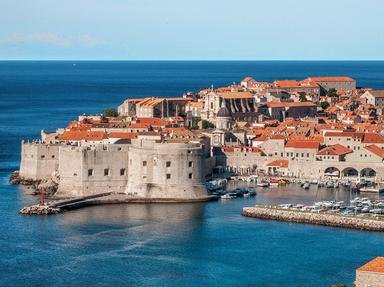
Dubrovnik. Dubrovnik was known as Ragusa in previous centuries and was the seat of the Ragusan Republic, an independent city state in the 14th-16th centuries. Napoleon created the title 'Duke of Ragusa' for his governor of this area in the early 19th century.
This sporting hero was born in Split, Croatia and carried his country's flag in the 1992 Olympics. He won a major tournament in 2001). What is his name? | All about Croatia
|
Goran . Tennis ace Goran Ivanisevic is Croatia's biggest sporting star. He won the men's singles at Wimbledon in 2001 after entering on a wild card.
One of Croatia's most famous monuments is Diocletian's {Palace;} where is it? | All about Croatia
|
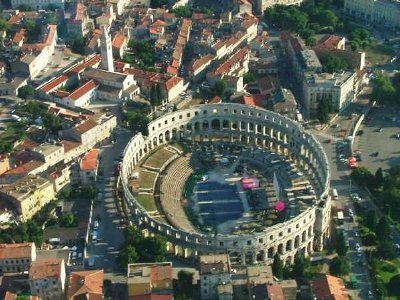
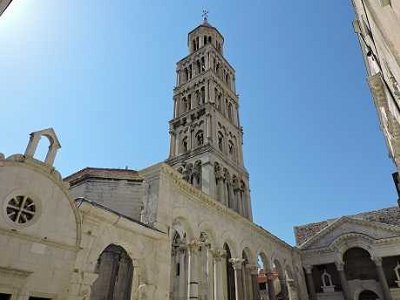
Split. Diocletian's Palace is in Split where its walls form the walls of the old town. Diocletian retired here after his notorious rule as Roman emperor, persecuting many early Christians. One of the refugees from his rule, Marinus the Dalmatian, went on to found San Marino in Italy. The city of Pula has a stunning Roman amphitheatre.
River. The Sava river is Croatia's main river.
Southeast. Croatia is in the southeastern part of Europe, besides Slovenia. It was originally a part of Yugoslavia. Croatians call their country Hrvatzka.
Italy. Croatia borders Hungary in the north, Montenegro to the far southeast, and Serbia to the northeast. It is also surrounded by Slovenia and Bosnia and Herzegovina.
20. It has 20 counties: Bjelovarsko-Bilogorska, Brodsko-Posavska, Dubrovacko-Neretvanska, Istarska, Karlovacka, Koprivnicko-Krizevacka, Krapinsko-Zagorska, Licko-Senjska, Medimurska, Osjecko-Baranjska, Pozesko-Slavonska, Primorsko-Goranska, Sibensko-Kninska, Sisacko-Moslavacka, Splitsko-Dalmatinska, Varazdinska, Viroviticko-Podravska, Vukovarsko-Srijemska, Zadarska, and Zagrebacka. These are the local names, but have been shortened and changed a bit on maps.
Croatia also has one city, Zagreb.
Tomislav I. He ruled from 910-928. He originally ruled as a duke, and later became the king. He controlled a powerful army, but disappeared from history without note.
No. In 1952, France, Germany, Belgium, Luxembourg, and the Netherlands joined the EU. Croatia, however, was not a founding member. It applied to become a member of the EU on February 21, 2003. Slovenia, another former Yugoslavian country, became a part of the EU on May 1, 2004.
red, white, blue. Croatia's flag has three horizontal stripes: red on the top (for Croatian blood), white in the middle (for peace), and blue on the bottom (faithfulness to God). It has a coat of arms in front of that. The coat of arms is split into two sections. The top quarter is blue, with five little historical shields on it. The bottom three quarters is a red and white royal checkerboard.
|