|
Structure
Interesting Questions, Facts and Information
- There are a total of 30 general entries.
Special Topics
|
Interesting Questions, Facts, and Information
Venezuela
Guyana. Guyana, the former, British Guiana, became independent from Britain in 1966. Venezuela has disputed the border with Guyana, both in the sixties and again in 1982. An agreement was reached in 1989.
Colombia. Colombia has coastlines both on the Caribbean and the Pacific.
Negro. The Negro and Orinoco rivers form most of the border between Venezuela and Colombia. The Negro enters Brazil, which lies south of Venezuela and then flow eastwards to join the Amazon about ten miles from Manaus.
Orinoco. The Orinoco forms a great arc 1,500 miles long. It has a vast delta area with many branches entering the Atlantic Ocean.
Pico Bolivar. Pico Bolivar is 16,411 feet high is in western Venezuela in the Cordillera Merida.
Lake Maracaibo. Lake Maracaibo is the largest lake in South America at 5,217 square miles. Lake Titicaca on the Bolivia/Peru border is South America's second largest lake.
Angel Falls . The falls on the Rio Churun drop 3,212 feet. They are named for an American aviator.
Andes. There are three distinct Andean ranges in Venezuela.
Venezuelan Bolivar. The bolívar was introduced in 1879, It had a short lived predecessor called the venezolano. Until the 1970s, the bolívar was the region's most stable and internationally accepted currency.
Because of its likeness to Venice Italy. The name Venezuela is believed to have originated from cartographer Amerigo Vespucci and crew who led a 1499 naval expedition of Venezuela. They first saw some distinctive stilt villages (palafitos) that local Añu people had built. This reminded them of Venice (Venezia) Italy; as a result the region was named Veneziela; later becoming Venezuela.
3. Venezuela borders Guyana to the east, Brazil to the south, and Colombia to the west.
Yes. The Amazon rainforest itself lies within eight different countries: Venezuela, Brazil, French Guiana, Guyana, Colombia, Peru, Bolivia, Suriname and Ecuador.
Spain. Spain first colonized Venezuela in 1522. The Spanish Empire founded its first permanent settlement in South America in Venezuela.
Andes Mountains. Venezuela is home to a wide variety of landscapes, including the Andes mountains in the north and west, the highest peak is
Pico Bolívar at 4,981 metres.
Venezuela is home the the world's highest waterfall, the Angel Falls. How did they get that name? | Do You Know Venezuela?
|
After the visit of a Pilot who spotted it from the air and landed there. Explorer Ernesto Sanchez La Cruz, was the first to find the falls but they were not well known across the world until 1933 when American Pilot, Jimmy Angel, spotted them while searching for a mineral bed. In 1936 he returned and landed his plane at the top of the falls and the falls were named after him.
Carib Indians. Venezuela was originally inhabited by Carib and Arawak Indians; it was later colonized by Spain. Mayans came from across Central America and Aztecs were from Mexico.
Canaima National Park. Canaima National Park in the state of Bolívar is the second largest park in the country. It was given World Heritage status because of the Tepuis or table top mountains found there the most famous being Auyan Tepui, which is the location of the Angel Falls.
Caracas. Caracas is also known as the witch capital of the world.
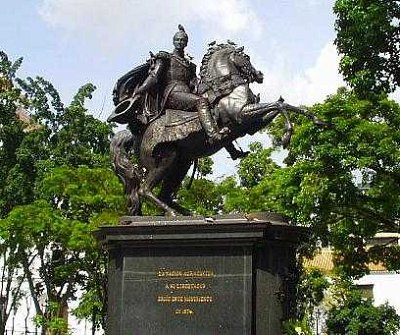
bolivar. The bolivar is named after Simon Bolivar, who is called El Liberator (The Liberator). He was born in Caracas, Venezuela on July 24, 1783. Simon Bolivar was one of South America's greatest generals.
3,276,000 people. The capital city is also the largest city in Venezuela.
What is Venezuela's oldest airline which currently has regular domestic and international flights to different points in the Americas? | Venezuela Facts
|
Aeropostal. Aeropostal was capitalized at 1.6 million Bolívares. It wasn't until May 21, 1937, that the government secured full ownership of the airline.
How many different landscape geographical regions does Venezuela have? | Venezuela Facts
|
9. 1. Llanos Region is the Amazon Basin, the largest rain forest in the world. 2. The Andean Region 3. Zulian Region (includes Maracaibo) 4. North-Eastern Region 5. Insular Region or the Caribbean Island region 6. Guyana Region (Rainforest region) 7. Capital Region (includes Caracas) 8. Central Region 9. Central-Western Region
|