|
|
|
Structure
Interesting Questions, Facts and Information
- There are a total of 30 general entries.
|
Interesting Questions, Facts, and Information
Zambia
What is the name of the big lake in the northern part of Zambia? | Zambia Trivia
|
What is the name of the river in the western part of Zambia? | Zambia Trivia
|
When did Zambia became the official name for this country? | Zambia Trivia
|
Dr. Kenneth Kaunda. Dr. Kenneth Kaunda was the first Republican President of Zambia. Dr. Kaunda was president from 1964 to 1991. All of the presidents listed were doctors except Rupiah Banda.
Konkola Copper Mine. The Konkola Copper Mine is also the biggest mine in Zambia. Nchanga, Nkana and Bwana Mkubwa are all part of the Konkola Copper Mine.
9. Zambia's nine provinces are: Copperbelt, Lusaka, North Western, Western, Luapula, Central, Eastern, Northern and Southern. The largest province by land area is the Northern Province.
Lake Tanganyika. Zambia has only one harbour port, found on Lake Tanganyika. It is called Mpulungu. Mpulungu is situated in Zambia's Northern Province.
Kafue National Park. Kafue National Park provides unique safaris, which include bird-watching, fishing, and open-vehicle safaris. It was established in 1924.
Luapula River. The Luapula River is part of the Congo River. It connects Lake Bangweulu to Lake Mweru.
Zambezi River. Victoria Falls is the most famous physical feature in Zambia. The waterfall is located in both Zambia and Zimbabwe. The Zambezi River is the fourth largest river in Africa, and the largest in Zambia.
In the past, the mining and processing of copper was one of the keystones of the Zambian economy. What resulting environmental problem is one of the most serious facing Zambia at the start of the 21st century? | Zambia, Proud and Free
|
Air pollution and acid rain. Copper has been so important to the Zambian economy that one of the nine provinces is named Copperbelt Province. By the end of the 20th century, output had fallen dramatically, and the government has been attempting to diversify into the exploitation of other minerals, especially nickel, and a fuller range of Zambia's other resources such as hydro-power, gemstones and tourism.
The major environmental issues facing Zambia at the start of the 21st century include air pollution, chemical runoff from industry into the watersheds, deforestation, and soil erosion. Poaching poses a serious threat to the survival of such species as the rhinoceros, elephant, and antelopes, which are one of the key tourist attractions.
Lake Bangweulu. Lake Bangweulu, whose name means 'where the water meets the sky', is part of one of the world's largest wetland systems. It is on the upper reaches of the Congo River, in Lupuala and Northern Provinces. The lake itself has a permanent surface area of about 3.000 sq km (1200 sq mi); the lake and surrounding wetlands have a combined area about five times as large. The average depth of Lake Bangweulu is only 4 m (13 ft).
Lake Tanganyika, the second-largest lake in the world by volume and the largest lake on the African continent, is on the northeast boundary of Zambia, not inside it. Similarly, Lake Kariba, the world's largest artificial lake, is on the Zambezi river along the border between Zambia and Zimbabwe. Lake Kashiba is one of a number of small and deep lakes in the Ndola district, formed as limestone sinkholes. It is said to contain a monster called Ichitapa or Isoka Ikulu which catches the shadow of anyone careless enough to let their shadow fall on the water surface, causing them to fall into the water and drown.
On what river, from which the country of Zambia derives its name, are the Victoria Falls located? | Zambia, Proud and Free
|
Zambezi. The source of the Zambezi River is in Zambia. The river first travels in a counterclockwise loop that takes it through Angola before returning to Zambia where it flows southwards through the western region, then turns east and forms the border with Namibia, Botswana and Zimbabwe. It then enters Mozambique, and empties into the Indian Ocean. The Zambezi is the fourth-longest river in Africa, behind the Nile, Congo and Niger. As well as Victoria Falls, it has a number of other spectacular waterfalls, such as the Chavuma Falls and the Ngonye Falls. There are a number of hydroelectric stations on the river, including the Kariba Dam, which supplies electricity to Zimbabwe and Zambezi.
The Congo is the other main river system of Zambia, draining the northeastern part of the country, while the Zambezi drains the southwestern region. The Kuafa and Lunagwe are two of the Zambezi's tributaries.
What missionary and explorer is thought to have been the first European to see (and name) the spectacular Victoria Falls? | Zambia, Proud and Free
|
David Livingstone. The Scottish explorer David Livingstone named the falls after his ruling queen. The local name, Mos-oa-Tunya, means 'Smoke that Thunders'. Pictures of the falls in the rainy season show the dramatic spray that inspired that name, which is recognised by the World Heritage List as an alternative name for the falls. Victoria Falls were originally located in the country of Rhodesia. Since independence, they are on the border between Zambia (formerly Northern Rhodesia) and Zimbabwe (formerly Southern Rhodesia).
The coat of arms of Zambia features a large shield covered in wavy black and white lines. What stunning natural feature of Zambia do they represent? | Zambia, Proud and Free
|
Victoria Falls. The shield is intended to convey the white water falling over black rocks at Victoria Falls. The black was chosen as the color representing African people, even though the rocks at the falls are not that color. Victoria Falls is often considered the largest waterfall in the world, due to the volume of water passing over it, although it is neither the highest (that is Angel Falls in Venezuela) nor the widest (that is Iguazu Falls in Brazil).
The Barotse Floodplain, located in the southwest of the country, is one of Africa's major wetlands. The Mafinga Hills, in the country's northeast, include Zambia's highest point, Kongera. Lake Tanganyika is one of the largest lakes on the African continent, bordered by Burundi, Democratic Republic of the Congo, Tanzania, and, on its southern tip, Zambia.
Zambia's flag was designed by the Zambian artist Gabriel Ellison, using some of the colors commonly used by many other African nations. What common heraldic image is shown in the top right corner of the flag? | Zambia, Proud and Free
|
Eagle. The colors of the flag are said to represent natural resources (green), mineral resources (orange), the people (black) and their struggle for freedom (red). Red, black and green are the colors of the Pan-African flag created by Marcus Garvey in 1920, with symbolism as described for Zambia's flag. The green, yellow and red stripes of the Ethiopian flag are also often referred to as the Pan-African colors. All of these colors are seen on many African flags.
The eagle is specifically referred to as the eagle of liberty, Zambia's symbol of the ability of the people to soar above the country's problems and maintain hope for the future.
Zambia has land borders with eight countries. With which one does it share the longest border? | Zambia, Proud and Free
|
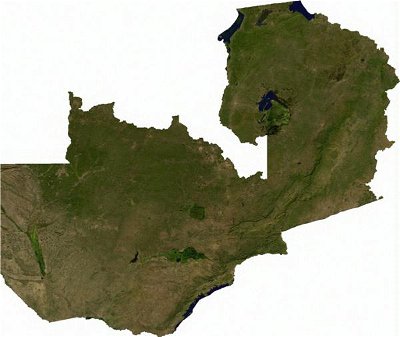
Democratic Republic of the Congo. As the map in the question illustrated, the longest border is with the Democratic Republic of the Congo, a distance of 1930 km (1200 mi), which is 34% of Zambia's total border. In order from longest to shortest, the remaining borders are with Angola (1110 km, 690 mi), Malawi (837 km, 520 mi), Zimbabwe (797 km, 495 mi), Mozambique (419 km, 260 mi), Tanzania (338 km, 210 mi), and Namibia (233 km, 145 mi).
Because of the large indentation formed along the border with DROC, Zambia's area is smaller than might be expected from its perimeter. A square with that perimeter would have an area of over 2 million square kilometres, while the area of Zambia is less than half that amount, about 750,000 square kilometres.
|